Highlight

Successful together – our valantic Team.
Meet the people who bring passion and accountability to driving success at valantic.
Get to know usApril 30, 2026

A modern ERP system like SAP Cloud ERP is essential – yet its implementation is repeatedly postponed. This is the reality for many mid-sized companies. The reason is rarely a lack of awareness, but rather a common prejudice associated with many ERP systems – especially SAP: long project durations, high costs, and complex transformation programs. Statements like “This takes too long,” “This will be expensive,” or “We don’t have the resources” are therefore quite common. However, this perception falls short. SAP does not have to be a massive undertaking, as valantic’s approach demonstrates.
In practice, one thing becomes clear time and again: the biggest challenge is not the technology, but the project approach. When companies try to implement everything at once, typical issues arise:
As a result, implementation projects become difficult to manage, and costs can hardly be calculated reliably. The key insight: SAP is not the problem – the attempt to solve everything at once is. In many cases, it is far more efficient to start with a dedicated business area.
A meaningful starting point is where the greatest leverage lies: finance. This department is the backbone of any organization. This is where the data is generated that drives management and decision-making.
A modern SAP Cloud ERP in finance creates transparency, reduces manual processes, and lays the foundation for scalability. At the same time, it enables advanced initiatives such as automation and AI. Establishing a clean finance setup creates a stable foundation—and thus the basis for all further steps.
This is exactly where our approach comes in: a clearly focused SAP Cloud ERP with a defined finance scope – live within just three months. Instead of an open-ended transformation project, the focus is on a structured and standardized entry point.
Implementation consistently follows a fit-to-standard approach. Proven SAP best practices are leveraged, while unnecessary customization is deliberately avoided. The result is a lean project with a clear structure, transparent methodology, and a realistic go-live within twelve weeks.
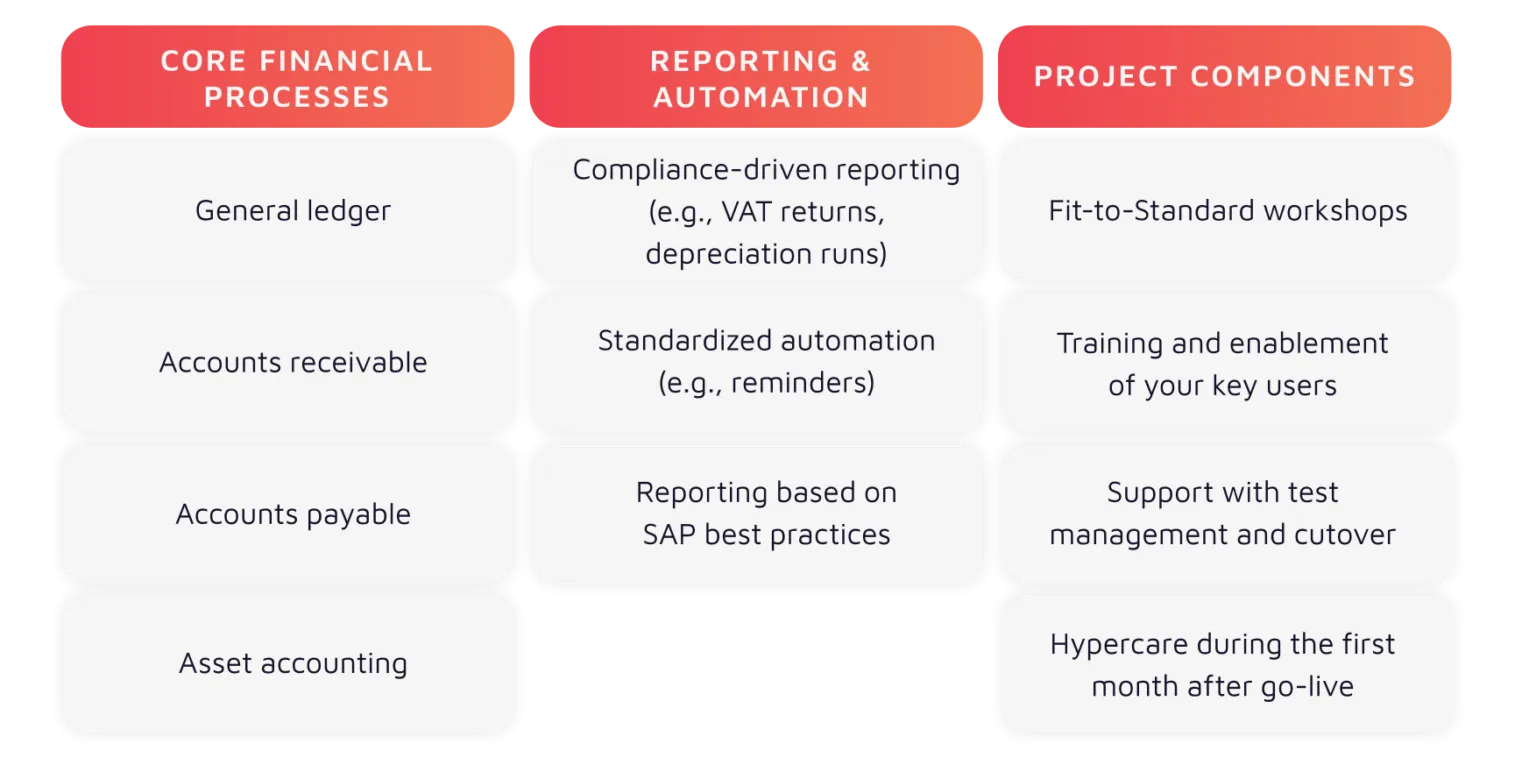
The focus is on core finance processes – the areas that are critical for transparency, control, and stability. These include:
This is complemented by a clearly structured project plan, including workshops, key user training, and support during testing and go-live. A subsequent hypercare phase ensures a smooth transition into productive operations.
Importantly, the system is deliberately designed to allow for future expansion at any time – without compromising the existing structure.
As clear as the approach is, so are its limitations. Companies with highly customized processes or complex international requirements will generally not find SAP Cloud ERP – and this model in particular – the optimal solution.
The same applies when extensive integrations are the primary focus or when finance is not the central priority. This level of transparency is crucial to making the right decision from the outset.
However, the model truly unfolds its strengths in the mid-market segment. Companies in growth or transformation phases, in particular, benefit from quickly establishing a stable and scalable foundation. Typically, this approach suits organizations that deliberately prioritize standardization, reduce complexity, and aim for a predictable, low-risk ERP implementation.
Standardization is often perceived as a limitation. In reality, it is a key success factor. In combination with a clean core approach, systems remain maintainable in the long term and open to upgrades.
At the same time, development effort is reduced – especially the kind caused by errors resulting from rushed, poorly structured solutions. Implementation becomes significantly faster. Standardization therefore does not mean less flexibility, but rather greater speed and future viability.
A key advantage of the valantic solution lies in its clear economic structure. The defined SAP Cloud ERP finance scope is implemented efficiently at a fixed price.
This creates planning reliability and prevents typical project risks. Companies know from the outset what scope of services is included and what costs will be incurred. Licenses are not included, and individual extensions are evaluated separately.
SAP Services September 17, 2026
The SAP BDC handbook: An interview on Business AI and data culture
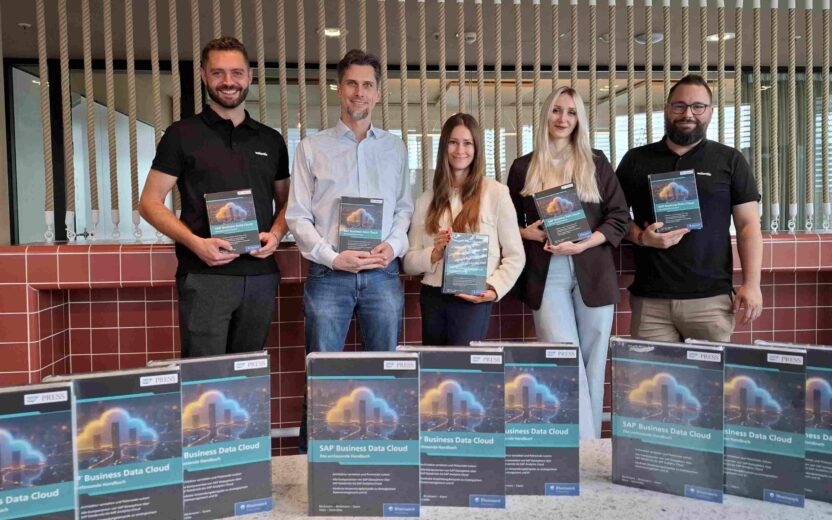
Five valantic consultants wrote the SAP Business Data Cloud handbook. In this interview, they explain why SAP BDC is the enabler for business AI and why this book is a must-read.
The SAP BDC handbook: An interview on Business AI and data culture
Artificial Intelligence August 4, 2026
Joule Studio 2.0: Shaping the Autonomous Enterprise with SAP AI Agents
In the third part of our blog series on the Autonomous Enterprise, we turn our attention to AI agents. With Joule Studio 2.0 and industry-specific Industry AI, SAP enables the transition from AI assistants to autonomously acting AI agents—including open development with n8n and Vercel, as well as integrated governance in the SAP AI Agent Hub.
Joule Studio 2.0: Shaping the Autonomous Enterprise with SAP AI Agents

Artificial Intelligence July 15, 2026
Homework for the Autonomous Enterprise: Architecture, Data, and Processes
SAP Sapphire has refined the vision of the Autonomous Enterprise—now it’s time to put it into practice. Part 2 of our blog series highlights four key building blocks: transparent architecture and agent governance with LeanIX, the path to the cloud, a solid data foundation in the SAP Business Data Cloud, and processes made visible through process mining.
Homework for the Autonomous Enterprise: Architecture, Data, and ProcessesDon't miss a thing.
Subscribe to our latest blog articles.