Highlight

Successful together – our valantic Team.
Meet the people who bring passion and accountability to driving success at valantic.
Get to know usShaping the future with responsibility
The abbreviation ESG stands for ‘Environmental, Social, Governance’ and encompasses the basis for responsible business practices that consider not only economic aspects, but also environmental protection, social behavior and good corporate governance. Alongside the economic success of the company, the reduction of the environmental impact caused – particularly in the form of emissions and resource consumption – is an important aspect. In the area of social responsibility, emphasis is placed on working conditions within the company and in the value chain, and on responsibility towards society. Transparency and ethical behavior in corporate management are at the forefront of governance.

Why is ESG relevant for companies?
Sustainability has become a key issue in the global economy and society, confronting companies with new challenges but also offering a wide range of opportunities. Regulation within the EU is becoming increasingly ambitious and requires the disclosure of ESG criteria. Investors are also being encouraged to invest more in ESG-compliant companies. At the same time, customer demand is growing for products that comply with ESG standards and thus support the environment, social justice and good corporate governance.
How do we implement ESG in companies?
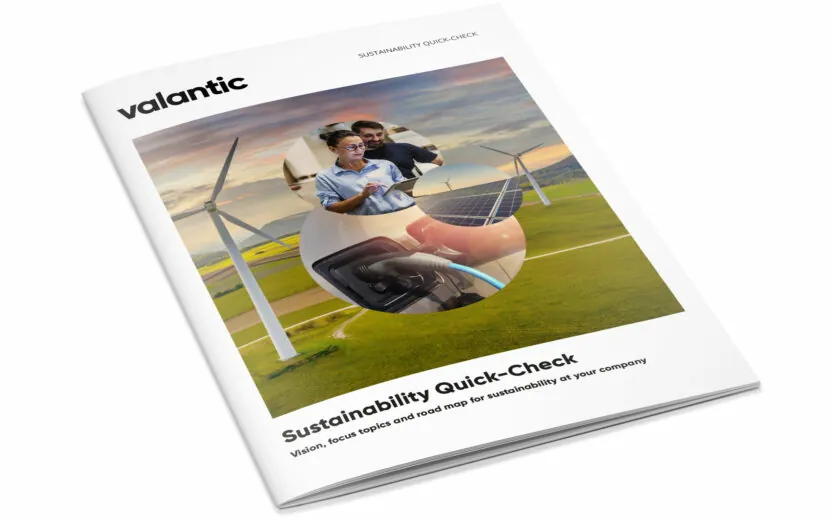
In this dynamic environment, we support companies on their path to sustainable transformation. We support the development and implementation of a comprehensive ESG strategy and rely heavily on innovative technologies to facilitate and accelerate change. In addition, we focus on key topics to drive the sustainable transformation: Decarbonisation and life cycle assessment, social supply chains and circular economy are just some of the areas where we bring our expertise and enable companies to grow sustainably while creating a positive impact on the environment and society.
By developing a holistic ESG strategy and deriving a roadmap for implementation, companies can integrate sustainability into every area of their business model. The ESG strategy includes the short and long-term sustainability goals and the development of the organisational structures and processes to achieve them. This step is particularly relevant for companies, as a solid ESG strategy not only ensures compliance with regulatory requirements, but also strengthens risk management and can lead to better performance on the market by increasing stakeholder confidence.

Transparent reporting on a company’s ESG activities is a prerequisite for compliance with many existing regulatory requirements and can also strengthen the trust of investors, customers and the public. The introduction of efficient and audit-proof reporting procedures and tools within the company is particularly relevant in order to implement the existing reporting and regulatory requirements (CSRD and EU taxonomy).

Decarbonisation plays a major role in companies as part of ESG since clear targets up to climate neutrality by 2050 have been defined in Europe. This means that companies also see it as their duty to define a decarbonisation strategy. The first step is to create transparency about greenhouse gas emissions within the company and along the value chain by calculating the carbon footprint as comprehensively and automatically as possible. By analysing the results and hotspots in detail, reduction measures can be derived and corresponding reduction targets defined. As requirements increase, the focus is not only on greenhouse gas emissions, but also on a holistic life cycle analysis that also takes into account environmental impacts such as water use and resource consumption.

The assessment of ESG criteria is not limited to the company itself but is also applied along the entire value chain. Increasing regulatory requirements, such as the German Supply Chain Duty of Care Act and the European Corporate Sustainability Due Diligence Directive (CSDDD), necessitate proactive risk management regarding sustainability. The focus of implementation here is on assessing supplier risks along the supply chain and reviewing suppliers in terms of their ESG compliance and performance.

Greenhouse gas emissions have increased significantly in recent years, as has the consumption of resources, which is due to the linear economic system – produce, use, dispose To solve the resource problem, a change in thinking from a linear to a circular economy is necessary: produce, use, recycle and reuse. This involves removing as few raw materials as possible from the cycle and instead utilising raw materials as fully or as long as possible in the cycle through reuse, repair, refurbishment and recycling. The implementation of a circular economy requires early adaptation within the product design, adjustments to relevant processes within the organisation and often a rethink among the employees themselves.

The EU Packaging Regulation (PPWR) introduces significant changes for all companies that manufacture, distribute, or use packaging. It mandates compliance with strict requirements regarding recyclability, recycled content, and reuse systems. For companies, this not only means regulatory obligations but also opportunities: A future-proof packaging portfolio enhances competitiveness, resource efficiency, and sustainability credentials. Through a structured readiness check and a clear roadmap, risks can be minimized, costs controlled, and long-term compliance ensured. This way, the PPWR transforms from a regulatory challenge into a strategic lever for sustainable supply chains.

A data-supported approach to implementing the ESG strategy and achieving the defined goals is essential to be able to quantify, manage and communicate the ongoing ESG initiatives in the best possible way. In the first step, the existing data situation in the company can be analysed to derive a suitable data strategy for the company. In the second step, the focus is on the agile implementation of the derived optimisation measures and the implementation of a suitable sustainability tool to automate sustainability practices as far as possible.

The EUDR requires companies to comply with due diligence obligations for deforestation-free supply chains from the end of 2025. This means that for certain raw materials – such as wood, cocoa, or soy – precise evidence of origin and deforestation-free status must be provided. The complexity of global supply chains poses major challenges for companies. In addition to transparency and geolocation, risk analyses, reduction measures, and annual reports are required. Early preparation not only protects against sanctions, but also creates a robust ESG foundation.

The EU Taxonomy defines uniform criteria for environmentally sustainable economic activities and is becoming the central reference for investors, banks, and companies. It creates transparency about which activities are considered taxonomy-eligible or taxonomy-compliant. Companies must report their revenue, investment, and operating expenses accordingly and demonstrate how they contribute to the EU’s six environmental objectives. With growing regulatory pressure, taxonomy is becoming not only a compliance issue but also a strategic management tool for sustainable transformation.

With the Carbon Border Adjustment Mechanism (CBAM), the EU is introducing a CO₂ border adjustment system that will become mandatory in 2026. Affected companies will in future have to record and certify the CO₂ emissions of imported goods – initially in particularly emission-intensive sectors such as steel, aluminum, and fertilizers. The quarterly reporting requirement will begin during the transition phase, supplemented by primary data and certificate purchases from 2026. Companies are faced with the task of setting up CO₂ management systems, calculating emissions accurately, and establishing CBAM-compliant governance structures.

Materiality analysis is a key tool for systematically identifying and prioritizing sustainability issues. It forms the basis for transparent and CSRD-compliant reporting, strengthens risk management, and opens up new opportunities for companies to differentiate themselves in the market. By integrating the dual materiality perspective, both external impacts on the environment and society as well as internal effects on business activities are taken into account. This creates a sound basis for making strategic decisions, meeting stakeholder expectations, and ensuring long-term competitiveness.


Sustainability transformation at Satair
Satair, a leading provider in the civil aviation aftermarket, has partnered with valantic for a sustainability transformation that includes organizational structures, processes and tools to support its environmental goals.

valantic enables emissions assessment of the Vinted Marketplace new logistics offering
valantic’s sustainability and supply chain experts assisted Vinted Go in developing a software tool that evaluates and interprets the logistics network’s greenhouse gas footprint.

Marco Fuhr
Managing Consultant
valantic

Jan Laakmann
Partner
valantic

Dr. Jens Lehnen
Principal
valantic

Sebastian Badaghlou
Partner & Managing Director
valantic