Highlight

Successful together – our valantic Team.
Meet the people who bring passion and accountability to driving success at valantic.
Get to know usMay 8, 2025

The newly introduced EU Packaging and Packaging Waste Regulation (PPWR) presents significant challenges for companies, particularly for medium-sized enterprises, requiring substantial adjustments. To support you, we have summarized the key requirements of the PPWR and offer tailored consulting – helping you ensure compliance with legal obligations while optimizing your packaging and waste management practices.
The PPWR generally affects all companies involved in the production, distribution, or use of packaging. The extent of its impact varies depending on the industry, product type, and business model. Sectors particularly impacted include:
To help you better understand the specific implications for your business, our PPWR Impact Matrix offers a detailed overview of how the regulation affects different industries:
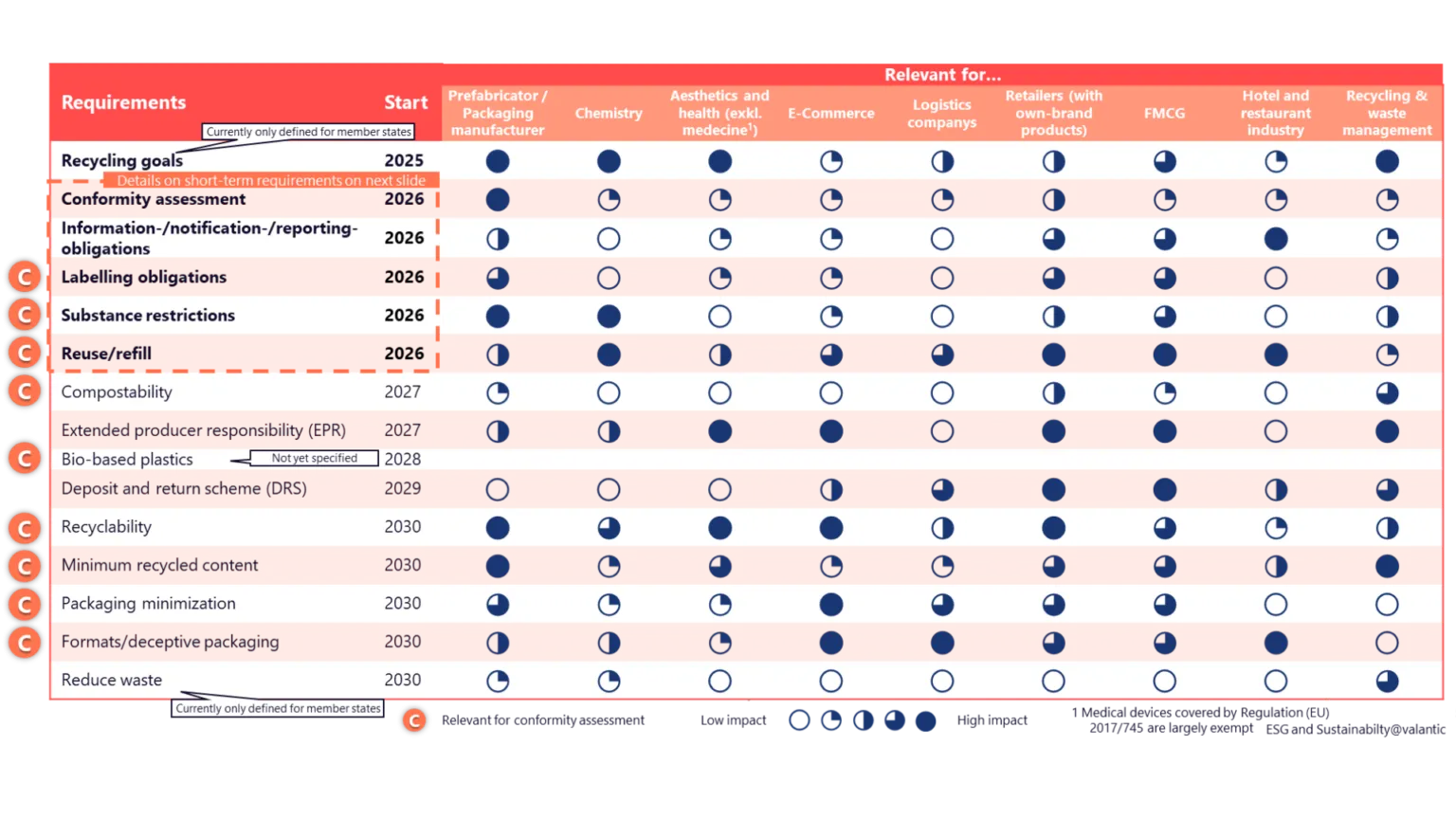
The Packaging and Packaging Waste Regulation (PPWR) came into force on February 11, 2025, and will fully replace the previous Packaging Directive 94/62/EC as of August 12, 2026. The regulation governs the production, use, reuse, recycling, and disposal of packaging throughout the EU. Companies are required to implement the new PPWR requirements progressively and on schedule. However, certain exemptions apply – notably for medical devices and products sensitive to contact.
Requirements due by August 2026:
Additional requirements from 2027 to 2030:
Although the deadlines provide some leeway, starting PPWR implementation early is crucial to ensuring future supply security.
Companies must prepare for significant challenges, such as maintaining packaging quality while adapting to new requirements – changes that may result in additional costs. Investments in new technologies by packaging manufacturers are expected, with cost increases likely cascading through the supply chain. Furthermore, non-compliance could lead to a ban on the use of packaging or fines, which may potentially be accompanied by significant losses in revenue and reputational damage.
Early and structured preparation for the PPWR is key. Companies should promptly assess their packaging portfolios to identify necessary adjustments and understand the regulation’s impact. This analysis provides the basis for prioritizing PPWR requirements and defining appropriate action plans.
The next phase involves piloting short-term measures, using these early experiences to build expertise and prepare for the more complex medium- and long-term requirements. Although the deadlines for some requirements are extended, their complexity demands immediate strategic planning and early action to ensure full compliance.
Our specialized consulting services focus on the following key areas:

Find out more about how the PPWR regulation can be implemented pragmatically!
Let’s work together to ensure your company is optimally prepared for the PPWR requirements – and to help you seize the new opportunities it brings!
In an initial, non-binding discovery call, we will discuss your current PPWR challenges and explore how we can best support you. Together, we will identify the right approach for successful collaboration. Give us a call or send us an email – we look forward to hearing from you!

Jan Laakmann
Partner
valantic

Supply Chain & Procurement February 13, 2026
Efficient production – the art of batch size optimization
Batch size optimization helps to reduce production costs and make processes more efficient. The aim is to achieve a good balance between set-up and storage costs. Throughput times, capacities and restrictions must also be taken into account. With the right strategy, tangible savings can be achieved.
Efficient production – the art of batch size optimization
Supply Chain & Procurement December 2, 2025
Avoiding supply bottlenecks – securing the supply of goods
Supply bottlenecks jeopardize production, sales and customer relationships. This makes it all the more important to identify causes at an early stage and initiate targeted countermeasures. Clear planning, digital tools and early warning systems can effectively strengthen the resilience of the supply chain.
Avoiding supply bottlenecks – securing the supply of goods
Supply Chain & Procurement July 8, 2025
Production planning 4.0: Agility as a success factor in volatile times
In a world where change has become the norm, companies are under massive pressure to make their production processes flexible and efficient. Especially in manufacturing industry, the dynamics of the market require more agile production planning.
Production planning 4.0: Agility as a success factor in volatile timesDon't miss a thing.
Subscribe to our latest blog articles.