Highlight

Successful together – our valantic Team.
Meet the people who bring passion and accountability to driving success at valantic.
Get to know usOctober 6, 2024

Public procurement encompasses all processes through which public institutions, authorities and municipalities procure products and services. State-owned companies are also involved in these processes. These activities account for a significant proportion of the total economic volume and are therefore of great economic importance.
Public procurement plays a central role in the economy. This results in an obligation to integrate sustainable principles into its processes in order to achieve positive social and environmental results in the long term. Sustainable practices not only promote climate and environmental protection, but are also committed to fair and safe working conditions and support for the local economy.
According to the Federal Ministry for the Environment, Nature Conservation, Nuclear Safety and Consumer Protection, the procurement volume of the public sector in Germany is around 500 billion euros. This represents a significant proportion of the procurement of products and services.
In comparison, local authorities are the largest players in the public procurement of goods and services. This can be attributed to the fact that they take on tasks that directly affect citizens, such as the provision of schools, public transportation and social services. The wide range of goods that need to be procured for public administration include office equipment, electricity, paper, furniture, official vehicles, medical equipment, etc.
Public procurement generates a considerable amount of greenhouse gas emissions. In 2006, the federal government, federal states, local authorities and public companies were responsiblefor 42.8 megatons (Mt) of carbon dioxide equivalent (CO₂e). This corresponds to around4 percent of all emissions in Germany. The distribution of these emissions, which are caused directly or indirectly by the procurement activities of the public sector, is as follows:
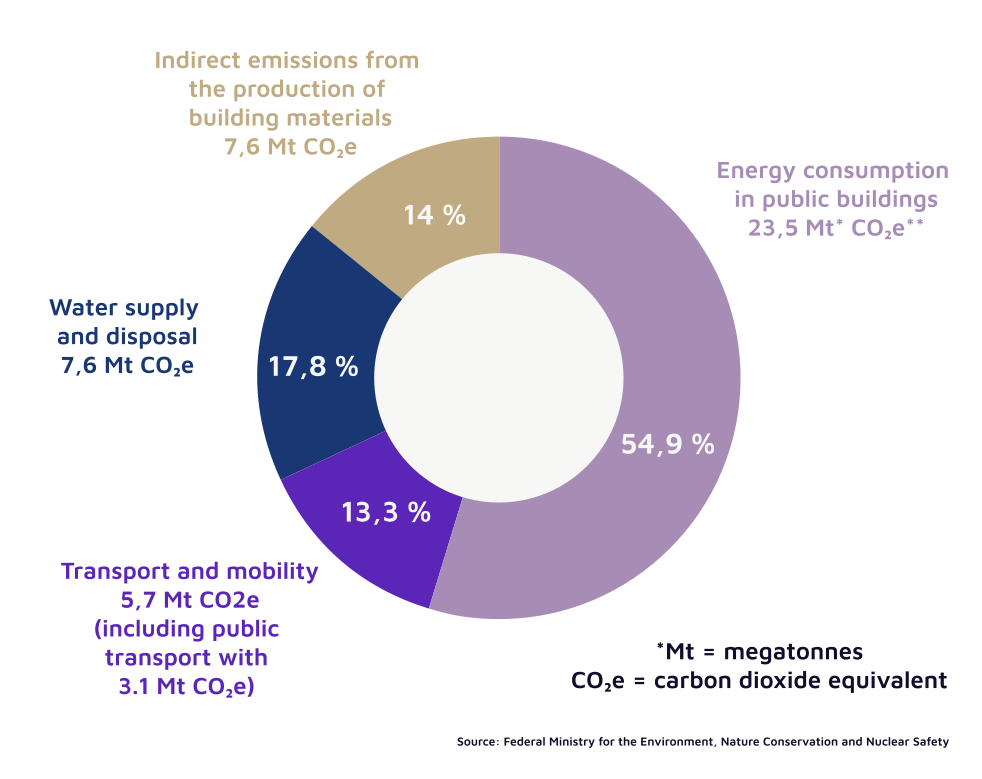
(Source:Federal Ministry for the Environment, Nature Conservation and Nuclear Safety)
These high figures clearly show the relevance for the procurement of sustainable goods, for example:
The concept of sustainable procurement is based on the three dimensions of sustainability. The following building blocks of an environmentally friendly procurement strategy can be implemented as part of this:
Integrating sustainable strategies into public sector procurement mechanisms is more than just a legal and ethical obligation. It offers numerous benefits and is based on four key drivers:
The implementation of energy-saving technologies and materials can reduce costs in the long term, for example for maintenance and energy.
Products that are environmentally friendly and socially responsible protect the climate and conserve natural resources. A long product cycle also helps to reduce emissions.
By integrating more sustainable practices into its processes, public procurement fulfills the legal requirements. At the same time, it can improve its reputation.
The integration of sustainability aspects into all public procurement activities can encourage consumers to also consume more environmentally friendly products.
The following criteria must be observed in order to qualify as “sustainable procurement”:
Comprehensive supplier management enables your company to identify bottlenecks and delays at an early stage and react flexibly to them. In addition, continuous measurement of your partners’performancehelps you to identify potential risks and strengthen your own security of supply. This reduces dependency on individual suppliers and promotes the stability of the entire supply chain.
In this context, various regulatory guidelines play a key role in ensuring compliance with sustainability principles for fair competition.
These include
Transparency regulations relate to the reporting and disclosure of relevant data. They concern all decisions and actions of the public sector in the context of procurement.
The increasing importance of sustainability in public procurement is reflected in the legal requirements and directives. Directive 2014/24/EU emphasizes the importance of taking environmental and social criteria as well as innovation into account in procurement procedures.
It encourages contracting authorities to take into account not only price, but also qualitative, environmental and social aspects when awarding contracts. This enables a more comprehensive evaluation of tenders and promotes the use of sustainable products and services.
The most relevant requirements of the Public Procurement Ordinance (VgV):
Contracting authorities are obliged to take into account all the costs of a product or service that are incurred throughout its life cycle. This comprehensive cost analysis should help to ensure that financial resources are used optimally and that more sustainable and economical decisions are made. The costs incurred include, for example, costs for acquisition, operation, maintenance and disposal.
The procurement regulation also requires the use of ecolabels and certificates awarded by recognized organizations. This increases transparency for consumers and helps to prove the sustainability of a product or service.
Among other things, these environmental certificates stand for the prioritization of environmentally friendly alternatives and the reduction of environmental impacts. They show that the contracting authority is making an explicit contribution to sustainable development.
Contracting authorities should define technical specifications that give preference to environmentally friendly products and services in order to comply with sustainable standards. The aim is to promote the use of environmentally friendly products and create incentives for the development and use of sustainable technologies. At the same time, green washingis to be avoided. The technical specifications include, for example, energy consumption, the emission values of the manufacturing process and the material composition.
Public clients must clearly and transparently document and communicate all processes, areas of responsibility and decisions that are established in their procurement processes.
This includes the publication of:
Discrimination and unfair practices during the award procedure are strictly prohibited. It is required that all applicants aretreated equally so that fairness and equal opportunities can be guaranteed.
Contracting authorities should formulate the required qualifications and selection criteria for the award of contracts in such a way that they are not overly restrictive. At the same time, these must be proportionate to the subject matter of the contract. This should ensure that the best possible provider can be found to meet the needs and objectives of the contract.
Public contracts must be put out to tender openly. This encourages fair competition and ensures that the most qualified bids for the contract can be found and selected. Special consideration is given to the participation of small and medium-sized enterprises (SMEs), as they often require support in order to participate in public procurement procedures.
Efficient digitalization of the awarding process not only speeds it up, but can also reduce errors and increase transparency.
In addition to the requirements of the Public Procurement Ordinance, strategic environmental criteria have also been defined with the aim of minimizing the environmental impact of public procurement. Resource efficiency, emission reduction and the use of sustainable materials play a special role here.
Numerous key players such as the Alliance for Sustainable Procurement (AfNB) and the Competence Center for Innovative Procurement (KOINNO) play a decisive rolein promoting sustainable procurement practices in the public sector.
This platform brings together various stakeholders from politics, business and society to establish best practices in the field of sustainable procurement. The AfNB supports the exchange of knowledge, skills and experience between public clients and suppliers. In this way, sustainable strategies can be developed and disseminated for all procurement processes.
The KNB is a central point of contact for public clients and provides support with consulting and training services. It also offers effective tools to make it easier to integrate sustainability aspects into procurement processes. This enables it to make an efficient contribution to increasing the effectiveness of public procurement.
KOINNO promotes the use of new technologies and solutions in the public sector. It supports public clients in identifying and evaluating innovative products and services based on sustainable criteria. In this way, the competence center can support public clients in the implementation of innovative procurement projects and make public procurement more sustainable.
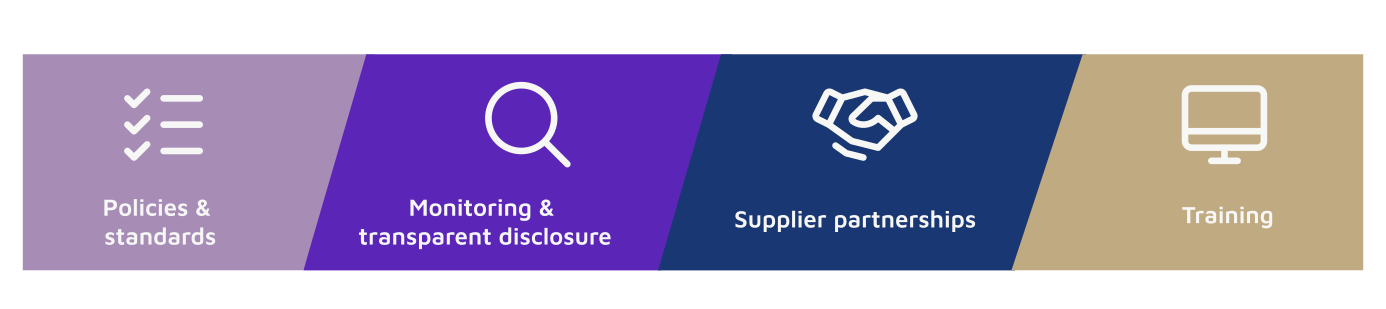
Public sector clients must adopt a strategic approach to ensure sustainable procurement. In this way, operational processes can also be made more environmentally friendly. Our approach goes beyond the mere consideration of environmental criteria and includes all relevant steps for the successful implementation of sustainability criteria:

How can your company become ESG-fit and future-proof?
Together, we identify ESG potential and develop solutions that make an impact. Talk to us – we look forward to exchanging ideas with you.

Jan Laakmann
Partner
valantic Supply Chain & Procurement Consulting
Don't miss a thing.
Subscribe to our latest blog articles.