Highlight

Successful together – our valantic Team.
Meet the people who bring passion and accountability to driving success at valantic.
Get to know usApril 30, 2025

Efficiently and effectively identifying the relevant optimization potential along a supply chain is a central task in today’s supply chain management (SCM). This is one of the main challenges, particularly in the consumer goods industry.
This is because companies are confronted with a variety of challenges: On the one hand, increased supply chain complexity due to geopolitical tensions and economic conflicts is a major challenge. It is therefore particularly important to strengthen supply chain resilience. Another challenge is the rapid pace of digitalization and the potential applications of artificial intelligence (AI). If the potential here is not exploited and the degree of digitalization along the supply chain processes is not reviewed, it will be virtually impossible to keep up with the competition.
In addition, volatile freight prices due to changing personnel and transport capacities make planning more difficult. As price volatility is not expected to end in the medium term, freight prices must be continuously monitored in order to realize potential quickly. Effective supply chain benchmarking helps to meet these challenges.
FMCG supply chains are generally complex, the starting points are diverse and resources are limited. Structured supply chain benchmarking of the optimization potential of all dimensions of SCM helps to identify significant potential quickly and accurately.
The major challenge in identifying optimization potential along a supply chain lies in the broad spectrum of associated functions and processes. These are typically assigned to the supply chain or supply chain management. For example, the functions of production, logistics and purchasing are often assigned to the supply chain.
At the same time, a wide range of structures and processes must be analyzed in the search for optimization potential. This ranges from strategic issues such as the physical structure of the supply chain to the value creation process and supporting tasks such as supply chain controlling.
With this multitude of areas and topics, it is easy to lose track. As a result, there is a risk of not identifying all relevant potential and focusing on the wrong topics.
In this situation, structured supply chain benchmarking helps to focus on the topics that are actually relevant. An analytical framework for supply chain management is presented below. On this basis, various qualitative and quantitative benchmarking methods are examined. Finally, it is shown how a stringent program of measures can be derived from the results of the analysis.
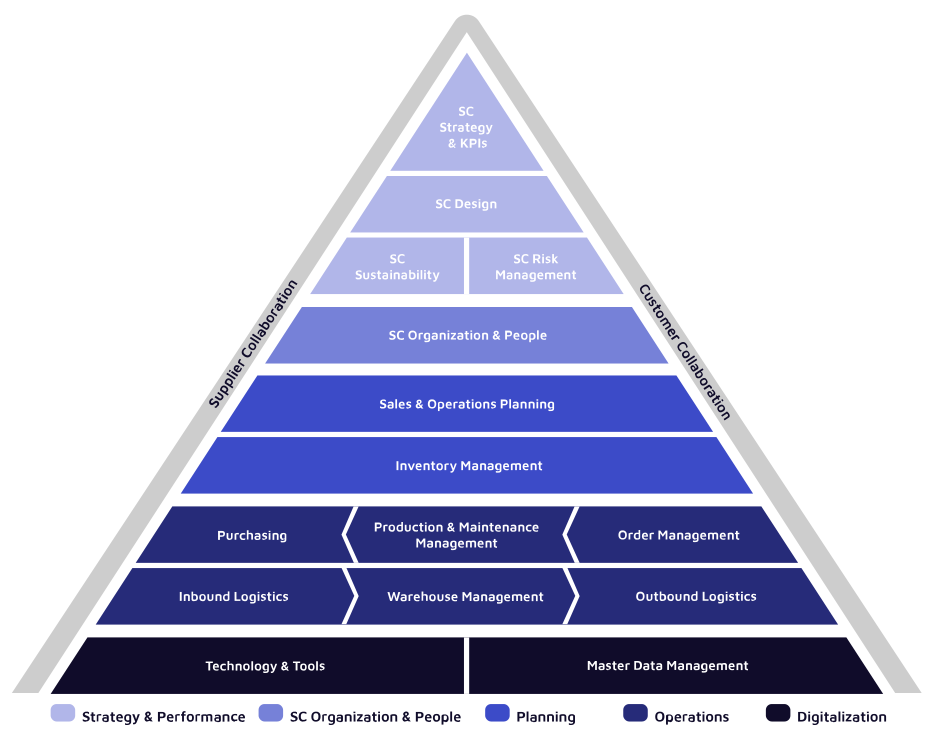
The Supply Chain Management Integration Framework (SCMIF, see Fig. 1) is a structured analysis grid for holistic supply chain benchmarking. It systematically evaluates all relevant dimensions of supply chain management and divides them into five functional levels.
The Strategy & Performance level addresses the strategic orientation of the supply chain as well as overarching control mechanisms. The focus is on questions regarding the future viability of the supply chain structure. Among other things, this involves whether strategic goals such as sustainability, resilience or performance management are being pursued effectively.
At the SC Organization & People level, the focus is on the organizational anchoring of supply chain management. The structural and process organization, clear allocation of roles and the existing competencies within the company are analysed. These are considered key levers for the successful implementation of strategic and operational goals.
The planning level comprises the overall planning along the value chain. It examines how well sales, inventories and demand are coordinated, how precise forecasts work and whether planning responsibilities are clearly assigned.
At the Operations level, the focus is on the operational core processes of service provision. Efficiency, responsiveness and stability are evaluated – from procurement and production to internal order processing. This level also includes the operational management of the physical flow of goods within the supply chain. This involves the design and control of logistics processes, warehouse structures and transport flows – key elements for a cost- and service-optimized supply chain.
The digitalization level forms the basis. It supports all other levels with digital tools, data availability and IT interfaces, thus creating the conditions for automation, transparency and controllability.
The performance status of a company is benchmarked qualitatively and – where possible – also quantitatively. This allows optimization potential to be identified in a targeted manner and translated into specific programs of measures.
The qualitative benchmarking is based on a so-called “Stages of Excellence” assessment.In this, all tasks and processes of a dimension of the Supply Chain Management Integration Framework are described at four different levels (e.g. “Laggard”, “Average”, “Progressing” and “Best Practice”). For example, the task “Forecast Quality Measurement and Incentives” in the dimension “Sales & Operations Planning” can have the following levels (see Fig. 2).
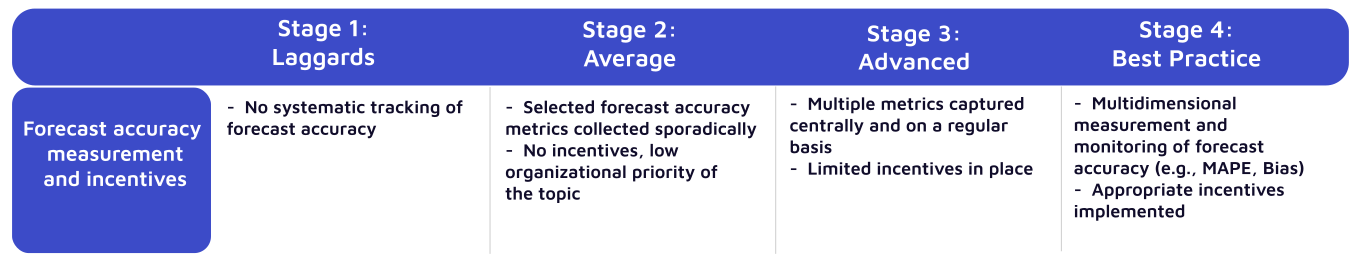
The next step is to record the company’s current performance and assign it to a level. Overall, numerous individual assessments must be carried out for an overall evaluation of the company’s current performance level. In this way, it quickly becomes clear in which dimensions and for which topics the greatest deviations from best practice exist.
In addition to qualitative benchmarking, quantitative benchmarking is carried out in a number of analysis dimensions.In this way, many of the qualitative benchmarking assessments are objectified once again. In many cases, they are also quantified so that the order of magnitude of a possible potential can be determined. The possibilities of quantitative supply chain benchmarking are manifold. Some benchmarking examples:
As with all benchmarking, there is of course a risk of comparing “apples with pears”. For this reason, quantitative comparisons should initially be viewed with a healthy degree of skepticism. Major deviations from the relevant best practice benchmarks generally indicate existing potential. This can then be leveraged in a targeted manner.
Finally, the benchmarking results are summarized in order to define the optimization measures to be initiated for your supply chain (see Fig. 3). Three assessments are included for this purpose:
The corresponding optimization measures are then defined to close the gaps. The supply chain benchmarking results ensure that
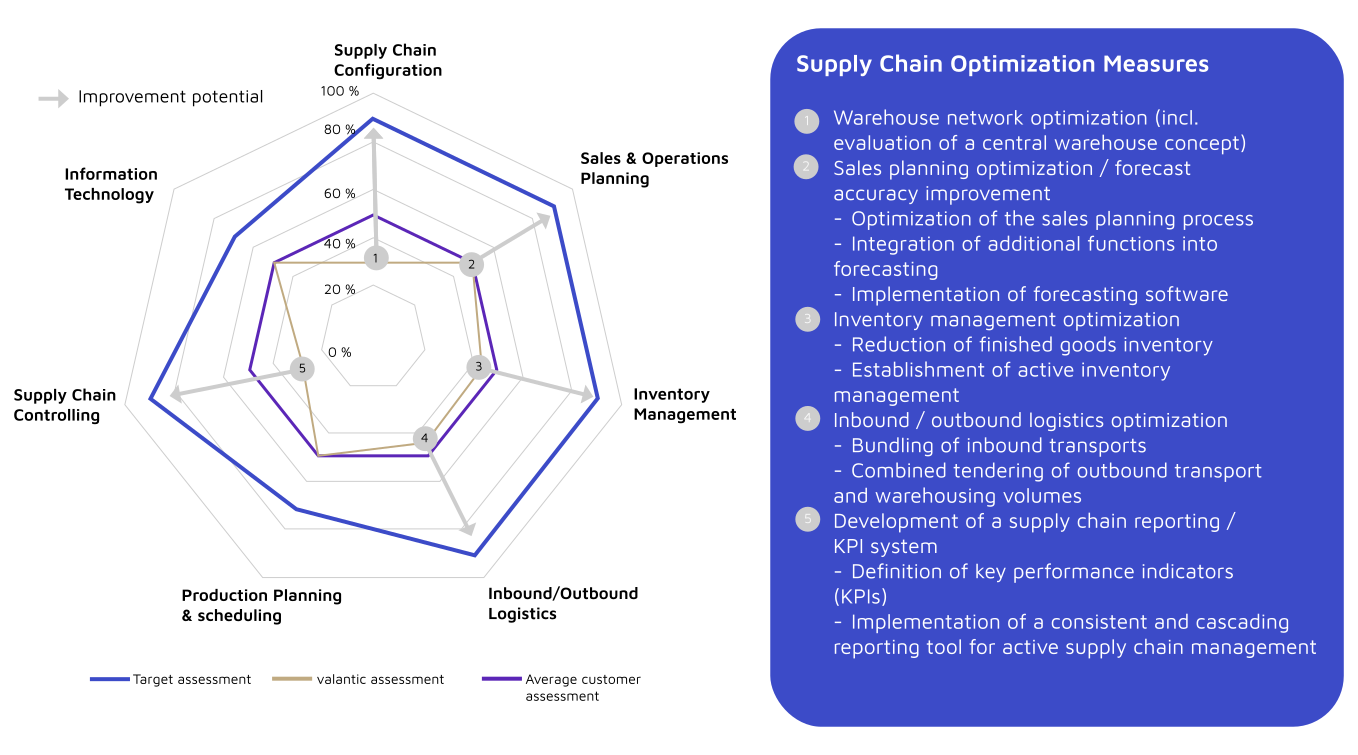
With qualitative supply chain benchmarking and – wherever possible – quantitative benchmarking, weaknesses in a company’s supply chain management can be quickly identified. They are identified in a targeted and precise manner.
The comprehensive approach across all dimensions of the Supply Chain Management Integration Framework ensures a holistic analysis. This means that all relevant topics are examined and no potential is overlooked. In addition, benchmarking provides an initial indication of the level of possible potential. Functional benchmarking is therefore the ideal approach for starting a supply chain optimization project.

How can your supply chain be optimized and made more resilient?
We identify optimization potential and design solutions that make an impact. Talk to us – we look forward to exchanging ideas with you.

Dennis Goetjes
Partner
valantic Supply Chain & Procurement Consulting
Don't miss a thing.
Subscribe to our latest blog articles.