Highlight

Successful together – our valantic Team.
Meet the people who bring passion and accountability to driving success at valantic.
Get to know usNovember 26, 2026
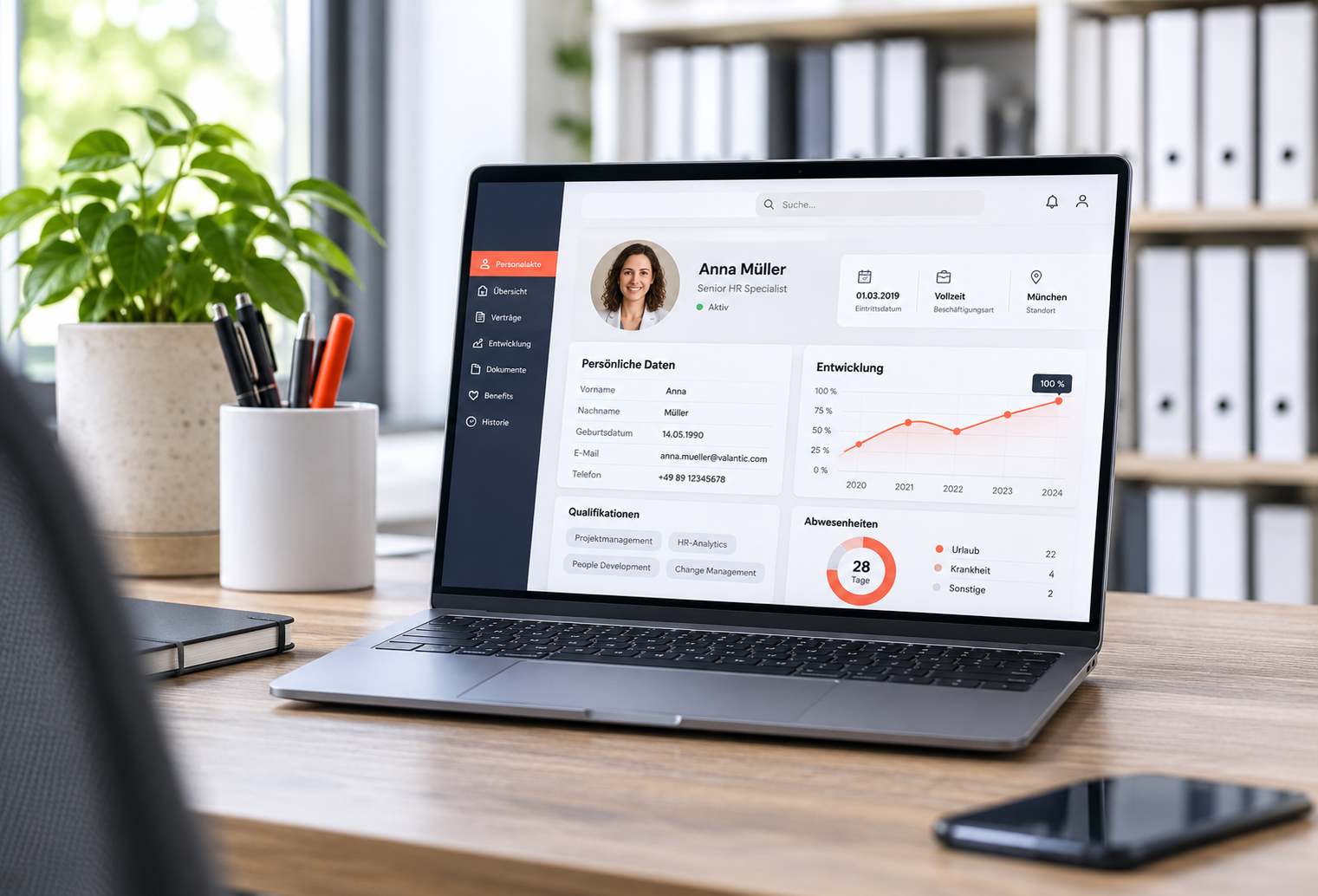

As of January 1, 2027, the paper era in payroll accounting will come to an end: Documents related to payroll and social security must then be available exclusively in electronic form (Section 8(2) of the Contribution Procedure Regulation). Those who fail to make the transition risk fines and estimated contributions.
There is little time left until the deadline. But the new requirement is more than just a compliance task. It is an opportunity to restructure HR operations: with a digital personnel file, clear access rights, and documents created right where HR processes take place.
HR departments still waste a lot of time on repetitive administrative tasks: filing documents, searching for records, responding to inquiries, and obtaining approvals via email. Digital processes shift the focus of HR work—toward consulting, development, and the people in the company.
Workflows automatically route applications, certificates, and contracts to the appropriate personnel; HR reviews and approves them instead of shuffling paper. Through self-service portals, employees can access their own documents, upload supporting evidence, or update their information—resulting in a noticeable decrease in routine inquiries to HR. Managers can keep track of their team’s agreements, deadlines, and pending tasks without having to check with the HR department. New employees have digital access to contracts and onboarding documents even before their first day of work. And structured HR data makes it possible to analyze topics such as staffing needs, qualifications, and employee turnover.
Many companies have taken advantage of the exemption from maintaining payroll records electronically through the end of 2026. It remains to be seen whether the time saved was actually used to prepare for the transition. “For many, the issue was largely put on the back burner,” observes Matthias Koch of valantic. Consequently, there is now a significant need for action. The first hurdle is usually technical: Does the existing software offer suitable features, and does it meet the specific requirements? This involves more than just digital storage. Managers need access to relevant agreements, while employees want to be able to retrieve pay stubs or certificates themselves at any time. Authorizations and access rights must be clearly defined. Introducing an electronic file system quickly becomes a project in its own right.
Pay records are just one part of a personnel file. Employment contracts, certificates, references, agreements on parental leave or remote work: Dozens of documents accumulate over the course of a career. If they’re scattered across folders, drives, and mailboxes, every search takes time, and every request requires a detour through HR.
A digital personnel file consolidates these documents in one place. A roles-and-permissions framework determines who can view which documents. Retention and deletion periods can be monitored by the system—a major advantage in light of the General Data Protection Regulation (GDPR). And for teams across multiple locations or working from home, the file is accessible anywhere without paper ever leaving the office.
“The personnel file is the memory of an employment relationship. As long as it sits in a cabinet, it ties up time in the HR department. In digital form, it becomes the foundation for processes in which employees, managers, and HR all access the same information. This frees up HR’s time to focus on people rather than on filing,” says Stefan Heins, Managing Director at valantic.
For companies using SAP HCM, the requirement to maintain compensation records electronically comes at a time when many are already considering the future of their HR system landscape. With regular maintenance support for SAP ERP HCM set to end on December 31, 2027, many companies are facing the question of a potential cloud transformation. This presents an opportunity: Companies already planning a transition to SAP SuccessFactors can integrate the digitization of payroll records directly into their future system landscape, rather than retrofitting the legacy system first. Existing on-premises files, on the other hand, must be checked for cloud compatibility.
However, the real added value comes from integration into existing HR processes. Documents are created or uploaded right where they are generated—for example, during parental leave or when applying for an extended work permit. Managers view the documents relevant to them based on their permissions; HR reviews and approves them, and they are automatically filed in the e-file. Instead of email correspondence, the entire document workflow takes place within the system.
Starting January 1, 2027, payroll and social security documents must be available exclusively in electronic form (Section 8(2) of the Contribution Procedure Regulation). Companies that do not make the switch risk fines and estimated contributions.
An electronic file is more than a digital repository. Permissions, access rights, and processes must be built in from the start.
The digital personnel file reduces HR’s workload through workflows and self-service options. It gives managers direct access to relevant documents and supports system-based monitoring of retention and deletion periods under the General Data Protection Regulation (GDPR).
Companies using SAP HCM should plan this transition alongside the end of maintenance support on December 31, 2027, and a potential move to SAP SuccessFactors.

SAP Services May 7, 2024
Cloud-based HR systems: challenges and opportunities
In this interview, Stefan Heins offers valuable insights into the use of cloud technology in HR, discussing the challenges and opportunities it presents. He also shares essential considerations for companies adopting cloud and SaaS solutions in the HR sector.
Cloud-based HR systems: challenges and opportunities
Artificial Intelligence July 15, 2026
Homework for the Autonomous Enterprise: Architecture, Data, and Processes
SAP Sapphire has refined the vision of the Autonomous Enterprise—now it’s time to put it into practice. Part 2 of our blog series highlights four key building blocks: transparent architecture and agent governance with LeanIX, the path to the cloud, a solid data foundation in the SAP Business Data Cloud, and processes made visible through process mining.
Homework for the Autonomous Enterprise: Architecture, Data, and Processes
SAP Services March 24, 2026
AI makes the difference: Efficient SAP S/4HANA data migration
Migration to SAP S/4HANA is considered complex and error-prone—especially when dealing with large amounts of data. A project with our customer shows how AI significantly speeds up the process, detects duplicates, processes unstructured data, and improves data quality. The result: less manual effort, shorter runtimes, and a reliable foundation for the new system.
AI makes the difference: Efficient SAP S/4HANA data migrationDon't miss a thing.
Subscribe to our latest blog articles.