Highlight

Successful together – our valantic Team.
Meet the people who bring passion and accountability to driving success at valantic.
Get to know usAsset Lifecycle Management with SAP
For a holistic and sustainable asset lifecycle management that is precisely tailored to the individual processes and specific needs of your company to ensure long-term efficiency, value enhancement and resource conservation.


Asset Lifecycle Management refers to the holistic management of assets throughout their entire lifecycle. From strategy and planning to maintenance, procurement, and end-of-life – sustainable Asset Lifecycle Management supports every key phase. Effective management enhances productivity, cost efficiency, and the longevity of assets.
Planning and Development
In this phase, the requirements for the asset are identified, procurement is planned and the corresponding budgets are allocated (investment decision).
Construction and installation
The asset is procured, built or installed and handed over to the company.
Operation and usage
Use, maintenance and condition monitoring of the asset in normal business operations in order to maintain its performance.
Optimization and modernization
During operation, improvements can be made to increase efficiency or adapt the asset to changing requirements. This often involves the use of specialized software to track asset information, create maintenance schedules, monitor operating costs and make decisions about repairs, refurbishments and retirements.
Decommissioning and disposal
At the end of its service life, the asset is taken out of operation and either sold, disposed of or recycled.
Asset lifecycle management involves tracking and managing these phases. This often involves the use of specialized software to track asset information, create maintenance schedules, monitor operating costs and make decisions about repairs, refurbishments and retirements. The purpose is to extend the life of assets, minimize operating costs and maximize overall performance and profitability.
In accounting, a distinction is made between OPEX (Operational Expenditures) and CAPEX (Capital Expenditures).
OPEX: Current operating expenses for daily business operations, such as inspection, maintenance, repair and operating costs. These expenses are typically recurring and are recognized directly as costs in the income statement.
CAPEX: Capital expenditure for the acquisition, improvement or expansion of non-current assets, such as plant, machinery or real estate. These costs are capitalized and depreciated over their useful life.
Related to the entire asset lifecycle:
Major modernizations and expansions during the use phase can again represent CAPEX, as they increase the long-term value of the asset. Smaller modernizations are usually handled as maintenance and represent OPEX.
Topic: The future on rails
Scarce resources, increasing maintenance requirements and the pressure to digitalize: The rail industry is facing massive challenges.
In the new episode of our valantic TrendTalk, you will learn how SAP APM & SAP EAM enable change in asset management – with digital twins, AI and predictive planning.
Savings and optimization potential in the area of maintenance
Technical systems are becoming increasingly complex these days. This not only presents challenges, but also opens up significant potential for savings and optimization, particularly in the area of maintenance. In order to do justice to this potential, it is essential to rely on standards and best practice processes that meet the increasing legal requirements and industry standards.
Maintenance plays a decisive role in competition and is a key factor for customer satisfaction. Innovative solutions such as predictive maintenance can reduce maintenance costs and minimize unplanned downtime, which in turn increases customer satisfaction and security of supply.
Close cooperation between plant operators, manufacturers and maintenance technicians is becoming increasingly important in order to enable automated data exchange. This promotes condition improvement and planning and helps to increase asset availability.
Together we will achieve your goals
By combining the following elements, we create added value for our customers and help them to manage their plants efficiently and effectively:
Ensuring adherence to legal requirements (compliance)
The SAP solutions we implement ensure that your maintenance processes always comply with current legal requirements.
Improving satisfaction among your end customers
Our SAP solutions help to achieve end customer satisfaction through security of supply (energy), reliability and punctuality (rail) and product safety (pharmaceuticals).
Enhancing the ROI of your investments
With our SAP solutions, you maximize the return on investment of your assets and secure their long-term value.
Maximize asset availability
Our solutions reduce downtimes and increase system availability to ensure fault-free operation of your processes.
Plannable condition improvements
We use integrated SAP solutions to help you plan and efficiently implement measures to improve the condition of your assets.
Real-time transparency over the entire lifecycle
Our SAP solutions provide you with up-to-date data to optimally monitor and control the entire lifecycle of your assets.
Full integration in supply chain, accounting and asset accounting
Our SAP solutions optimize the supply chain, ensure cost transparency and support informed decision-making through asset accounting.
Enhancing sustainability goals
It is important to us that sustainability goals are not only defined but also implemented in a measurable and realistic way. We place particular emphasis on continuous optimization to harmonize ecological, social, and economic aspects.

SAP Asset Lifecycle Management April 16, 2025
Generative AI in maintenance: Three use cases
Generative AI helps automate manual maintenance, reduce costs, and improve decision-making. Through three practical examples, we show how companies can avoid downtime, optimize maintenance, and allocate resources more effectively.
Generative AI in maintenance: Three use cases
SAP Asset Lifecycle Management April 16, 2025
Six Success Factors for the Effective Use of AI in Maintenance
Six key success factors for applying AI in industrial maintenance – from data management and IT infrastructure to change management and governance. Learn how to unlock the full potential of Generative AI and turn it into real business value.
Six Success Factors for the Effective Use of AI in Maintenance
SAP Asset Lifecycle Management October 23, 2024
Key maintenance figures and risk management | A key to reducing costs
In today's competitive landscape, efficient plant maintenance is a key success factor for companies. But how can you ensure that your maintenance efforts are truly effective while minimizing the risk of costly breakdowns?
Key maintenance figures and risk management | A key to reducing costsWhen moving from Return on Investment (RoI) to Return on Asset (RoA), the focus is clearly on the benefits derived directly from the assets themselves, rather than from the overall investment. The benefits of effective asset lifecycle management in terms of RoA can be specified as follows:
Specific cost optimization
As a sub-activity of maintenance, servicing aims to maintain the target condition of assets. Regular maintenance allows assets to work more efficiently, which leads to direct cost savings and improves the RoA.
Improved availability and reliability of assets
Inspections help to assess the actual condition of assets and take preventative action before failures occur. This leads to higher availability and reliability, which increases RoA through less unplanned downtime and associated costs.
Value enhancement through repair
Repair, which includes prompt repairs or the replacement of defective components, helps to get the asset back into working order as quickly as possible. This minimizes downtime and supports a steady flow of value, which has a positive impact on RoA.
Long-term value retention through improvement
Modern maintenance also includes the improvement of assets, which enables an increase in value through technical improvements or upgrades. This strategy helps to ensure that assets retain their value beyond their planned operating life, which optimizes RoA.
Increase in asset efficiency
With a better understanding of asset performance and condition, companies can optimize their maintenance and repair efforts. This leads to improved asset efficiency and performance, which directly increases RoA.
Reduction of capital costs
A more efficient asset management can help to reduce the need for major new investments by extending the useful life of existing assets. This can reduce capital costs and thus improve the RoA.
Compliance and risk management
Proper maintenance and improvement of assets in accordance with legal requirements can reduce the risk of penalties and downtime. This helps to safeguard the investment and protects the RoA.
Overall, the RoA focuses more on direct measures that increase the value and efficiency of individual assets. Maintenance activities such as servicing, inspection, repair and improvement are key components that directly impact RoA by optimizing the value and performance of assets throughout their lifecycle.
Companies face various challenges in asset lifecycle management, such as cost pressure, generational change and a shortage of skilled workers. In order to remain competitive, they must face up to these challenges. This is where we come in:
Change of legacy systems
First-time introduction of an SAP EAM solution (paper), replacement of a non-integrated existing solution, heterogeneous EAM applications, switch to S/4HANA, introduction of a cloud solution, etc.
Cost pressure in maintenance & procurement
Efficient use of assets (availability, reliability) and/or increased RoA (return on asset), end-to-end cost transparency, etc.
Generational change & digitalization expertise
Generational change in employees or maintenance specialists, optimization of employee utilization, better or simplified work processes, reliable decision-making, etc.
Automation & mobilization
Automation of tasks, mobile maintenance solutions, consistency, transparency, traceability, legal certainty, etc.
Investment programs
Use of government funding opportunities or special investments in the EAM environment, for example to modernize assets, modernize EAM processes and tools, etc.
High regulatory requirements
Legal certainty, traceability, increasing regulatory requirements, verification obligations (particularly in the areas of safety and health), etc.
Harmonization of master data and processes
Comprehensive asset segmentation, consistency of relationships between different data objects, comparability of processes, cross-system and cross-national standards.

Online consulting on asset lifecycle management and your challenges
Are you faced with the challenge of efficiently managing the lifecycle of your assets, planning investments in maintenance strategies or want to optimize your asset management processes using digital tools?
SAP Intelligent Asset Management enables companies and organizations to operate their assets efficiently and sustainably throughout their entire lifecycle.
State-of-the-art technologies such as the Internet of Things (IoT) and artificial intelligence (AI) contribute to continuous process optimization and are able to reliably identify even short-term and unusual deviations.
Advanced collaboration solutions and the mobilization of processes not only increase efficiency, but also improve the quality of data. Various tools for short, medium and long-term planning ensure the timely availability of personnel, service providers, materials and components.
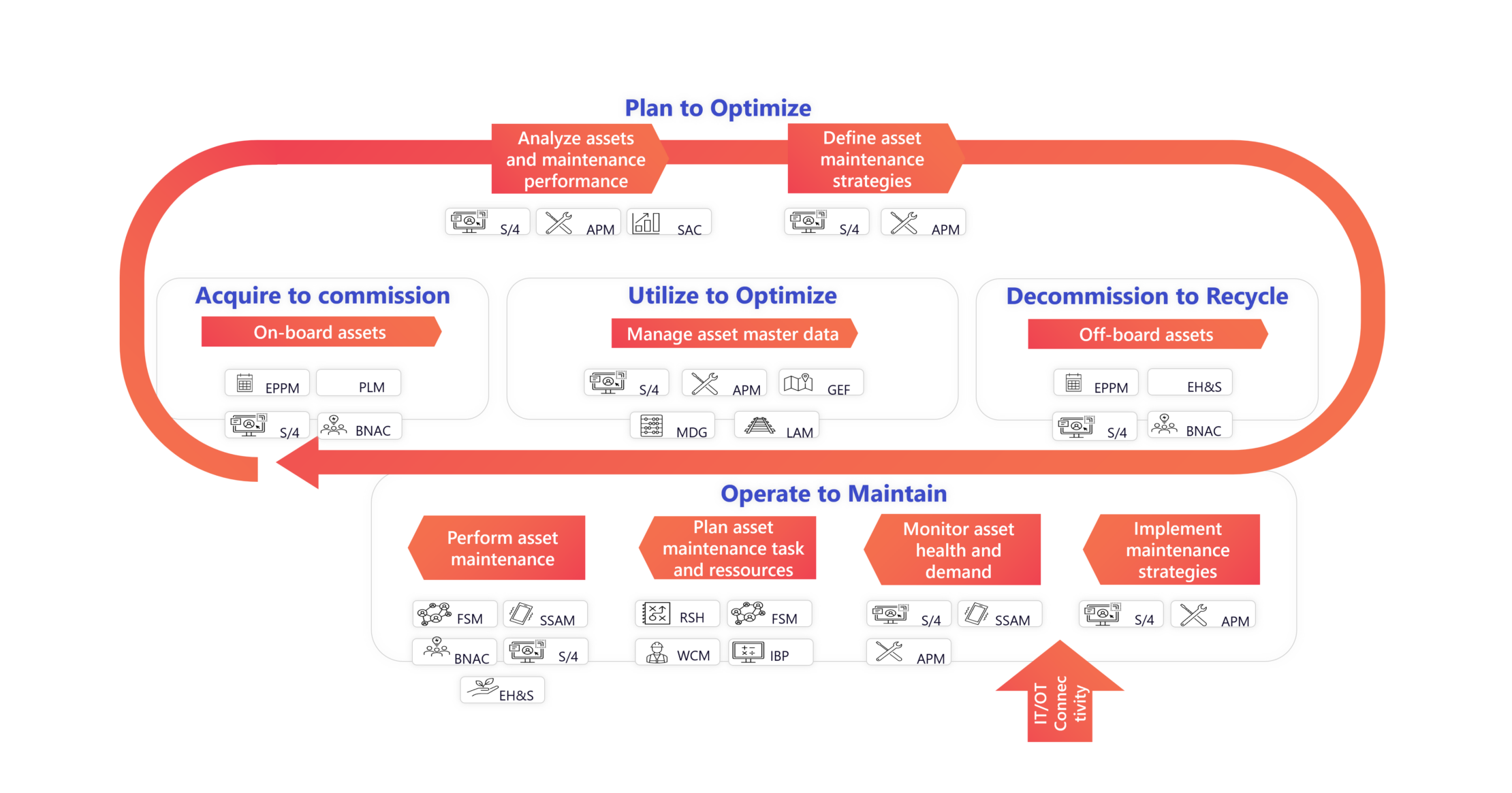
SAP Enterprise Asset Management covers core maintenance functionalities such as notifications, orders, maintenance plans and master data. As part of the ERP system, Enterprise Asset Management is the starting point for holistic asset management and a central data and information basis.
SAP Asset Performance Management aims to improve the performance and reliability of assets. With functions for condition monitoring, predictive maintenance and risk-based maintenance, strategy development and collaboration, the availability, condition and maintenance of assets are continuously optimized.
SAP Business Network for Asset Collaboration enables collaboration between asset operators and manufacturers, suppliers and service partners on a shared platform and database. Processes are simplified, data quality is increased and the availability of assets is improved.
The SAP Service & Asset Manager enables the mobile processing of maintenance. The offline (capable) solution also makes it possible to work in areas where there is no or only a very poor data connection. Different role concepts take into account the individual requirements of the respective task.
SAP Field Service Management is designed to increase the efficiency of service processes and customer satisfaction. This is achieved through intelligent deployment planning and control, mobile process management, service portals, a central knowledge database and real-time analyses, among other things.
SAP Environment, Health and Safety Management helps to minimize risks, improve safety in the workplace and promote sustainable business processes. The core functions include hazardous substance and waste management, occupational safety, health protection, emissions management and sustainability reporting.
SAP Work Clearance Management supports companies in ensuring safety during maintenance work. Approval processes, safety measures and integration with maintenance planning from SAP EAM ensure that all necessary safety approvals are obtained and documented before work begins.
SAP Linear Asset Management is specially designed for the management of linear assets such as roads, railways, pipelines, power lines and similar. The core functions include the segmentation of assets, condition monitoring and maintenance planning of individual segments as well as georeferencing.
SAP Spatial Asset Management integrates geodata into the management of assets and, in addition to technical management and analysis, also enables geographical aspects to be taken into account.
SAP Asset Management for resource scheduling enables efficient short and medium-term planning of employees and resources.
SAP Master Data Governance for Enterprise Asset Management is specifically designed to improve data quality and data management in the area of asset management. Processes and guidelines for master data management ensure high data quality both initially and in the future.
To ensure a high level of asset availability, maintenance must be able to rely on a functioning spare parts management system. High availability of the right spare part in the right quantity, at the right time, in the right place and in the right quality ultimately leads to minimized downtime costs for the respective asset.
SAP EPPM is a solution for the strategic planning, control and monitoring of portfolios (e.g. investment projects on assets) that helps companies to use resources efficiently and optimize project execution.
SAP PLM is a solution that helps companies manage the entire lifecycle of their products, from development and manufacturing to maintenance and decommissioning. It integrates data and processes across different departments to improve efficiency and collaboration in product development and maintenance.
With our comprehensive SAP Intelligent Asset Management (IAM) and Asset Lifecycle Management services, we offer you innovative tools to efficiently manage and monitor your assets in real time. From predictive maintenance to maximizing asset life – we help you to significantly increase the performance and reliability of your assets.


Gotthard Base Tunnel: Maintenance for the longest railway tunnel in the world
Learn more

Modular revision of multiple units with SAP EAM
Learn more

Regionalverkehr Bern-Solothurn AG – Unlock the full potential of SAP EAM
Learn more

Migros Distribution Center Suhr – Automated Maintenance Planning with SAP EAM
Learn more

BLS AG – Mobile Maintenance Feedback Solution
Learn moreWe base our projects on internationally recognized standards and guidelines. This makes our approach transparent and comprehensible. The use of DIN standards in industry brings tangible, measurable benefits for companies:
When implementing asset management solutions, we ensure that our customers comply with the relevant DIN standards.
According to DIN 31051, which defines the basic principles of maintenance, preventive maintenance is a specific sub-area of maintenance.
Inspection
Objective: To determine and assess the current status of technical systems.
Activities: Checking functionality and detecting wear and tear.
Preventive Maintenance
Objective: Maintain the target state of technical systems.
Activities: Measures to delay the depletion of existing wear stocks; these include lubrication, cleaning, readjustment, refilling of operating materials, replacement of wearing parts, etc.
Repair
Objective: To restore the target state if a technical system has failed or its functionality is limited.
Activities: Repair or replace parts that can no longer fulfill their function.
Improvement (modernization)
Objective: To increase the value of the technical system and improve reliability and availability without having to purchase a new system.
Activities: Implementation of upgrades or changes that improve the performance or functions of a technical system.
In terms of return on asset (RoA), each of these activities has a specific impact:
In practice, this means that effective asset lifecycle management that focuses on these aspects of maintenance can directly contribute to optimizing RoA by increasing the performance and efficiency of assets throughout their lifecycle.
This norm provides an overview of asset management, its guidelines and terminology, and the benefits expected from the application of asset management.
The standard can be applied to all types and categories of assets and organizations of any size, but does not provide financial, accounting or technical guidance for the management of specific asset types.
This norm defines the basic terms of all types of maintenance and maintenance management, regardless of the type of object under consideration. As maintenance makes a significant contribution to the functional safety of a building, correct and precise definitions are required. These terms can be of particular importance when drafting maintenance contracts. In addition to technical measures, the definitions also cover the planning and handling of documentation.
DIN EN 15341 provides “key performance indicators for maintenance” to support company management in achieving the best possible condition in maintenance and using technical equipment competitively.
The norm specifies requirements such as competencies, basic knowledge as well as basic and target qualifications and describes the qualifications of personnel for maintenance tasks. However, it does not specify the verification criteria or the specialized training of personnel.
DIN EN 16646 introduces the relationship between strategic planning and the management system for maintenance and describes the interactions between the maintenance process and all other asset management processes over the entire life cycle of an object.
DIN EN 17007 provides maintenance managers with a management tool that enables them to compare their own organization with the general description provided here and thus identify inadequate actions or measures, undefined responsibilities and/or poorly established links. This norm contains a general description/representation of the maintenance process and is applicable to all maintenance systems and organizations.
The norm EN 60812 deals with the method of failure mode and effects analysis (FMEA). This method is used to identify potential faults in products, systems or processes, evaluate their effects and develop measures to prevent or reduce faults. The norm defines the FMEA process and provides instructions for carrying it out in order to improve the reliability and safety of products and processes.
This norm is the world’s leading QMS certification. DIN EN ISO 9001 describes the entire quality management system as a model and is the basis for setting up a comprehensive QMS. It specifies requirements that can help you to improve your overall performance and at the same time provide a good basis for sustainable development initiatives.
DIN EN 81346 describes general principles for structuring systems and information about systems. Based on these principles, rules and instructions are provided for the creation of unique reference identifiers. These are used for the consistent identification of objects and associated components.
The norm provides a process for controlling RAMS that is based on the system life cycle and the requirements contained therein. DIN EN 50126 deals with rail-specific features and enables the effective regulation and control of conflicts between RAMS elements.
DIN EN 15380 is a norm that deals with the topic of “Railway applications – Marking system for rail vehicles”. More specifically, it defines a system for the marking of rail vehicles in the field of rail transport. It ensures clear communication of vehicle information, maintenance requirements and more in order to improve efficiency, safety and interoperability in the rail industry.
The norm is intended to regulate the nature of manufacturer information in terms of structure, scope, content, and data format. The aim of the norm is to create a win-win situation for manufacturers and customers.
Contact our experts directly now for personalized advice!

Ewald Rehm
Partner & Managing Director
valantic Division SAP Services