Highlight

Successful together – our valantic Team.
Meet the people who bring passion and accountability to driving success at valantic.
Get to know usIn cooperation with

SAP Transformation: Overall development, trends and indicators for success
Since 2018, valantic has been surveyed top-class SAP experts about investment intentions and relevant business opportunities. Every year, valantic puts its finger on the pulse of the SAP community in the DACH region to find out where companies using SAP solutions currently stand in their digital transformation process, what course they are setting for the future, and what tasks they still have to complete.
This year, 201 decision-makers and CxOs took part in the survey, which we conducted in cooperation with techconsult (a research and analyst institute of the Heise Group). The priorities have shifted significantly compared to the previous year.
The core topics of the SAP Study 2025, which are important for every company, include migration strategies to SAP S/4HANA, cloud strategies, SAP Business Technology Platform (BTP), SAP Business Data Cloud (BDC) as well as artificial intelligence.
Role of AI in a year-on-year comparison
AI is an integral part of business processes
54 %
see SAP BDC as a strategic element in data management
Advantages of systems in the cloud
Top 3

Your opinion
How do you rate the percentage of AI applications used within your company?
0 %
100 %
SAP S/4HANA Transformation
More companies with ongoing migration projects

201
Business decision-makers from companies using SAP solutions have been surveyed on current given their assessment of current digitization topics
Compared to the status of SAP S/4HANA transformations in 2024, there has been a remarkable development.: The share of companies with ongoing migration projects has risen from 21% to 40%.. 27% have already completed their SAP S/4HANA migration project.
57% of companies prefer the happy medium in their migration strategy: extended brownfield/bluefield conversion. This strategy combines the best of both worlds: a complete new start on a greenfield site and a purely technical migration (brownfield) that dispenses with process optimizations.
In-house deployment (on-premises), which companies have favoured in recent years, has become dramatically less attractive. In contrast, the managed, dedicated SAP S/4HANA private cloud has made significant gains. However, the overall trend is clear: the majority of companies are looking for progress in controlled change and not in disruptive upheaval.
58 %
prefer SAP S/4HANA Private Cloud as deployment model
SAP S/4HANA
Comparison of migration strategies
Basis: 2024 = 200 companies; 2025 = 201 companies
The discussion about cloud transformation projects has changed noticeably in recent years. Instead of technological exuberance, the picture today is characterized by a realistic assessment that takes into account both potential and limitations. Compared to the valantic SAP Survey 2024, there is a clear upward trend. Openness towards cloud models continues to increase.
However, awareness of the associated pitfalls is also increasing. The ambivalent assessment of costs is particularly striking. Many companies recognize the business benefits of the cloud, such as the elimination of in-house data centers or lower operating costs (44%). At the same time, almost as many report considerable financial hurdles during the migration itself. Complex customizing or costly integration work in particular cause headaches for companies (42%).

Rüdiger Hoffmann, Partner & Managing Director at valantic
"Just do it!" is Rüdiger's motto, according to which he has been strategically advising and supporting companies in their digital transformation change processes as a structured problem solver for many years.
A successful cloud migration requires a precisely structured strategy that takes into account the specific framework conditions, uses the SAP Business Technology Platform (BTP) as a central integration platform and consistently puts the principles of a clean core into practice.
Rüdiger Hoffmann, Partner & Managing Director at valantic
The issue of security is viewed with similar ambivalence. On the one hand, centralized management by established cloud providers is often seen as a guarantee of stability, redundancy and rapid response in the event of a fault (35%).
On the other hand, trust in globally distributed infrastructure remains limited. Companies with international business in particular raise concerns about data protection, data sovereignty and compliance with regulatory requirements (41%).
SAP Cloud
The biggest obstacles to switching to the cloud environment
Basis: 201 companies | multiple selection permitted
SAP BTP will remain the central technological backbone of SAP transformations in 2025, but its function within the SAP system landscape will change noticeably. The focus is increasingly shifting towards concrete value creation (30 percent). Thus, SAP BTP is evolving from a purely infrastructural element to a strategic enabler for data-driven innovations.
This development manifests itself above all in the increasing use of the platform’s analytical functionalities. The SAP Analytics Cloud acts as a central front end for reporting and dashboarding. Its role goes far beyond traditional evaluation. Rather, it marks the transition from operational data usage to action-guiding data intelligence.

In our webinar (German only), we provide an introduction to SAP BTP as an integrative platform for AI applications. A practical example explains the successful use of GenAI on SAP BTP.
The classic technical core areas of SAP BTP such as integration (30%) and application development (28%) remain highly relevant, but fall slightly down the priority ranking.
This can be partly explained by the increased maturity of many projects, as compared to 2024, many companies are now in the implementation and operational phases, where the focus is less on development work and more on business value.
SAP BTP
Preferred functions and components are the foundation for data-supported and AI-based solutions
Basis: 201 companies | multiple selection permitted
Consolidated, high-quality data is the basis for business analytics, forecasting, reporting, artificial intelligence and the AI assistant Joule; it is the fundament for almost every SAP solution that companies can make use of. This “data foundation” is SAP Business Data Cloud (BDC).
As a result, it has increasingly moved into the strategic focus of the companies surveyed in the broader context of the increasing requirements for data-driven business models. More than half of the IT managers surveyed already consider SAP BDC to be an integral part of their future data management (54%).
This is remarkable in that it is a comparatively “young” platform whose range of functions continues to grow.

Timo Rüb is Member of the Board & Head of Innovation at valantic
Timo has more than 20 years of experience as an SAP consultant and is an expert in SAP BTP and SAP BDC.
With SAP BDC, the boundaries between the SAP departments and the data science teams disappear. Instead of separate silos, everyone now works on one consistent data layer. For companies, this means less effort, higher data quality and fewer sources of error.
Timo Rüb, Member of the Board & Head of Innovation at valantic
SAP BDC
Role of SAP BDC
Basis: 201 companies
How can intelligent data integration succeed in times of AI and real-time analyses?
In this episode of the valantic TrendTalk series (German language), you will learn how companies can use SAP BDC to break up their data silos, ensure governance and create a future-proof basis for artificial intelligence (AI).
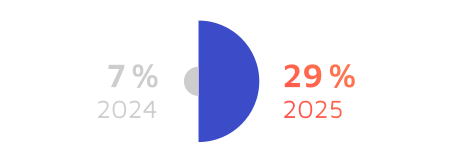
SAP AI is no longer just a pure promise of innovation, but a concrete technology with clear business relevance and real added business value. The proportion of companies that already use AI as an integral part of their business processes is now 29% (2024: 7%). A further 51% will be using AI services for the first time in 2025 (2024: 26%), i.e. on a project basis in selected specialist areas.
In addition to dialog-oriented assistants, the focus is primarily on other productive and far-reaching use cases. With GenAI capabilities, such as those addressed via SAP Build Code with Co-Pilot “Joule”. These achieve the highest relevance value with 48 percent. The AI Foundation of SAP BTP and the transformation of planning and analysis processes through AI are only just behind with 43% each.
The AI strategy is primarily motivated by economic drivers. Process acceleration and cost savings are each cited by 51% as the main motives. However, it is equally clear that companies do not view AI solely as an automation tool. Improved problem analysis (44%), safeguarding the future (42%) and targeted relief for employees (39%) underline the fact that AI is perceived as a strategic lever for transformation in the SAP world.
Artificial intelligence
Mentions of the most interesting SAP Business AI services or functions
Basis: 201 companies | multiple selection permitted
Companies should start building up expertise in the field of artificial intelligence today and be open to experiments and agile methods. We help to systematically tap into AI potential and anchor it in the organization.
Sascha Göpfert, Senior Manager SAP AI at valantic

Sascha Göpfert, Senior Manager SAP AI at valantic
Sascha is Head of LoB AI and an expert in AI and software development.
Trend
1
0
The acceptance of cloud solutions is growing steadily, while on-premises operations are losing importance. One example is SAP S/4HANA Private Cloud, whose share has risen from 31 to 58 percent.
Trend
2
0
Artificial intelligence is no longer just a promise of innovation, but a specific technology with clear business relevance. The proportion of companies that are already using AI as an integral part of their business processes now stands at 29%. Another 51% are using their first AI services in 2025, and the trend is still upward.
Trend
3
0
Imagine that your business had a central location for all data—structured and unstructured, from SAP and non-SAP systems, integrated, qualified, and ready for real-time AI applications. That's exactly what SAP Business Data Cloud (BDC) promises. But is it really the game-changer you are hoping for, or just another name in the SAP universe?
SAP Study 2025
Download full study report now and gain exclusive insights into strategic decisions, future trends, and priorities for digital transformation with SAP.