Highlight

Successful together – our valantic Team.
Meet the people who bring passion and accountability to driving success at valantic.
Get to know usOpenness to cloud solutions continues to grow. Companies are increasingly reaping the many benefits that business software from the cloud has to offer and putting their concerns aside. The SAP S/4HANA Private Cloud, just one example, has almost doubled its share from 31 to 58%. On the other hand, SAP S/4HANA “in-house” deployment (on-premises) is rapidly losing relevance in the minds of cloud strategists. These are the results of valantic’s SAP Study 2025, which was conducted in cooperation with the research and analyst firm techconsult, and for which 201 business decision-makers from companies using SAP software were surveyed.

We interpret this significant growth as an indication that companies are becoming increasingly adept at working with cloud architectures. However, this is subject to the condition that customizing and the integration of investments made, meaning in-house developments, remain reproducible. Regulated industries in particular rely on the balance of control and scalability that SAP S/4HANA Private Cloud can provide. These include finance (67%), specialized manufacturing industry (e.g., mechanical engineering, high-tech, equipment manufacturing with 59%), and the public sector (67%).
Although SAP S/4HANA Public Cloud is catching up, it lags significantly behind with a current share of just under 22%. It is particularly suitable for industries with standardized front and back-office processes. That is, where economies of scale, rapid implementations, and standardized processes really count.
SAP dove into the cloud early on and is now reaping the benefits of its work. In 2024, the cloud division accounted for 50.2% of total revenue; in 2020, the cloud accounted for just 29.6% of SAP’s total revenue. Just in a comparison of 2023 and 2024, revenue grew by 25.4% (SAP Integrated Report 2024). The figures speak for themselves. SAP’s cloud offerings are winning customers over and generating real business value for them.
SAP offers a wide range of cloud solutions and is continually expanding its offerings. In addition, SAP is increasingly integrating its AI assistant Joule into all cloud products, from SAP Analytics Cloud to SAP S/4HANA Public Edition to SAP Datasphere. In SAP Build, business users can create UI components using natural language. AI makes SAP Cloud more productive, agile, and efficient.
Overview
SAP top cloud offerings at a glance
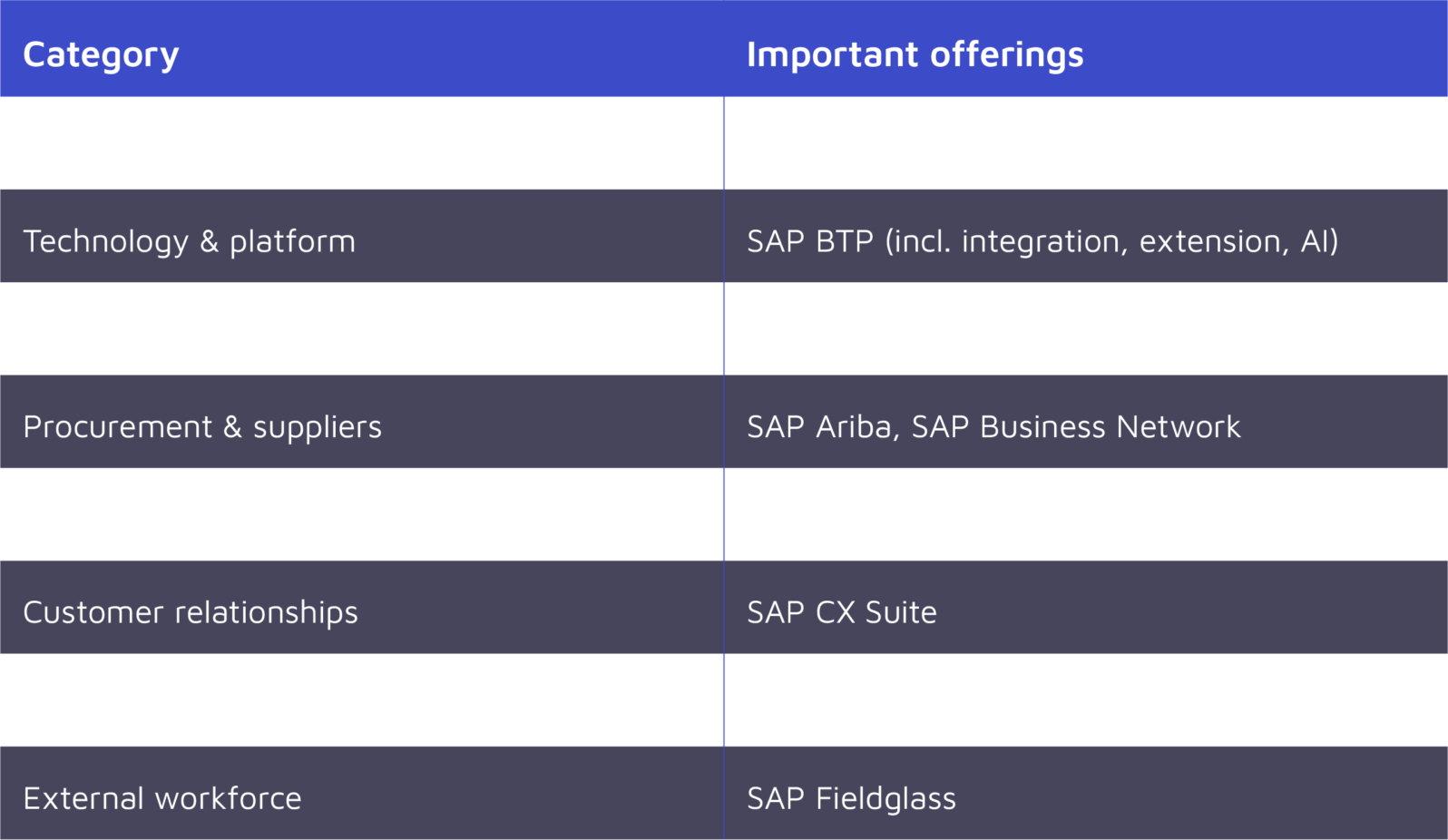
Choosing SAP S/4HANA Public Cloud, SAP S/4HANA Private Cloud, or both requires some strategic preliminary work, but it pays off. Both cloud deployment models have many advantages, but also some disadvantages.
SAP identifies three core benefits of SAP S/4HANA Public Cloud: A first initial release can be set up relatively quickly thanks to many pre-configured best practices. Implementation costs are significantly less than those for SAP S/4HANA Private Cloud, and time-to-value is shorter, i.e., the time required to go into productive use. However, these advantages are offset by limited adaptability (customizing) that companies have to accept.
SAP S/4HANA Public Cloud is the ideal solution for growing companies with standardized processes that are looking for quick time-to-value versus lower costs.
SAP S/4HANA Private Cloud, which 58% of participants in this year’s valantic SAP study prefer, is much more flexible. Companies can transfer their SAP customizations (in-house developments), which can number in the hundreds or even thousands at larger companies. In addition, private cloud customers retain control over release cycles, allowing them to plan and control updates more accurately themselves.
The advantages of SAP S/4HANA Private Cloud, in turn, are offset by a number of disadvantages. More complex migration and higher operating and maintenance costs require customers to invest more effort and take on greater responsibility. They have to take care of more themselves than in the more carefree, but also more standardized public cloud.
SAP S/4HANA Private Cloud is ideal for large companies with complex processes and high customizing needs that also want to control their cloud solutions more effectively.
Quick check
SAP – cloud comparison in a quick check

The cloud, which companies striving for business success are using strategically, is currently enormously important and relevant. In the survey conducted by valantic in cooperation with the Handelsblatt Research Institute “Digital 2030: The Rise of Applied AI”, cloud computing is at the forefront of technology trends. 83% of companies using SAP solutions named the cloud as one of the key technologies for business success over the next five years. This means that the cloud has even surpassed the current hype topic of artificial intelligence, which took fourth place on the relevance scale, and the perennial favorite cybersecurity (second place). Third place goes to the Internet of Things (IoT).
However, the many undeniable advantages of the cloud are offset by a number of concerns and pitfalls that are causing headaches for business decision-makers in the valantic SAP Study 2025. The ambiguous evaluation of costs is particularly striking. Many companies recognize the business benefits of the cloud, such as the elimination of their own data centers and lower operating costs (44%). At the same time, almost as many companies report significant financial hurdles in connection with the migration itself, especially when complex customizing or complex integration work becomes necessary (42%).
The picture is also mixed when estimating project duration. Although the rapid availability and low entry barriers of cloud-based systems are considered advantages (44%), in practice they frequently encounter technical complexity, which is particularly noticeable in legacy systems that have grown over the years. As an alternative, there is often only the time-consuming migration to the more adaptable and flexible private cloud.
The issue of security is similarly ambivalent. On the one hand, there is centralized management by established cloud providers, which is often regarded as a guarantee of stability, redundancy, and rapid response in the event of a malfunction (35%). On the other hand, trust in globally distributed infrastructure remains limited. Internationally active companies in particular express concerns about data protection, data sovereignty, and compliance with regulatory requirements (41%). The uncertainty about data center locations and responsibilities acts as a brake that should not be underestimated.
However, SAP stands for high standards in the technical and organizational security of its cloud offerings, with locations in Germany and certifications according to standards (ISO 27001), comprehensive audit concepts, and dedicated compliance offerings for industry-specific requirements.
Overview
SAP cloud offerings at a glance
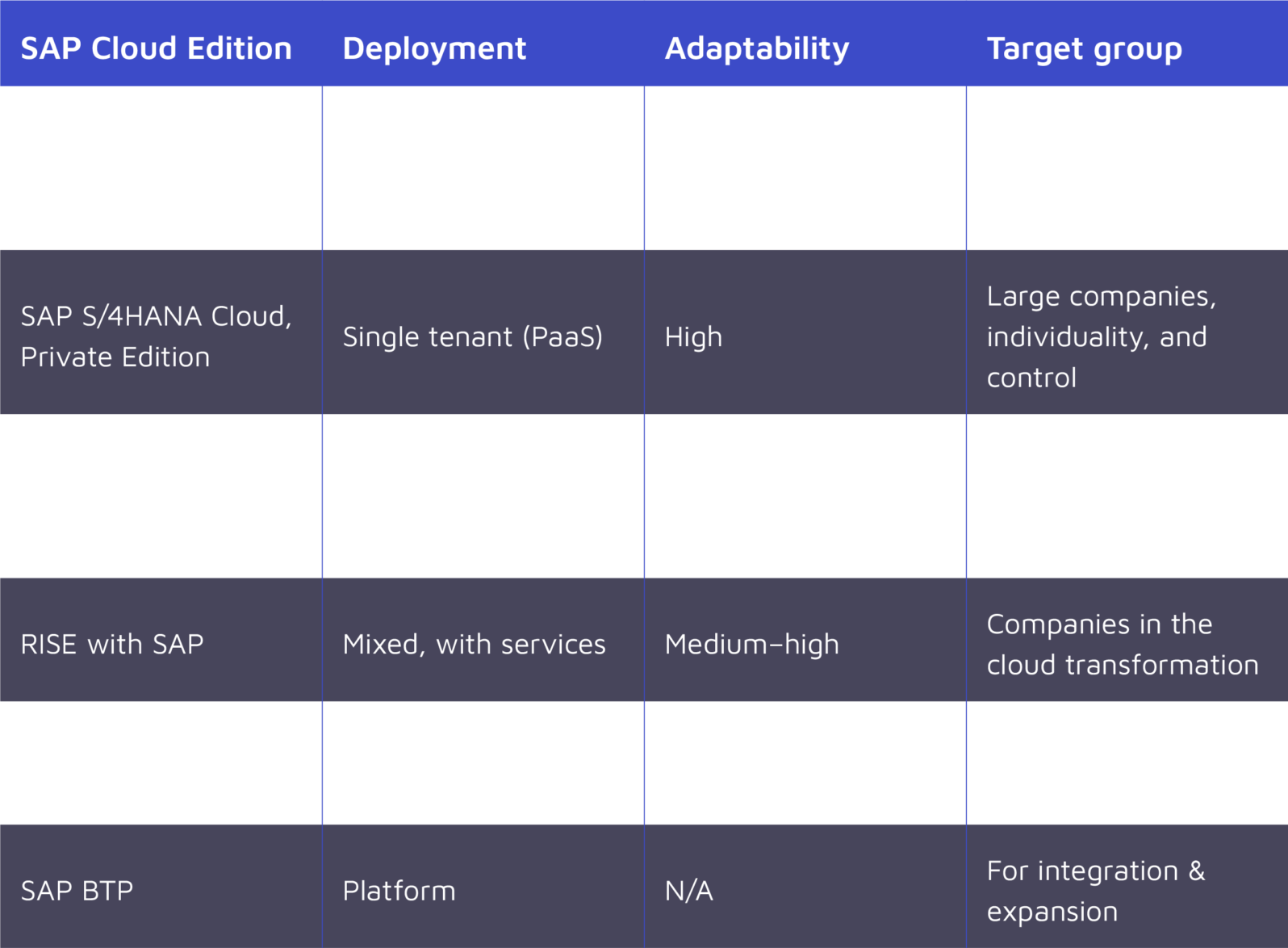
In summary, it can be stated that a clearly structured cloud migration strategy is required, one that takes individual framework conditions into account, relies on the SAP Business Technology Platform (BTP) as an integration hub, and consistently applies the principles of a clean core. Only under these conditions can the tension between strategic ambition and operational feasibility be resolved productively.
valantic SAP Study 2025
Since 2018, valantic has been asking top-class SAP experts about investment intentions and relevant business opportunities. Every year, valantic puts its finger on the pulse of the SAP community in the DACH region to find out where companies currently stand in their digital transformation process, what course they are setting for the future and what tasks they still have to complete.