Highlight

Successful together – our valantic Team.
Meet the people who bring passion and accountability to driving success at valantic.
Get to know usvalantic Viewpoint
Industrial fan and ventilation system manufacturers face tighter EU efficiency rules that reward engineered, certified niches over commodity volume.
This is an excerpt of our viewpoint on industrial fan and ventilation system manufacturers. Get in touch if you would like to learn more about the market dynamics, regulatory drivers, business model, competitive landscape and buy-and-build potential in this market.


~3.8bnEUR
EU industrial fan market size in 2025
~4% CAGR
expected EU market growth from 2025 to 2030
~53.5bnEUR
projected global industrial fan trade volume by 2030
Executive Summary
Industrial fan and ventilation system manufacturers operate in a large, resilient market that is moving steadily toward engineered, high-performance solutions. Axial fans lead product growth. Tunnel, defense, nuclear, shipbuilding and biogas projects create a demand base that spans several investment cycles. The EU Ecodesign Regulation is the decisive market driver in Europe: stricter efficiency thresholds, system-level assessment and mandatory spare-parts availability raise the bar for commodity and low-cost suppliers.
Competition splits into broad European scale players, design-to-order specialists, single-niche engineering houses and Asian challengers entering price-sensitive segments. Value sits in customized, certified fans for safety-critical duties, where certifications, proven references and local engineering proximity form durable barriers. Business models combine one-off project sales with a growing aftermarket of replacements, spare parts and service. For investors, the most promising growth levers are aftermarket build-out, a fragmented universe of add-on targets, access to new verticals and Asian expansion via cost-efficient Indian production.
Efficiency regulation widens the gap between engineered specialists and commodity or low-cost suppliers.
Few players combine design-to-order depth with breadth across several mission-critical niches.
A fragmented mid-sized landscape and active deal flow support credible buy-and-build strategies.


Jan Dingerkus
valantic Partner & Managing Director
”Our analysis shows that EU efficiency rules turn engineering depth into the strongest competitive moat in industrial fans.“
The EU industrial fan market reached ~3.8bnEUR in 2025 and is expected to grow to ~4.6bnEUR by 2030, a steady ~4%CAGR. Beneath this solid headline, the mix is changing. Axial fans grew fastest at ~5.8%CAGR between 2020 and 2025, and their growth is forecast to accelerate further, while centrifugal and other fan types grow more slowly. At the same time, buyers increasingly specify fans for the full duty point, the operating environment and the life cycle rather than for price alone. This pushes value toward customized, designed-to-order solutions in high-power classes, where engineering effort and certification requirements rise sharply. Global trade in industrial fans tells a similarly bullish story. However, the gap between trade growth and EU production growth needs careful reconciliation, since re-exports or inventory effects can overstate real consumption. The COVID-related spike in ventilation demand has normalized, leaving structural drivers in charge. For investors, the key message is clear: the attractive part of the market is not the commodity base, but the certified, high-performance niche on top of it.
Key Takeaways:

Regulation is the strongest single driver for industrial fan and ventilation system manufacturers in Europe. The EU Ecodesign Regulation raises minimum efficiency requirements for fans between 125W and 500kW, binding for stand-alone and new embedded fans from July 2026. From July 2027, assessment moves from a single best efficiency point to the full fan assembly, including part-load performance. From July 2028, manufacturers must guarantee spare parts and software updates for up to 10 years. Each step hits commodity and low-cost suppliers hardest and rewards players with proven efficiency engineering and an established service organization. On the demand side, defense, tunnel and metro infrastructure, nuclear, shipbuilding and biogas projects converge into a structural growth base rather than a short-lived cycle. These segments share one feature: failure is not an option, so reliability and approvals matter more than price. In Asia, strong infrastructure spending, particularly in India, adds a further demand pool. The main open question is how stable public defense, nuclear and tunnel budgets remain across tender and framework cycles.
Key Takeaways:

The competitive landscape for industrial fan and ventilation system manufacturers divides into four groups that differ mainly in customization depth and focus on high-reliability industries. Broad European scale players such as Systemair and Howden offer extensive portfolios and strong reach across industries, but limited customization depth. Design-to-order specialists such as Zitrón and Elektror combine deep engineering capability with strength in selected verticals. Single-niche specialists such as Stiavelli Irio, CFT, CBI Group, and Reitz deliver highly customized fans, yet focus on a narrow set of applications. Asian challengers such as Jindun and Hi Air Korea enter with competitive products in price-sensitive segments. Few players combine design-to-order engineering depth with breadth across several mission-critical niches. This combination forms a double moat: depth plus breadth defends against scale players, while certifications plus references block low-cost entrants. In the nuclear segment, for example, only a handful of certified suppliers compete. Tunnel ventilation is the exception. It has lower certification barriers and rising intensity from larger European players, which makes it the segment to watch for price pressure.
Key Takeaways:

The business model of industrial fan and ventilation system manufacturers rests on three revenue pools: new installations, replacement of the aging installed base, and recurring service and maintenance. New installations form the largest share of the addressable market. They are sold project by project into shipbuilding, tunnel and metro, power plants, offshore, renewable energy, and industrial sites. Market value can be approximated as fan volume multiplied by the average selling price per fan type (axial, centrifugal, or jet), plus a customization surcharge that reflects engineering effort. Relevant projects in the engineered segment range from ~100kEUR to more than 5mEUR in fan spend. Every installation expands the future replacement and service base, which turns one-off sales into long-term customer relationships. Along the value chain, manufacturers sit between suppliers of motors, drives, and controls on one side, and EPC contractors, shipyards, and operators on the other. Certifications such as ISO 19443, ATEX, F4N, and KTA 1401 are often tied to specific sites and qualified people. This protects the position but limits physical consolidation. The upcoming spare-parts duty strengthens the aftermarket and rewards firms with a dedicated service arm.
Key Takeaways:

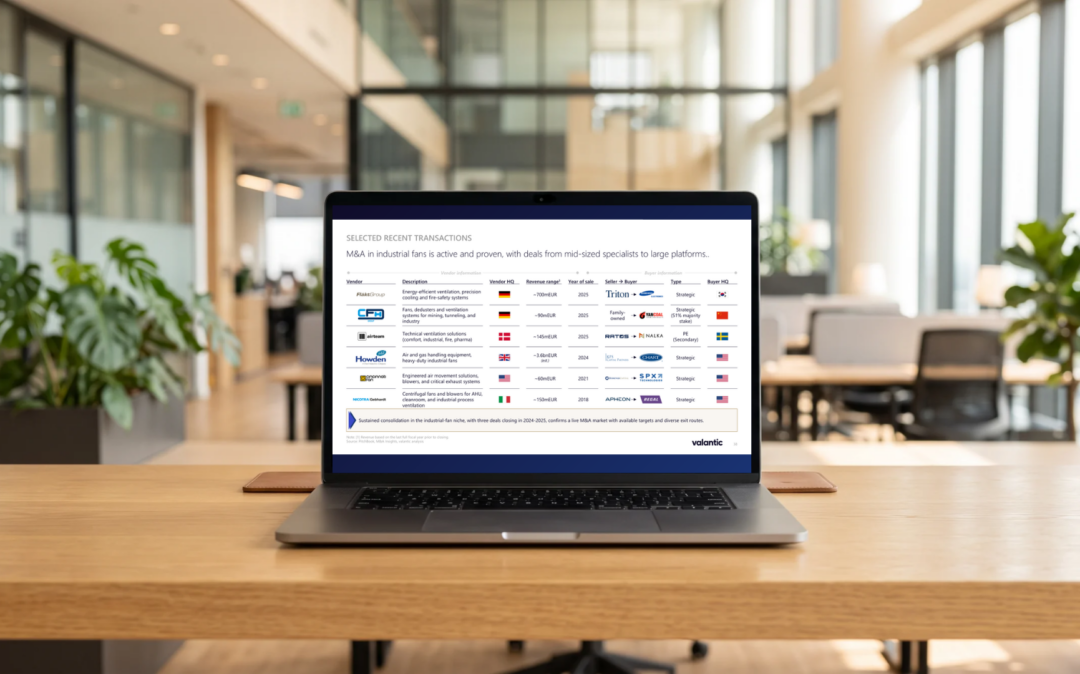
Growth beyond the core market comes from three levers. First, the aftermarket remains underdeveloped at many firms. Proactive service sales, installed base transparency, and long-term service agreements can turn reactive spare-parts orders into recurring revenue. Second, the market is highly fragmented. Out of more than 20,000 ventilation and air movement manufacturers worldwide, around 2,000 fall into the 50 to 250 FTE bracket, and ~650 of these are European mid-sized players. Add-on directions include vertical integration into motors and controls, access to underrepresented verticals such as data centers, semiconductors, hydrogen, and metallurgy, geographic expansion, and adjacent products such as filters, dampers, and silencers. Third, Asia offers a credible expansion route via India, where heavy fabrication labor costs are 80%+ lower than in the EU. Shipping to APAC takes 8 to 16 days from India, compared with 25 to 40 days from Europe. In addition, exit routes are proven: recent deals involving FläktGroup, airteam, CFH, and Howden show that strategic buyers, Asian acquirers, and PE secondaries are all active in the space.
Key Takeaways:
Want the full breakdown? The full viewpoint on industrial fan and ventilation system manufacturers is available on request. The typical scope includes market size, market trends & drivers, competitive landscape, competitor groups, competitor benchmarks, explanation of the business model.

Jan Dingerkus
Partner & Managing Director
Private Equity Practice

Christoph Nichau
Partner & Managing Director
Private Equity Practice

Khalid Ouaamar
Managing Director
Private Equity Practice