Highlight

Successful together – our valantic Team.
Meet the people who bring passion and accountability to driving success at valantic.
Get to know usvalantic Viewpoint
Cyber and data security spending is growing faster than other IT spend. Threats, regulation and AI keep demand rising, and a fragmented market leaves room for buy-and-build.
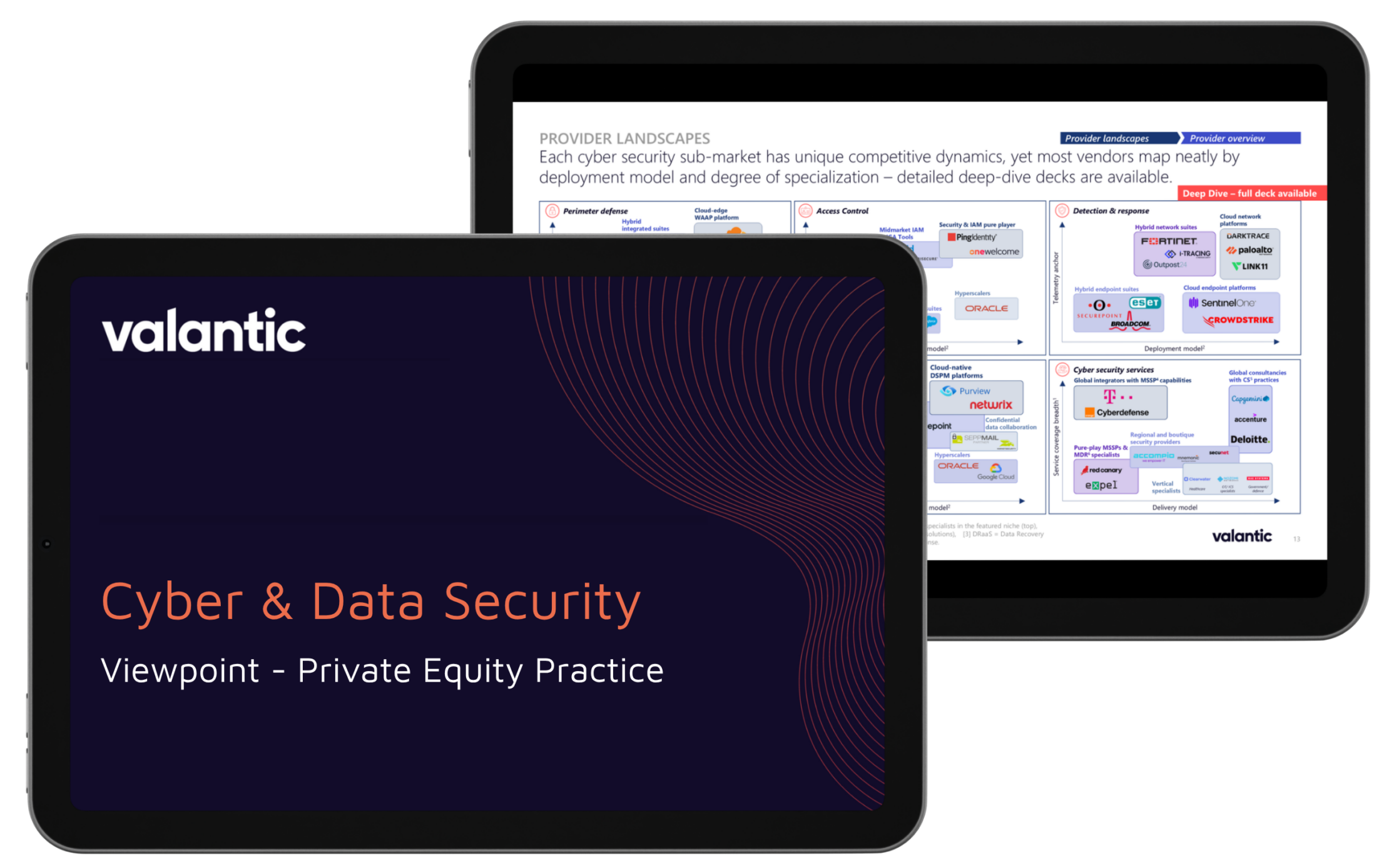
This is an excerpt of our viewpoint on cyber and data security. Get in touch if you would like to learn more about the market dynamics, security layers, competitive landscape, valuation drivers and M&A activity in this market.


~10% CAGR
expected global cyber security market growth (2025 to 2027)
15-17x EBITDA
stable median multiples of profitable listed vendors
~9tnEUR
projected global cost of cybercrime in 2025
Executive Summary
Cyber and data security is one of the few technology markets that pairs structural growth with low cyclicality. Security budgets are growing faster than the wider IT market for three reasons. Attack volumes keep rising. Cloud and IoT keep widening the attack surface. And a wave of European regulation now makes managers personally liable. AI adds a new dimension: it gives attackers cheap, scalable tools, and it also makes self-learning defense platforms possible.
The market spans six security layers: perimeter defense, access control, detection & response, resilience & recovery, data security, and cyber security services. Within this market, the competitive landscape is fragmented across five key provider groups: hyperscalers, cloud-native platforms, hybrid and on-prem suites, pure-play specialists, and service providers. Most revenue comes from SaaS and managed services on multi-year contracts, and high entry barriers keep that revenue predictable. Demand is moving toward outsourced, continuous protection, and customers increasingly prefer integrated platforms. For private equity, this opens buy-and-build opportunities, especially among European mid-sized players. Valuations increasingly reward vendors that balance growth with profitability.
Customers increasingly outsource continuous monitoring. Due to that, managed security services outgrow classic consulting and project work.
Public investors now reward cyber and data security vendors that combine growth with profitability.
Prevention and early detection absorb more than half of security software budgets, led by perimeter defense with ~34% in 2025.

Christoph Nichau
valantic Partner & Managing Director
”Our market mapping showed that single-feature vendors are already under pressure. Customers want fewer tools, which favors buy-and-build strategy.“
Cyber and data security has become one of the most dynamic parts of global IT spend. Most IT categories grow at a moderate pace. Security budgets keep rising even when the economy tightens, because protection is no longer optional spending. Cyber security software leads, with an expected ~11% CAGR between 2025 and 2027. Other IT segments such as data centers, semiconductors and communication services grow at roughly 7%. In absolute terms, the software segment is set to grow from ~139bnEUR in 2025 to ~172bnEUR by 2027. Every security layer is growing, but spending shows a clear preference: organizations put stopping threats early and finding intruders fast first. Recovery capabilities are also gaining ground, because ransomware makes downtime expensive. Services are rising too, and demand is moving from one-off projects to outsourced, continuous operations. For investors, cyber and data security offers something rare: above-market growth, low cyclicality and rising strategic relevance in one segment.
Key Takeaways:

Demand for cyber and data security rests on four megatrends that reinforce each other: threat intensity, digitalization, regulatory pressure and AI. Attack volumes keep climbing. Incidents per organization rose by 29% between 2021 and 2024, and the damage now reaches whole operations, not only IT systems. The attack surface is also growing. Connected devices are set to increase from 18bn in 2024 to 24bn by 2027, and every sensor, API and cloud workload is a possible entry point. Regulation turns this exposure into accountability. NIS2, DORA, the Cyber Resilience Act and KRITIS-Dach set minimum standards, require incident reporting and bring steep fines, which pushes laggards to invest. AI speeds up both sides. Generative tools make attacking easier and enable very realistic phishing and deepfakes. At the same time, self-learning defense platforms spot anomalies in real time and cut manual work. Together, these drivers make security spend a structural, multi-year priority across sectors and company sizes.
Key Takeaways:

The cyber and data security market is best understood as six connected layers: perimeter defense, access control, detection & response, resilience & recovery, data security, and cyber security services. Each layer has its own competitive dynamics. Most vendors can still be mapped on two axes: how they deploy and how specialized they are.
Key Takeaways:

Business models in cyber and data security are built for predictability. Software vendors increasingly sell SaaS subscriptions and cloud-hosted services, often alongside appliance sales with support contracts. Service providers package their offerings into fixed-price managed bundles backed by service level agreements. Multi-year enterprise contracts, high gross margins and relatively low capital needs make revenue highly visible. Along the value chain, many vendors sell through certified resellers, distributors and managed service providers, which extends their reach into SMEs and the public sector. Services hold the value chain together. Professional services such as advisory, audits and incident response still make up ~71% of cyber security services revenue in 2025. Managed security keeps gaining share as customers outsource continuous monitoring to security operations centers. Adjacent players add to demand as well. Cyber insurers, whose global premiums are projected to reach ~25bnEUR by 2027, increasingly ask for proof of baseline controls. Certifications, sovereignty requirements and constantly changing attack techniques raise entry barriers and protect established providers from inexperienced newcomers.
Key Takeaways:

For investors, consolidation is the strongest growth lever. Customers increasingly prefer integrated platforms to a patchwork of vendors, and this is already squeezing single-feature and single-service players. Several leading financial sponsors have each completed at least two cyber security acquisitions since 2022. They combine email, identity, threat detection, managed security or governance, risk and compliance capabilities into scalable platforms. The typical playbook pairs a platform company with regular add-ons that broaden the portfolio, extend the regional footprint and enable cross-selling to a shared customer base. Valuation logic is shifting at the same time. Our analysis of 23 publicly listed cyber security companies shows that the Rule of 40 explains valuations better than revenue growth alone (R² of 0.57 vs. 0.53). Profitability now matters as much as momentum. Beyond M&A, there are organic levers too: moving customers from appliances to cloud and SaaS, adding managed detection and response to software offerings, and serving compliance-driven demand in regulated sectors such as critical infrastructure, healthcare and financial services.
Key Takeaways:
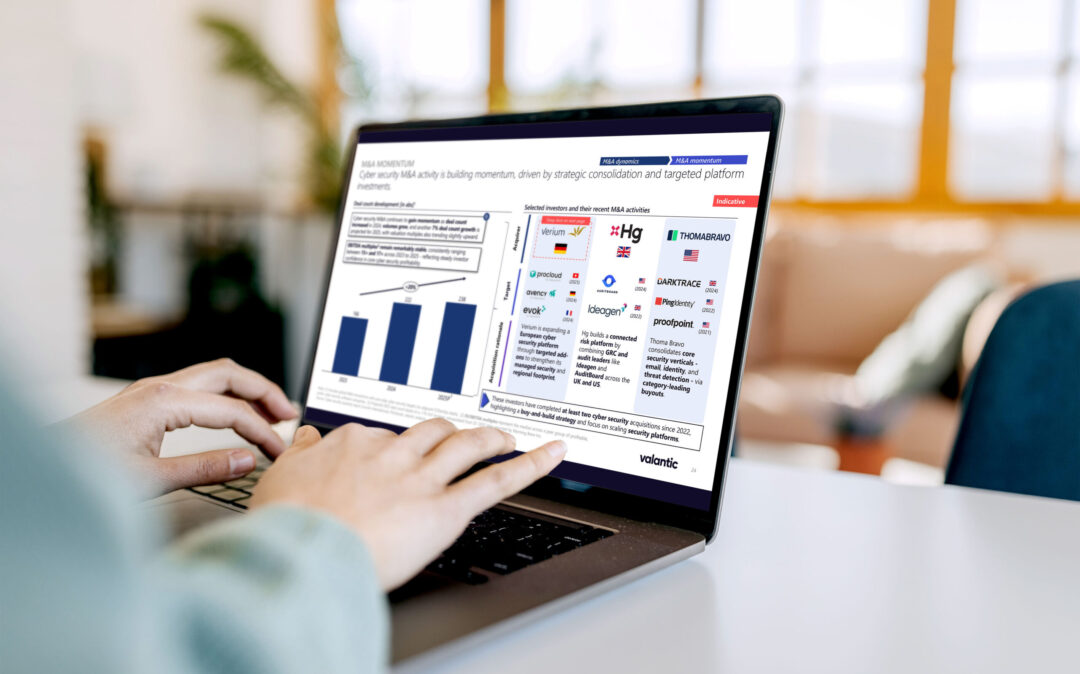
Want the full breakdown? The full viewpoint on Cyber & Data Security is available on request. The typical scope includes market size, market trends & drivers, competitive landscape, competitor groups, competitor benchmarks, explanation of the business model.

Christoph Nichau
Partner & Managing Director
Private Equity Practice

Jan Dingerkus
Partner & Managing Director
Private Equity Practice

Khalid Ouaamar
Managing Director
Private Equity Practice