Highlight

Successful together – our valantic Team.
Meet the people who bring passion and accountability to driving success at valantic.
Get to know usMunich, May 04, 2026: For most companies in German-speaking countries, SAP transformation is part of their operational reality. For 70 percent of SAP customers, the migration to S/4HANA is currently underway or has already been completed. This is shown by the current SAP Study 2026 by valantic with the analyst firm techconsult. According to the study, the private cloud is the dominant operating model at 64%, while on-premises environments continue to lose importance. Artificial intelligence (AI) is also becoming the standard: 67% of respondents use AI operationally or as an integral part of their business processes, primarily to speed up processes and save costs. valantic has been conducting the SAP study since 2018. This year, 409 managers from the DACH region took part in the survey.
Every year, the digital consulting, solutions and software company valantic asks decision-makers about the status of their SAP S/4HANA transformation as well as their investment intentions, preferred technologies and expected business opportunities. This makes the valantic SAP Study an important barometer of sentiment in the SAP community.
The current edition focuses on the topics of cloud strategy, data platforms and artificial intelligence. The survey has been methodically* expanded compared to 2025: It is based on a significantly larger sample of companies from Germany, Austria and Switzerland and thus allows a regionally differentiated comparison within the DACH region for the first time. In 2026, it also provides in-depth sector-specific analyses – particularly for key SAP industries such as discrete manufacturing, the food industry and retail.
The market has largely left the planning phase, with the implementation of SAP S/4HANA migrations and the stabilization of modernized system landscapes dominating. At the same time, the focus is shifting. What initially began as an ERP migration is increasingly developing into a more comprehensive transformation of IT environments towards a cloud-based platform architecture for the integration of data, processes and AI based on the SAP Business Technology Platform (SAP BTP) and SAP Business Data Cloud (SAP BDC).
For many companies, the switch to SAP S/4HANA does not mark the end of the transformation, but rather a starting point for further optimization with the aim of exploiting potential competitive advantages.
The majority of the companies surveyed have reached the SAP S/4HANA implementation and stabilization phase. 28 percent of those surveyed are already working productively with their new ERP system landscapes, 42 percent are in the middle of their implementation projects and a further 25 percent are specifically planning the migration. Only five percent currently have no plans to migrate.
The transformation is moving through the market segments: While larger organizations started earlier and are gradually going live (65% of completed projects), the proportion of ongoing implementations among SMEs has risen from 17% to 25% year-on-year.
The private cloud is expanding its dominant position in the operating model. 64% (2025: 58%) of respondents operate their SAP systems in their own cloud environment. This confirms the trend from the previous year: the majority of companies prefer a continuous, controlled transformation.
This is particularly true for industrial sectors such as discrete manufacturing, the food industry and transportation and logistics. The reasons: a high degree of individualization, complex production and SCM logics, the integration of store floor and PLM systems as well as stricter regulatory frameworks. 25 percent of companies use the public cloud (2025: 22 percent), while on-premises environments continue to lose significant appeal at 11 percent (2025: 20 percent).
“The dominant role of the private cloud in the SAP community is a clear signal: companies want to shape their transformation in a controlled manner and at their own pace,” says Rüdiger Hoffmann, Partner & Managing Director at valantic. “At the same time, the proportion of public cloud use is growing, especially where standardization and fast rollouts are required. Our study shows: The most successful companies combine both worlds and use SAP S/4HANA, SAP BTP and SAP BDC to build a flexible platform architecture that optimally positions them for future data and AI scenarios,” says Hoffmann.
With SAP Cloud ERP migration, the focus is shifting to actual project experience due to the increased number of ongoing implementations and systems already in production. The evaluation is differentiated in the transformation phases of implementation and operation.
Financial ambivalence prevails among respondents in ongoing migrations. For example, 42% expect cloud ERP to be more cost-efficient, while at the same time a majority (57%) fear high project costs. SMEs (45%) and the utilities sector (63%) in particular perceive the transformation costs to be too high.
Around 30% of decision-makers consider the complexity of migration to be too high, while the figure is significantly higher in the chemical and pharmaceutical industries at 44%. The slowing factor here is not so much the cloud technology itself, but the transfer of historically evolved processes and proprietary systems to standardized cloud environments.
After the go-live, companies assess whether the effort required for the transformation to SAP Cloud ERP actually pays off. Here, the cost perception provides an initial clear signal: 51% of respondents attest that their cloud solution is cost-efficient in productive operation.
The improved accessibility of the systems is now also gaining in importance and is rated positively by one in two companies; in the chemical and pharmaceutical industries, this is even appreciated by 56%. For logistics (69%) and retail (46%) with their decentralized structures and omnichannel models, uniform access to central solutions and platforms is particularly beneficial.
Artificial intelligence is clearly relevant to the business of companies. They expect clear added business value such as process acceleration, cost savings and better problem analysis. Accordingly, the technology is already widely used (67% in total).
In detail, 42% of companies are using initial AI applications and services, while 25% have already firmly integrated them into their business processes – particularly companies with a completed cloud ERP transformation (28%) and in the automotive industry (53%). 17% of companies have created an AI strategy, while 13% are currently working on one.
When it comes to specific AI solutions, companies primarily want AI agents from SAP and partners (42%). Other priorities are AI-supported planning and analysis, AI support for developers and AI functions integrated into SAP applications; the latter is particularly in demand in logistics (around 70 percent) as well as in discrete manufacturing, automotive and pharmaceuticals.
“Voice-based AI agents can relieve employees enormously in the work context,” says Sascha Göpfert, Head of SAP AI at valantic. “Projects in sales and maintenance show not only efficiency effects but also higher data quality.”
Integrated data is essential for the value-creating use of AI. This is one of the reasons why the SAP Business Data Cloud (SAP BDC) is establishing itself as a central point of reference for data-based management at companies. A total of 60 percent of respondents see the platform as an integral part of their data management. For the majority (66%), SAP BDC already plays a key role in the planning phase and is therefore on the transformation roadmap at an early stage.
At the same time, there is increasing consolidation in favor of data architectures close to SAP: the proportion of companies using a comparable architecture outside the SAP portfolio is falling to 30 percent (2025: 40 percent).
With the SAP Business Technology Platform (BTP) and the SAP Business Data Cloud (BDC), a platform architecture for integration, data management and extensions is being created. The SAP landscape is thus evolving into a technological platform for data, processes and innovation.
Migration to SAP S/4HANA
Preferred operating models
Cloud migration
SAP Business Data Cloud
Artificial intelligence
SAP Business Technology Platform (SAP BTP)
*Due tothe expanded sample and the greater regional differentiation, individual values may shift slightly compared to the previous year (n=201). However, the fundamental trends and lines of development remain comparable and allow a well-founded classification of current developments.
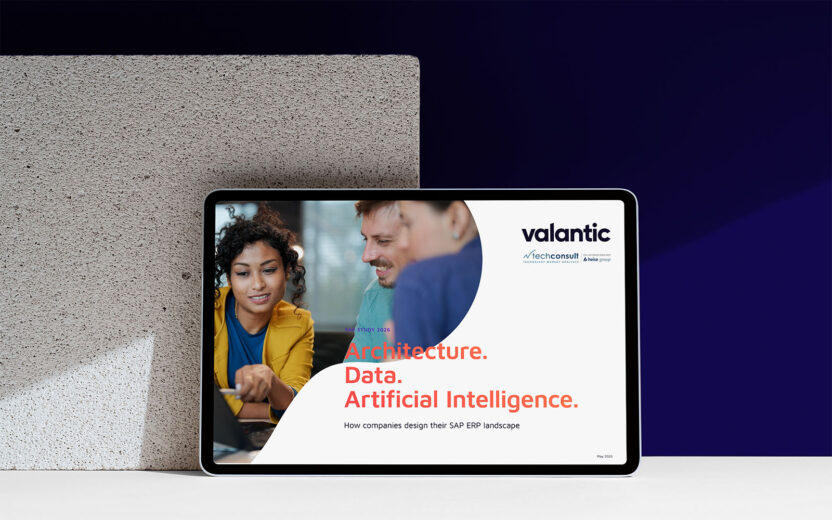
valantic SAP Study 2026: Architecture. Data. Artificial Intelligence.
The valantic SAP Study 2026, conducted with the analyst firm techconsult, provides an up-to-date picture of the mood of the SAP community in the DACH region regarding S/4HANA transformation, cloud, AI and data platforms.