Highlight

Successful together – our valantic Team.
Meet the people who bring passion and accountability to driving success at valantic.
Get to know usTransform your enterprise architecture
Enterprise Architecture Management (EAM) addresses the growing complexity of modern IT landscapes by managing legacy architectures and identifying potential for improvement. The valantic Transformation Navigator provides a strategic framework for designing the IT landscape in line with business requirements.

Challenges are increasing due to the complexity of modern IT infrastructures and the variety of different applications
Despite the relevance of corporate IT for sustainable business success, 75% of all companies lose at least 10% of their IT budget every year due to unnecessary expenditure, such as technical debt and redundancies. Nevertheless, in 40% of cases, no further steps are taken to optimise IT (IT Cost Optimzation Survey 2023).
Respondents see obstacles primarily in the lack of an overview of the IT landscape and in technical dependencies (59%), in a lack of information about the business context of technological decisions (53%), but also in hasty decisions (50%), in a lack of transparency about technical debt and outdated technology (49%) and in a lack of governance (48%). Reasons for this include …
Heterogeneous & complex IT landscape with historically grown legacy IT
Due to the growing complexity, it is becoming difficult to maintain an overview of all IT systems, interfaces and dependencies (e.g. shadow IT, EoL systems and dependencies between business processes, IT systems and projects).
Business & IT are not sufficiently interlinked
The IT & system landscape is not sufficiently linked to the business processes and capabilities; as a result, there is a lack of common understanding between business and IT at various points.
An IT inventory is completely missing or not fully available
An incomplete IT inventory harbours risks and a lack of transparency with regard to information security risks, dependencies and IT costs and their optimisation potential.
A strategically designed Enterprise Architecture (EA) provides the right concept for overcoming these challenges by analysing the status quo of the IT landscape and (re)structuring it into architectural levels. As a mediator between business and IT, EA not only ensures business-IT alignment within the company, but also the targeted adaptation of IT to changing framework and market conditions.
How companies organise their EA can have a significant negative and positive impact on the innovative strength and speed of their digital transformation. This is because the administration of legacy architectures is challenging and cost-intensive. Without an efficient EAM, it is rarely possible to gain the necessary transparency about the existing IT architecture in order to identify potential savings, security risks and threats to the stability of your business.
Companies that addressed their EA at an early stage and created the necessary transparency reported in Bizzdesign’s State of Enterprise Architecture 2023 on…
80%
improved alignment of capabilities with the strategy
80%
improved compliance and risk management
77%
improved business processes
The Transformation Navigator for clear insights into complex legacy architectures
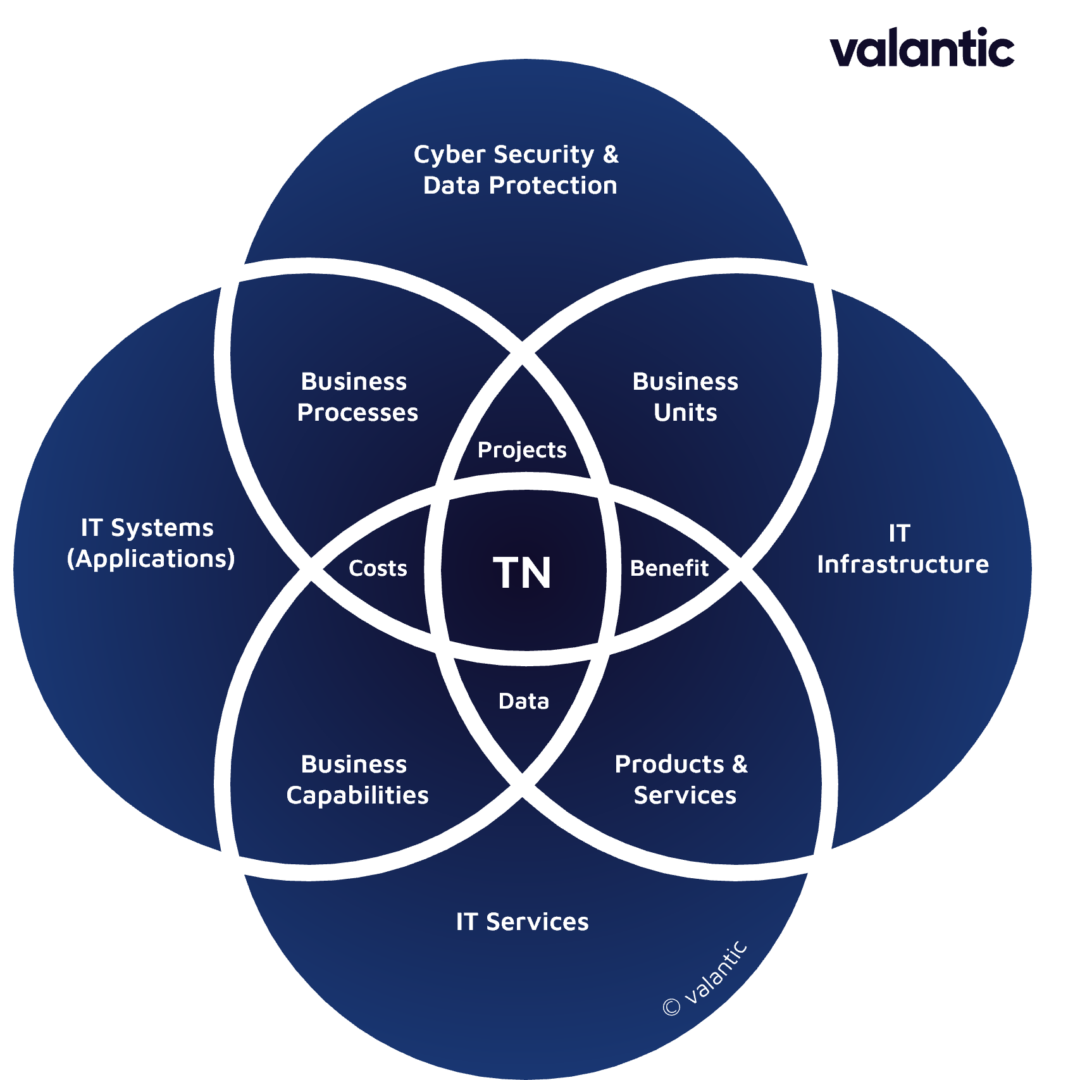
valantic’s Transformation Navigator supports your organisation in taking a holistic view of digital transformation in the context of EAM. It enables a comprehensive view of various aspects of your organisation, both in the business and IT areas. In other words: ‘The Transformation Navigator is like Google Maps for your company’s IT’. This allows you to manage your legacy architectures and identify potential for improvement.
Bringing the business and IT worlds together with the valantic Transformation Navigator
The Transformation Navigator provides you with the necessary transparency and a clear overview of your IT landscape, business processes, products and services, business capabilities, projects, data, information security and data protection. The Transformation Navigator thus supports companies in answering complex business and IT questions holistically within the organisation and making well-founded business and IT decisions.
Benefit from the advantages of an efficiently operated IT landscape
IT as a lever for differentiation and innovation
Holistic view
The Transformation Navigator enables companies to gain a comprehensive overview of their business processes, business units, products and services, business capabilities, projects, data, IT applications, IT infrastructure, IT services, information security and data protection. This allows complex interrelationships and critical dependencies to be identified and analysed.
Decision making
The Transformation Navigator supports well-founded decisions by creating the necessary transparency. Managers can prioritise investments and transformation strategies and assess the impact of changes on business processes, products and business capabilities. At the same time, this can support the consolidation of the application portfolio.
Optimisation of business processes
The Transformation Navigator supports companies in documenting and improving their business processes. By analysing process flows and identifying the players involved, efficiency increases and adjustments can be made and IT systems can be used efficiently.

360° assessment
The Transformation Navigator helps companies that want to determine their current location, including the critical areas of action, at the start of or during their digital transformation via a 360° assessment and need to better understand the dependencies between IT (IT systems, IT infrastructure, information security, etc.) and business (processes, capabilities, products and services, projects, etc.).

S/4HANA transformation
The Transformation Navigator helps companies that are planning an SAP S/4HANA transformation or an S/4HANA readiness check and want to understand the complexity of the system landscape including all dependencies between sub-projects, processes and IT systems with the help of development plans and interface overviews and need to visualise them in a comprehensible way for a smoother transformation.

Information security
The Transformation Navigator helps companies that need to identify the most critical systems and business processes in the shortest possible time in the event of a cybersecurity incident so that they can be put back into operation as quickly as possible by the crisis team. Or want to evaluate information security along the IT application landscape and IT infrastructure used as a preventative measure.

IT cost optimisation
The Transformation Navigator helps companies that want to evaluate and optimise IT costs and the benefits of IT systems and services as part of strategic optimisation measures. This can be achieved with the help of the Transformation Navigator by optimising software licences, eliminating unused applications, optimising data storage, consolidating servers, sourcing strategies such as offshore/nearshore and merging IT services.

Strategy to roadmap
The Transformation Navigator helps companies that want to digitalise their business strategy and business model and thus derive concrete measures for action and translate them into IT initiatives. With the help of the Transformation Navigator, the business world and the IT world can be more closely interlinked and harmonised to create a common understanding between business and IT.

Harmonising business processes & IT systems
The Transformation Navigator helps companies that want to harmonise their business processes and IT systems. This enables companies to align themselves in a process-orientated manner and at the same time set up their IT landscape in a modern and future-proof way in order to be able to react as quickly as possible to necessary changes from the business on the system side.
With our process model, we bring the business and IT worlds closer together
Our offer in three phases
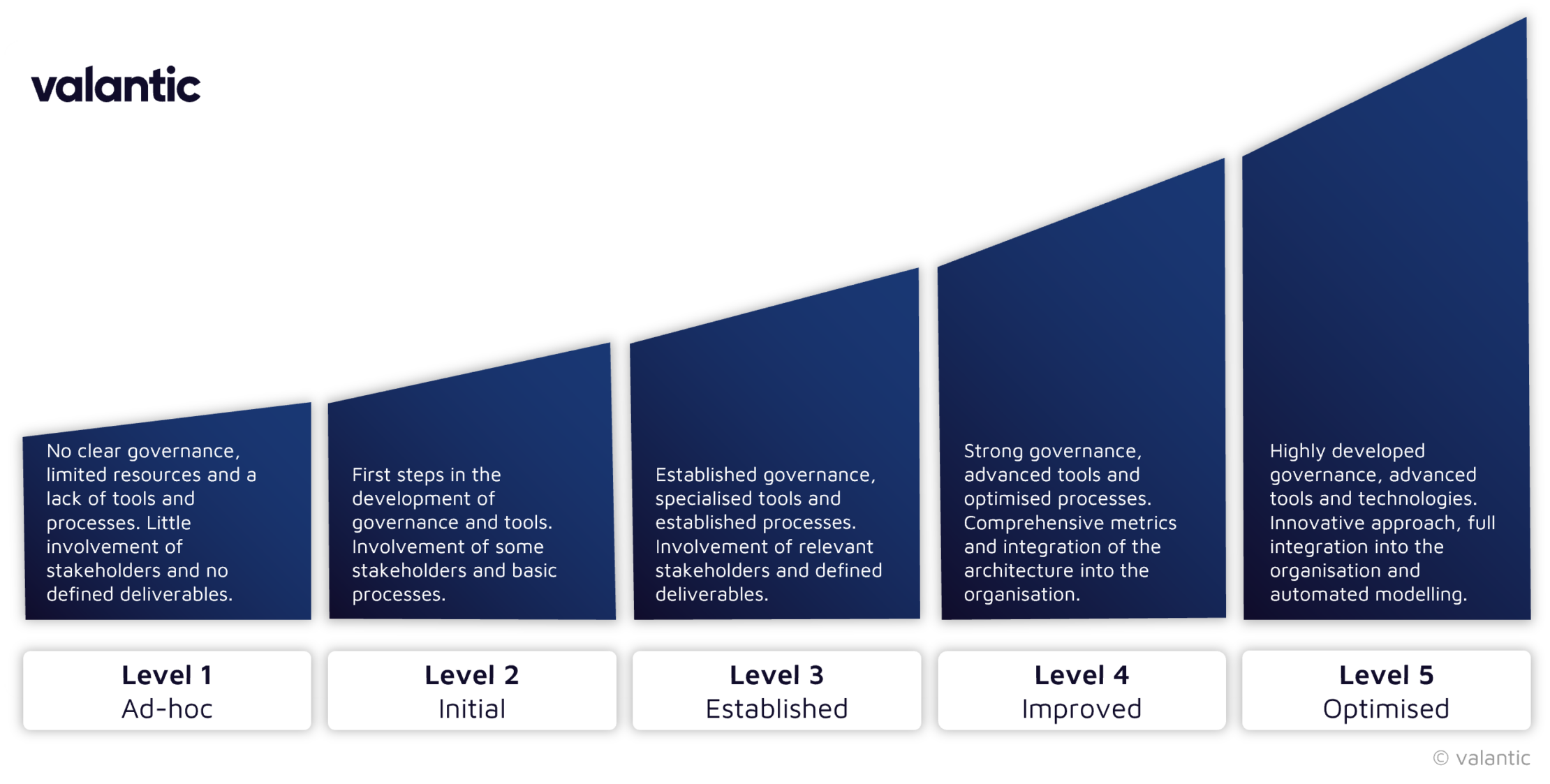
Our experts give you a real competitive advantage – tailored to your needs: We support you in all phases of your EAM journey – from the start and further development to determining your EAM maturity level.
Positioning and target image
We help you to determine the current EAM maturity level of your company based on the assessment of various stakeholders and to define the target status/maturity level as a common goal.
Identify focus areas as fields of action
The structure of the model makes it possible to identify critical fields of action with a focus on IT, business and the cross-section as well as dimensions such as people, process, tools, governance, stakeholders, organisation, methods, architecture models and metrics. This allows you to prioritise your EAM journey/roadmap and identify options for action for potential cost savings.
EAM tool landscape
There are a large number of EAM tools on the market. Based on the determined EAM maturity level, our experts at valantic support you in selecting an EAM tool that is suitable for your company as part of a software selection process. This will take your EAM journey to the next level. We take into account both the maturity level and the specific needs of your organisation and show you clearly what effect the solution you are considering would have on your company.
With our valantic EAM Maturity Level Assessment, you can get a quick and uncomplicated initial overview. As part of a short project, we quickly show you the EAM fields of action and business potentials and levers that are relevant for your company.
Let us support you transform your system and application landscape