Highlight

Successful together – our valantic Team.
Meet the people who bring passion and accountability to driving success at valantic.
Get to know usNovember 5, 2020

Many business processes share similarities across companies, especially those within the same industry or producing similar products.
However, no two companies are alike. That’s where standardized solutions reach their limitations, and the concept of “one size fits all” falls short. This can be clearly observed in IT infrastructures, including the SAP ERP system.
The ERP system, known by this name since 1993, has long been offering a comprehensive standard version that covers numerous processes and functionalities. While it has evolved over time to meet various business and industry needs, most companies have implemented custom adaptations or supplementary solutions.
This has led to a complex, heterogeneous system landscape that is challenging to manage and requires significant maintenance effort. Clearly, this situation is far from ideal.
Migrating from SAP ERP to SAP S/4HANA offers companies a valuable opportunity to reassess their existing system landscapes. Often, long-standing customizations or enhancements prove to be unnecessary, making it redundant to exactly replicate the existing structure in S/4HANA. Instead, companies can increasingly lean on SAP’s standard offers, streamlining processes and reducing complexity.
SAP Activate plays a central role in this process. As a modular, agile framework, it simplifies and accelerates the implementation of SAP S/4HANA. Whether managing new implementations, system conversions, or broader landscape transformations, SAP Activate delivers both a structured methodology and best-practice packages. These packages include ready-to-use business and technology processes, all optimized for S/4HANA.
Importantly, the benefits of SAP Activate extend well beyond the initial implementation. The framework supports the continuous integration of future innovations, ensuring companies remain agile and up to date. SAP Activate has effectively replaced earlier implementation approaches like Accelerated SAP (ASAP) and SAP Launch.
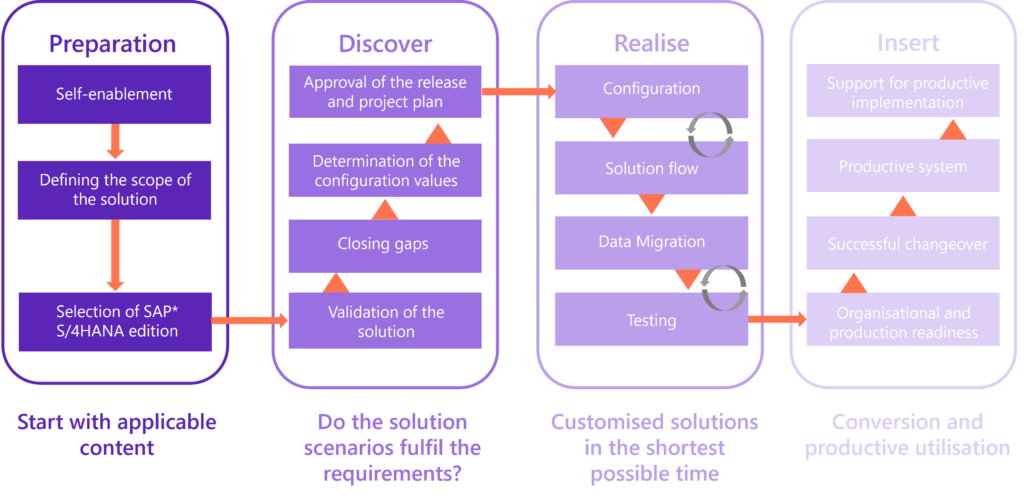
Caption: The SAP Activate Framework includes four phases – Prepare, Explore, Realize, and Deploy – which systematically assist in implementing SAP S/4HANA, ensuring a smooth and standards-compliant migration.
Source: SAP -> Own illustration
To support the migration to SAP S/4HANA, SAP provides the Simplification List – a detailed guide that explains how SAP ERP transactions and functions are mapped within SAP S/4HANA. Even if certain transactions or functions appear to be missing, they are often consolidated or integrated into other simplified elements. The Simplification List helps clarify these relationships, offering valuable insights into the system logic and structure of SAP S/4HANA.
Generally speaking, companies can retain their asset management processes after adopting SAP S/4HANA, as mapping existing structures poses no problem from a technical point of view. However, it’s crucial to decide whether this is a feasible and future-oriented choice. The advantages of returning to SAP standard functionalities are evident: reduced effort and innovative options for advanced asset management, such as real-time data analyses or Fiori-based apps.
Plus: From valantic’s perspective, the migration to SAP S/4HANA presents an excellent opportunity to reevaluate asset management holistically, considering not just technological advancements, but also strategic and process-related dimensions. Modern maintenance strategies can be more efficiently established, particularly with new SAP technologies. SAP Intelligent Asset Management plays an essential role alongside SAP S/4HANA in this domain.
For companies looking to advance their asset management, the first step involves a detailed analysis of their current situation, aiming to identify weaknesses and define optimization potentials. Subsequently, considering the new technological possibilities, a target scenario should be designed. It’s important to keep in mind the fast-paced nature of current innovations. What may seem technically unfeasible today could be possible within months, requiring openness and scalability in planning.
Once the future asset management is defined, the next step is its implementation on the IT side – ideally leveraging SAP S/4HANA’s standard functionalities.
The final phase involves the technical implementation of the IT architecture, which can follow one of two scenarios:
The optimal approach depends on the company’s individual circumstances and should be carefully assessed on a case-by-case basis.

Switch to SAP S/4HANA with valantic now!
Are you looking for an experienced partner to guide your successful migration to SAP S/4HANA? Our team of SAP experts at valantic is here to answer all your questions!
Don't miss a thing.
Subscribe to our latest blog articles.