Highlight

Successful together – our valantic Team.
Meet the people who bring passion and accountability to driving success at valantic.
Get to know usDecember 17, 2025

Automation is at a moment that feels similar to software development before cloud and APIs became mainstream. Many established concepts still work, but their limits are increasingly visible. At the same time, a new combination of technologies is emerging—one that doesn’t just solve isolated problems, but changes how organizations connect processes, systems, and decisions.
This new approach to automation can no longer be reduced to a single tool. It is a stack—made up of intelligent AI agents, a clear orchestration layer, and software that is no longer built purely through traditional development, but generated on demand.
Traditional automation has primarily focused on execution: triggering steps, moving data, and following predefined rules. With AI agents, that picture changes fundamentally. Agents can analyze situations, evaluate information, plan next steps, and carry out actions autonomously.
This shifts automation from simple task completion to real responsibility—within clearly defined boundaries. That makes automation far more powerful, but also more complex.
The more decision-making capability we hand over to AI systems, the more important control, transparency, and governance become. Orchestration platforms such as Camunda take on this role. They define process boundaries, integrate humans at the right points, and ensure traceability.
Without orchestration, AI agents remain isolated point solutions. With orchestration, they become part of a consistent, scalable end-to-end system.
Large language models can now generate complete applications—tailored to specific requirements, integrated into existing architectures, and implemented in a technically sound way.
As a result, software is no longer best understood as a one-off project, but as a product that can be created flexibly when needed. Processes define the framework, agents make decisions, and generated software provides the right tools.
The new automation stack marks a fundamental shift: away from mechanical execution and toward intelligent, responsible process design. Organizations that establish this stack early build a future-proof foundation for digital innovation.

Jörg Rodehüser
Senior Expert AI Process Automation
valantic


Artificial Intelligence October 21, 2026
Your AI Bill Isn’t About the Price Per Token
AI inference prices have fallen by around 90%, yet most companies aren’t seeing lower bills. The reason: costs depend on more than token prices. Usage volume, model choice, context size, and repeated agentic workflows all drive spending. To control AI costs, organizations need to understand not just how much they spend, but what drives that spend in the first place.
Your AI Bill Isn’t About the Price Per Token
Customer Experience September 18, 2026
From webshop to virtual try-on: how AI is making its way into retail stores
Digital interfaces such as smart mirrors turn AI in the store into a tangible business case. What potential does this hold for the customer experience and in-store personalization? Matthias Vollmer explains how the retail industry can combine the best of both worlds and turn physical touchpoints into an intelligent part of the omnichannel journey.
From webshop to virtual try-on: how AI is making its way into retail stores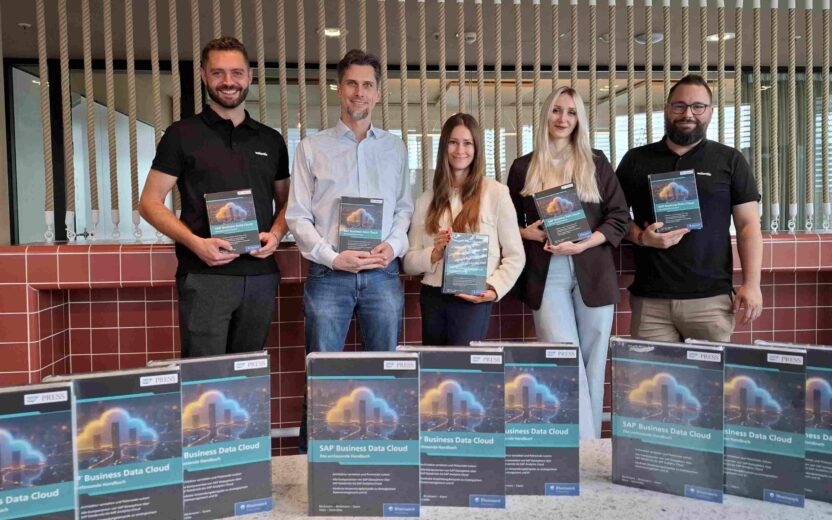
SAP Services September 17, 2026
The SAP BDC handbook: An interview on Business AI and data culture
Five valantic consultants wrote the SAP Business Data Cloud handbook. In this interview, they explain why SAP BDC is the enabler for business AI and why this book is a must-read.
The SAP BDC handbook: An interview on Business AI and data cultureDon't miss a thing.
Subscribe to our latest blog articles.