Highlight

Successful together – our valantic Team.
Meet the people who bring passion and accountability to driving success at valantic.
Get to know usNovember 27, 2026
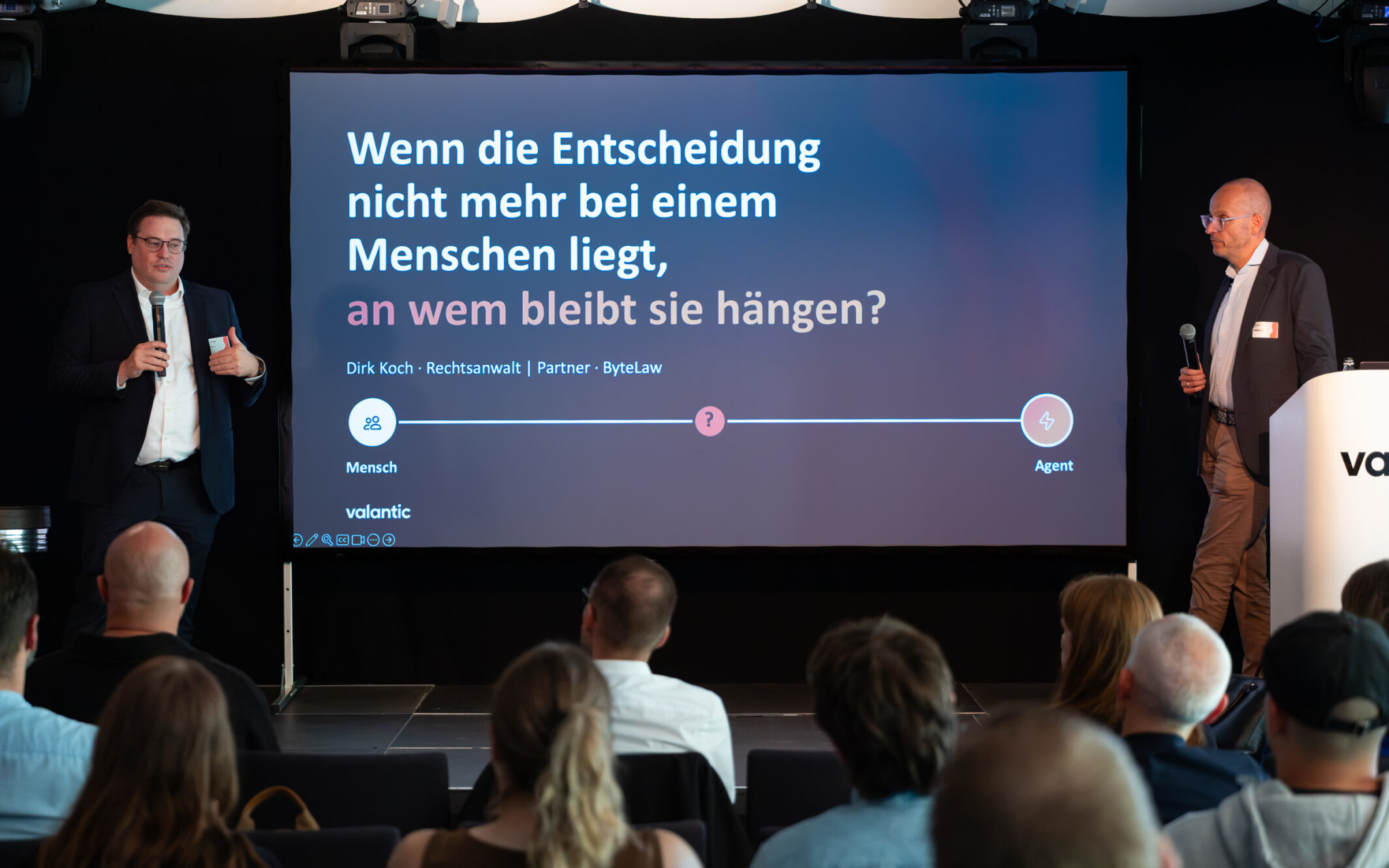
AI agents answer customer inquiries, prepare actions, and trigger processes. The more decisions they make independently, the more urgent it becomes to address regulatory and organizational questions:
Attorney Dirk Koch of ByteLaw and Breach Coach Thomas Lang, Managing Director & Partner at valantic, provided answers at DigitalXperience 2026 in Mainz. This article summarizes their expertise and recommendations.
More than 80 percent of executives in the DACH region expect that by 2030, companies with transparent, well-managed AI will be more successful than those that focus solely on speed.1 In practice, however, two aspects that belong together are often treated separately: the management and control of AI on the one hand, and preparedness for security incidents and crisis management on the other.
A viable approach to AI governance frequently fails at three critical points:
The problems with each of these aspects become apparent—at the very latest—when an organization’s own AI system causes an incident. The most costly mistakes occur in the hours that follow.
In the event of a security incident caused by third-party AI systems or cybercriminals, there is a clear narrative when communicating with employees, regulators, and insurers: An external perpetrator carried out the attack. The company is the victim.
This narrative changes when the trigger comes from within—specifically, from the company’s own AI agent. In that case, the company must report an incident it caused itself, conduct an internal investigation to find clues, and quickly take the appropriate steps:
Attorney Dirk Koch answers this question unequivocally: An AI agent is not a legal entity.
Liability remains with the company and its management
The legal principles are largely well-known; agents simply apply them to a new situation.
In the event of a breach of duty, management may be liable on two levels:
The basis for this is the management’s duty of organization under German corporate law and case law. For AI, this is specified by NIS2 and DORA. For AI agents, it involves three steps: Agents must be carefully selected, authorized, and monitored.
At this point, reference is often made to the Business Judgment Rule2: However, this liability exemption for board members and managing directors (Section 93(1), second sentence, of the German Stock Corporation Act (AktG)) only provides protection if business decisions were made based on adequate information. Whether a company complies with applicable laws and guidelines is not a matter of discretion but part of the duty to act lawfully. Internal rules also provide relief only if they are actually applied within the company.
Dirk Koch sums it up: “A policy that no one knows about does not provide protection.”
Dirk Koch distinguishes three bases of liability for the company itself:
The EU AI Act makes AI governance mandatory.
The EU AI Act provides for fines in the event of violations. The maximum penalty of up to 35 million euros or 7 percent of global annual revenue applies to prohibited AI practices. For violations of requirements such as operator and transparency obligations, the fine is up to 15 million euros or 3 percent.3
The specific requirements and prohibitions that apply to an AI agent depend on its use. For example, a customer service agent is generally subject to transparency requirements. An agent that pre-screens job applications, on the other hand, is considered a high-risk system. For such systems, operators must ensure human oversight, monitor operations, and establish mechanisms to stop or correct the AI in the event of undesirable or erroneous results. Under the AI Omnibus4, these high-risk obligations will not take effect until December 2, 2027.
The EU AI Act distinguishes between providers, who develop or distribute AI applications under their own name, and operators, who deploy a system under their own responsibility. In practice, responsibility is shared among a “triangle of liability” consisting of the manufacturer, the integrator, and the user. However, the boundaries of these roles are fluid.
Dirk Koch emphasizes: “Anyone who customizes the AI can become a manufacturer themselves.”
For example, an operator who significantly modifies a high-risk system or markets it under their own name becomes a provider.
The Bundestag did not pass a significant piece of legislation until early October: With the implementation of the new EU Product Liability Directive5, software is considered a product for which liability applies regardless of fault.
Providers and integrators of AI systems thus face a significantly higher liability risk. A defect, for example, may also result from missing security updates or from the behavior of the software after it has been placed on the market—such as in the case of self-learning AI. For users, it becomes all the more important to contractually define roles, warranties, and recourse. The new directive applies to products placed on the market on or after December 9, 2026.
What is new is not so much the law itself as its application. Dirk Koch refers to it as “old wine in new wineskins.”
Existing obligations remain in effect:
New obligations are being added:
The more autonomous an agent is, the greater its responsibilities.
As a general rule, the degree of autonomy drives the level of risk and, consequently, the cyber security and compliance requirements. Regulations and guidelines such as NIS2, DORA, the GDPR, and the ISO/IEC 42001 standard specify the obligations relevant to the issue of liability for AI systems.
The EU Directive on Network and Information Security requires, among other things, risk management measures that must be approved and monitored by senior management. Significant security incidents must be reported to the Federal Office for Information Security (BSI) in three stages:
Whether NIS2 applies to an organization depends primarily on the industry and the size of the company. The directive affects approximately 30,000 companies across 18 sectors, including energy, healthcare, digital infrastructure, and manufacturing.6
For the financial sector, DORA specifies the reporting requirements for incidents involving information and communication technologies (ICT), which also include AI models and agent platforms. A reportable ICT incident could, for example, be triggered by an agent that disrupts payment or customer processes. Among other things, DORA requires a risk management framework, resilience testing, and the reporting of serious ICT incidents in four tiers:
Since 2018, the GDPR has required companies, among other things, to ensure data protection through design and to report data breaches to the supervisory authority within 72 hours. The regulation thus underscores companies’ responsibility regarding AI: For example, if an agent accesses customer data or discloses it to unauthorized recipients, this constitutes a reportable data breach. Fines can reach up to 20 million euros or 4 percent of global annual revenue.8
The international standard for artificial intelligence management systems defines how an organization responsibly manages the development, deployment, and use of AI systems. This includes AI policies, roles and responsibilities, risk and impact assessments, and the management of suppliers and third-party providers. Many of these requirements overlap with provisions in the EU AI Act, such as those regarding risk management, documentation, human oversight, and monitoring. For this reason, the standard is considered a sound organizational framework for demonstrating compliance with the AI Regulation.9
Our short answer to the question of liability: AI security is a leadership responsibility, not purely an IT issue.
To fulfill this organizational obligation, clear points of control between humans and AI must be established . This is not about “checklist-based security,” but rather about embedding rules, processes, and responsibilities within the organization.
Audit-proof evidence that risks, levels of autonomy, controls, and approval processes have been adequately reviewed serves, in the event of a crisis, as the basis for exonerating management and thus provides personal liability protection.
Four building blocks should be in place beforehand:
For companies that use AI agents, the golden rule is: Consider governance, control, and crisis preparedness from the very beginning.
A good place to start is by taking stock:
Would you like to assess your AI agents against these questions? Talk to us.


AI Governance Journey with valantic
Three steps to AI security & resilience
Through our AI governance program, we work together to lay the foundation for a security framework that enables you to scale AI in a controlled, low-risk, and rapid manner—from an initial assessment to a governance operating model and audit-ready assurance.

Thomas Lang
Partner & Managing Director
valantic Division Digital Strategy & Analytics
As Managing Director & Partner at valantic, Thomas Lang is responsible for the Information Security & Data Protection division. In over 25 years of IT consulting and as a breach coach, he has learned that the most costly mistakes do not occur during an attack, but afterward. He views cybersecurity as a leadership responsibility and focuses on the intersection of technology, regulation, and corporate governance.

Dirk Koch
Lawyer & Partner
ByteLaw
Dirk Koch is a partner at the law firm ByteLaw Rechtsanwälte (https://byte.law) in Frankfurt. His practice focuses on the regulation and application of digital technologies, particularly data security, internal corporate IT governance, the detection and prevention of data theft and cyberattacks, and GDPR-compliant data protection. His clients include international and mid-sized companies as well as public-sector entities.

Artificial Intelligence October 16, 2026
Autonomous Enterprise Journey: How AI value engineering creates measurable business value
How can the ROI of AI initiatives be reliably assessed and measured? How can companies identify the biggest levers and key processes for AI? Katrin Luft, Senior Expert at valantic and co-developer of the “Autonomous Enterprise Journey,” provides answers and recommendations in a conversation with Darya Basarhina, Vice President of Sales & Marketing and Manufacturing Practice Lead at valantic.
Autonomous Enterprise Journey: How AI value engineering creates measurable business value
Digitalization June 18, 2026
valantic joins Anthropic’s Claude Partner Network, bringing Claude Enterprise to Europe
valantic has joined the Claude Partner Network as a Select Partner in the Services Track, among the first consulting and solutions firms in Europe to do so. The partnership with Anthropic, the AI safety company behind Claude, positions valantic to bring Claude Enterprise to organizations across Europe.
valantic joins Anthropic’s Claude Partner Network, bringing Claude Enterprise to Europe
Artificial Intelligence August 26, 2026
From pilot to real value: scaling Claude successfully across your organization
Scaling Claude Across the Organization: Why 95% of AI pilot projects fail to deliver a return on investment—and how to turn licenses into daily, measurable usage.
From pilot to real value: scaling Claude successfully across your organizationDon't miss a thing.
Subscribe to our latest blog articles.