Highlight

Successful together – our valantic Team.
Meet the people who bring passion and accountability to driving success at valantic.
Get to know usWhy do you need an integrated sales and operations planning process?
Sales & Operations Planning (S&OP) is a management tool originating in the USA that brings together the most important areas of a company in a cooperative manner in order to create a common basis for decision-making. The aim is to optimally coordinate production and purchasing planning with corporate and sales planning. This includes, in particular, comprehensive financial planning.
Performance deficits in supply chain planning resulting from inaccurate, outdated and frequently changing sales, production and purchasing plans can be avoided by using S&OP. Challenges such as sales volumes that are difficult to forecast, high price volatility on the sales and purchasing side, resource bottlenecks and high fixed costs can be better addressed.

The main objectives of introducing integrated S&OP processes are:
In the area of Sales & Operations Planning, companies are faced with a number of complex challenges. valantic works with you to develop customized solutions that both optimize your cross-departmental collaboration and significantly increase efficiency with the help of state-of-the-art technologies. Possible challenges in medium-term planning are
Interdepartmental coordination
It is crucial to effectively integrate and coordinate departments such as sales, purchasing, production and logistics into the planning process. The different working methods and priorities of these departments can make coordination considerably more difficult. This can cause misunderstandings and ultimately lead to delays in the entire process flow.
Data quality and availability
Consistent and integrated data sources are essential for making informed decisions in the planning process. Unreliable data sources or inadequate data quality mean that planning is based on incorrect assumptions, which can affect the entire supply chain. Companies are therefore obliged to ensure that they have all the necessary systems in place so that relevant data can be obtained and processed.
Lengthy decision-making process
In most cases, several rounds of coordination between all departments are required. This can delay decision-making, which poses a risk, especially for dynamic markets. Lengthy decisions mean that companies cannot react quickly enough to changes.
Potential for conflict
The individual departments pursue different interests, which can lead to tensions in the planning process. For example, the sales department strives to achieve high sales targets, while the logistics department aims to optimize stock levels. These different approaches harbor a high potential for conflict, which could hinder constructive cooperation.
Technological support
Modern software solutions support companies in analyzing complex data volumes and identifying the best solutions or making decisions on this basis. Companies often lack these necessary tools for automation and analysis. Without these advanced technologies, the efficiency of the S&OP process can only be optimized to a limited extent.
Forecast accuracy
Uncertain market conditions, particularly in volatile environments, make precise forecasts difficult. This increases the risk of overcapacity or bottlenecks. For this reason, the development of flexible planning strategies plays a fundamental role in minimizing risks and being able to react agilely to changes in the market.
Customer satisfaction and security
Reliable forecasts promote smooth production planning & execution, which leads to significantly lower planning risk.
Increase in sales
Satisfied customers increase their order volume and “lost sales” are reduced, as “out-of-stock” situations occur less frequently.
Profit increase
Integrated planning processes lead to lower inventory costs, fewer errors and less planning nervousness. Overall, production processes run much more smoothly. Short-term rescheduling becomes less frequent. All these effects have a positive impact on many expense items in the profit and loss account. Overall, costs can be significantly reduced.
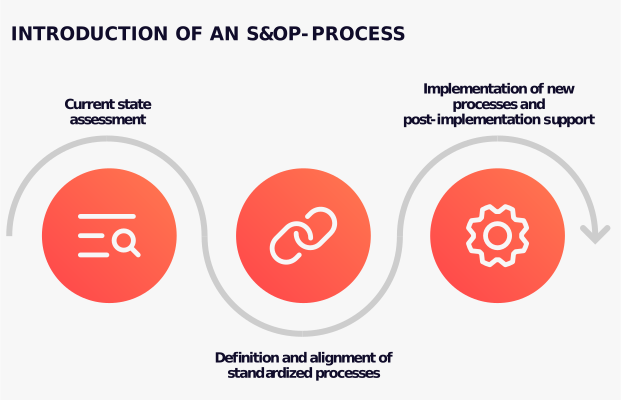
Analysis of the current situation
In the first step, current company practice in the area of sales and production planning is recorded and evaluated on the basis of interviews and workshops, data analyses and existing process and workflow descriptions. Quantitative aspects such as forecasting quality and planning uncertainty as well as qualitative aspects such as the degree of cooperation between departments in the planning process play a role here.
Definition and coordination of binding processes
In a second step, the future S&OP processes are then defined together with all relevant specialist departments. We draw on best practices for processes and workflows, roles, meeting structures and KPI systems. The future processes are defined in detail for each process step in comparison with best practice, together with the corresponding organizational anchoring and the respective IT support. The key milestone at the end of this step is the binding coordination of the new processes.
Implementation of the new processes and aftercare
The core challenge in the implementation phase is to make the change sustainable and to convince all employees involved of the necessity of the new processes. As part of our supply chain consulting, we support this with comprehensive training programs, accompanied test runs, coaching for the real launch and accompanying implementation monitoring.

Dennis Goetjes
Partner
valantic

Gereon Küpper
Partner
valantic