Highlight

Successful together – our valantic Team.
Meet the people who bring passion and accountability to driving success at valantic.
Get to know usOptimize efficiently and reduce costs sustainably
In today’s increasingly volatile and competitive market landscape, companies face constant changes, challenges and opportunities. The dynamics of the markets are based in particular on varying consumer preferences and technological innovations, which is why optimizing your production planning is crucial to your business success. It enables you to react flexibly and agilely to changes and thus increase your competitiveness. You can also use your resources efficiently, which saves costs. These measures not only strengthen your internal efficiency, but also promote your customer satisfaction and your relationships with suppliers, which ultimately contributes to the sustainable growth of your company.

Are you confronted with high and capital-intensive safety stocks in order to avoid downtime? Is there a lack of transparency between the purchasing, warehouse and maintenance interfaces and no clear definition of responsibilities?
We help you to optimize your service level and your working capital at the same time by creating transparent, efficient and holistic maintenance management with a link to inventory management. In addition, we take your maintenance management to the next level with the help of our suitable digitalization approaches!
Forward-thinking organization
Production planning is an integral part of production management and focuses on the effective organization and control of the manufacturing process of goods or services. It is a key aspect of operations management, logistics management and supply chain management. The core aspects of production planning include demand, capacity, deadline, material and resource planning. The tasks range from the creation of detailed production plans to the monitoring of production activities and close coordination with other areas of the company. The overarching goals of production planning are to maximize efficiency, minimize costs, ensure product quality and customer satisfaction, and ensure flexibility in order to be able to react to changing market requirements. Overall, production planning plays a decisive role in achieving strategic corporate goals and creating competitive advantages.
Evaluating the performance of the production process is a crucial factor for any company that wants to hold its own in a dynamic market environment such as the one we have today. Various key performance indicators play a central role in identifying and evaluating the efficiency, quality and profitability of production and driving continuous improvement.
The most relevant performance factors are:
Step by step to your goal
Production planning is a complex process designed to coordinate and control the production of goods and services with maximum efficiency. Both strategic and operational aspects are taken into account, each of which requires specific core tasks.
As part of strategic production planning, key decisions are made that influence both the performance and the long-term orientation of the production process. These include
Long-term capacity planning
In this step, the focus is on long-term decisions that need to be made regarding plant, machinery and labor to ensure that future capacity requirements can be met.
Location planning
During site planning, great care is taken to select suitable locations for the production facility. However, in order to ensure optimal conditions, a number of factors must be taken into account, such as access to raw materials and the availability of a skilled workforce.
Production strategy
Defining a concrete strategy for your production is crucial for the long-term success of your company. To this end, general goals and guidelines should be clearly defined, such as the focus on mass production or the trend towards customer-specific production.
Long-term production volume planning
Another relevant step is the planning of production volumes over a long-term period. This ensures efficient use of resources and smooth production processes.
In the operational area of production planning, short-term measures are taken to coordinate daily production activities and to identify and avoid bottlenecks. It comprises the following core tasks.
Short-term production planning
This step deals with the daily coordination of production activities. Targets and work plans are defined in such a way that both personnel and available resources are used effectively.
Material requirements planning
Material requirements planning is used to precisely determine the required materials and quantities for ongoing processes. This ensures that sufficient raw materials are available to keep the production process running continuously.
Short-term capacity planning
This core task focuses on the optimal utilization of systems and employees. Bottlenecks are not only identified, but innovative solutions are also developed in order to achieve production targets on time.
Scheduling & order planning
This step is carried out in close coordination with the specific customer requirements. Production orders are planned and scheduled so that delivery deadlines are met and customer satisfaction is promoted.
Quality planning
Quality planning plays a crucial role in ensuring high product quality. By setting clear quality standards and controls, the goods produced can meet customer requirements.
Optimize your production planning with these principles
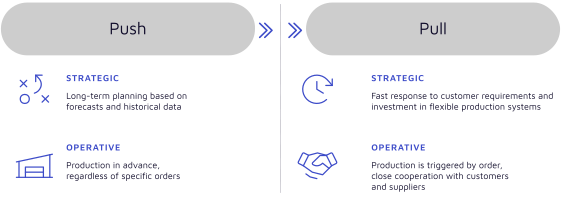
The planning of production processes requires a choice between different approaches in order to optimize both the efficiency and flexibility of production. Two basic principles are the push and the pull principle. Both approaches offer different approaches to the organization and control of production and are specified in both strategic and operational core elements.
The strategic approach of the push principle requires long-term planning based on forecasts and long-term data. At the operational level, production is planned in advance, regardless of specific orders. At the same time, stock levels are constantly monitored to ensure continuous availability.
In contrast to this, the pull principle focuses strategically on reacting quickly to customer requirements and investing in flexible production systems. Operationally, production is triggered by specific orders, with close cooperation with suppliers and customers. In order to achieve maximum benefits, hybrid strategies combine both principles. However, the successful application of this approach requires flexible action and precise planning in order to effectively adapt to changing market conditions and satisfactorily meet customer needs.
Production planning is subject to constant change, which presents companies with a variety of challenges that need to be overcome. These require efficient optimization of production planning in order to be able to hold their own in a dynamic environment based on new market trends, customer requirements and technologies.
Increase your own performance
To effectively optimize their production planning and meet any requirements, companies should implement a number of proven strategies and techniques:
A thorough analysis of the existing production process is the first step in identifying weak points and areas with potential for optimization.
By investing in technology such as automation, advanced planning systems and artificial intelligence, production processes can be optimized and made more efficient. For example, advanced planning tools and integrated ERP systems allow companies to better coordinate and control their production processes. The use of data analysis tools enables companies to make informed decisions and continuously improve the performance of the production process.
An accurate forecast of demand enables effective planning of production capacities and material requirements in order to avoid over- or underproduction.
Just-in-time principles help to minimize stock levels and make production processes leaner and more efficient.
The efficient use of manpower and machinery can reduce bottlenecks and increase productivity.
Flexible production processes enable companies to adapt quickly to changes and respond to new market requirements.
A reliable supply of materials is crucial for smooth production. It is therefore important to build and maintain close and trusting relationships with suppliers.
By applying Lean or Six Sigma methods, companies can continuously optimize their production processes and achieve efficiency gains.
A comprehensive risk analysis along the entire production chain helps to identify and avoid potential disruptions at an early stage.
The implementation of quality controls ensures compliance with high quality standards and contributes to customer satisfaction.
Employees should be actively involved in the improvement process by being able to contribute their ideas and suggestions for optimizing production processes. Training is also important to expand specialist knowledge and skills and to ensure that optimization measures can be implemented effectively.
The comparison with best practices in the industry enables companies to learn from successful strategies of others and apply them to their own production process.
Continuous monitoring of production performance enables companies to react quickly to changes and adapt strategies accordingly to ensure long-term success.
valantic’s competent team offers tailor-made solutions for optimizing your production process so that you can achieve your goals more quickly and effectively. From strategic planning to operational implementation, we support you in increasing your efficiency as well as minimizing costs and maximizing your use of resources. Rely on our expertise to take your production to the next level.
Optimize maintenance management
12-18%
Reduction of process costs
For example, the timely provision of spare parts or the digitalization of maintenance processes reduce process costs
8-15%
Inventory reduction
The introduction of a procurement and inventory strategy leads to a reduction in inventories and thus capital commitment
3-6%
Savings potential in purchasing
Savings can be achieved by bundling orders, reducing short-term orders and avoiding "double purchases"
1-3%
Increase in system availability
By reducing out-of-stocks and, as a result, reducing downtimes and extending the service life of systems, system availability increases
Our approach
Supply chain management in maintenance is optimized holistically on four levels:
Strategic level
Tactical level
Operational level
Capability level
Analysis of the current situation
Conception of the catalog of measures
Implementation

Dennis Goetjes
Partner
valantic

Gereon Küpper
Partner
valantic