Highlight

Successful together – our valantic Team.
Meet the people who bring passion and accountability to driving success at valantic.
Get to know usWho will plan, control, and decide in the future?
AI in supply chain management means that people and AI agents share planning and control: people set goals, rules, and boundaries; agents plan, act, and coordinate. valantic supports companies from assessing their first use cases to building an agentic supply chain organization – independently of vendors and with a focus on data, rules, and governance.


Artificial intelligence does more than make supply chain management faster: it changes who plans, who controls operations, and where decision-making ends and execution begins. The linear supply chain becomes a network that corrects itself across locations, functions, and company boundaries. The pace of change is reflected in the BVL-Trendstudie 2025/2026: AI use in logistics and supply chain management has more than tripled since 2023.
The key insights from this page at a glance
AI in supply chain management is developing through five stages, from assistance to networks of agents. Planning is furthest along; control and physical execution are progressing more slowly. The bottleneck is rarely the AI model itself, but rather data, rules, and governance. The value shifts from “planning at lower cost” to “making better decisions.” valantic brings AI into operation in three steps: assess use cases, build the platform, and implement one agent at a time.
Most companies currently use AI as an assistant: it summarizes analyses, creates reports, and explains deviations. This helps individual employees but changes neither the process nor the role of the function.
The real leap begins when people and AI agents share the work of planning and control. The roles are clearly defined: people set goals, define rules and boundaries, and decide on exceptions. Agents observe, plan, act, and coordinate with one another – beyond their own department and across suppliers and customers.
The key question is not whether AI is being used, but how much work it actually takes on. Five stages provide a useful framework:
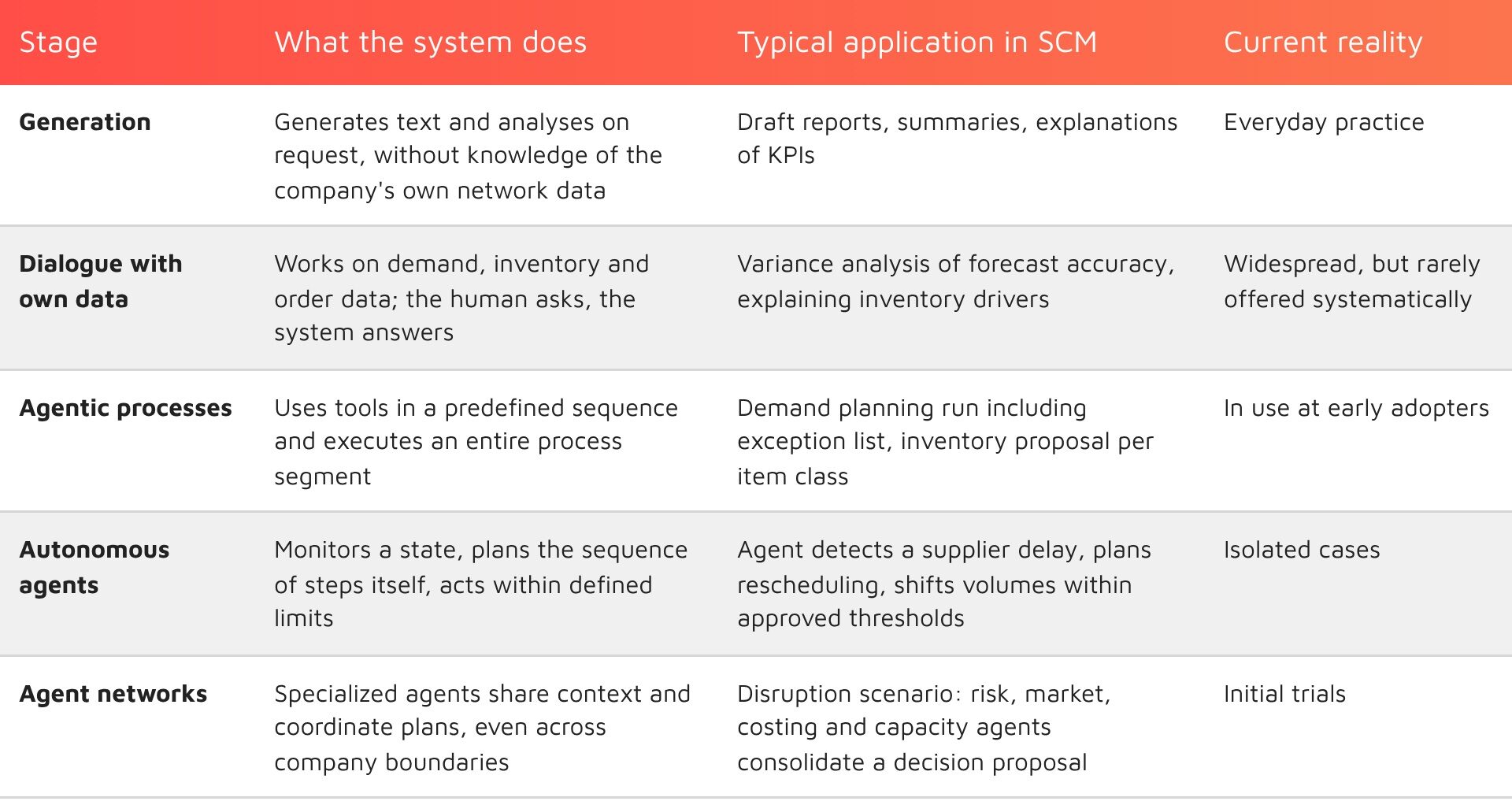
Five stages and the current state of AI in supply chain management
Generation
AI generates text and analyses on request without systematically accessing company data.
Dialogue with your own data
AI works with company data and connects to ERP and other systems through interfaces. When prompted, it can access demand, inventory, and order data, for example. A person asks; the system responds.
Agentic processes
AI carries out defined process steps and presents a result ready for a decision. The right governance determines when people intervene. People make the decision.
Autonomous agents
AI plans the steps itself and acts within defined boundaries. It flags exceptions rather than routine cases. People decide on exceptions and special cases.
Agent networks
Multiple specialized agents manage entire process chains across organizational boundaries and resolve competing objectives themselves. Complex processes are connected across functions. People oversee and direct the agents.
The move from stage 3 to stage 4 is primarily a technical challenge. The move to stage 5 is an organizational one. This is where individual tools can become a new operating model.
Supply chain management comprises not one but three layers of work. AI reaches each at a different pace and under different conditions. Overlook this, and your timelines will be based on the wrong assumptions.
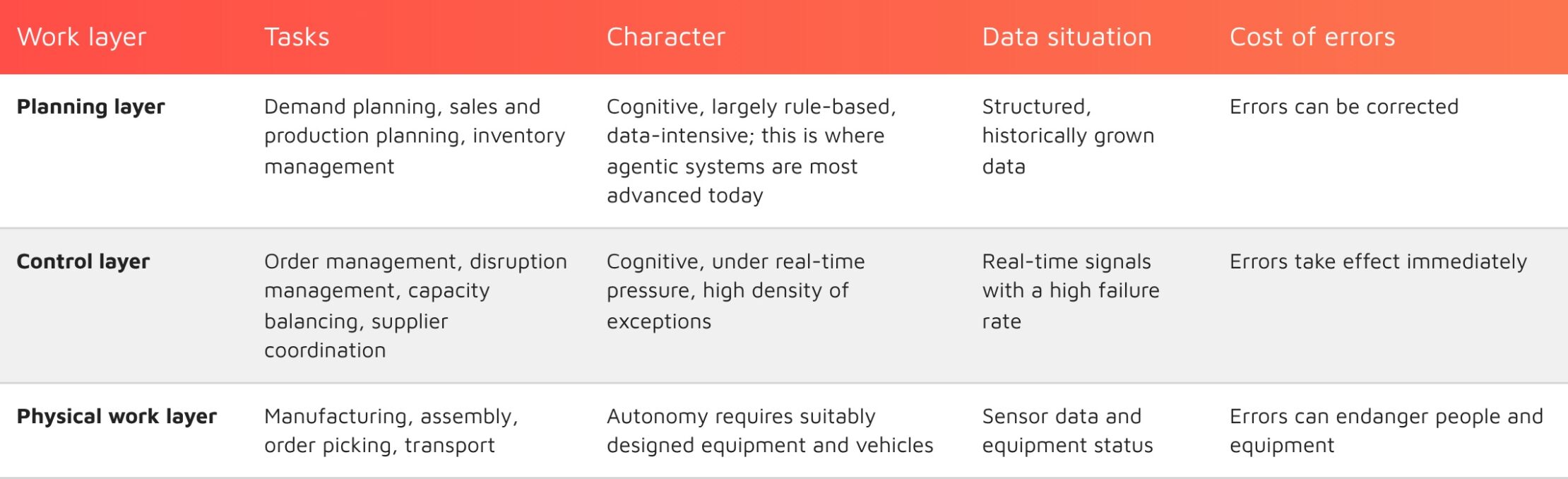
Three layers of work in supply chain management
The bottleneck is rarely the AI model. It lies in the data and in how precisely planning and control rules are defined today.
AI has an impact across the supply chain, from planning to physical execution. Depending on the maturity of each area, the following use cases range from assistance to autonomous agents.
| Area | Examples of AI use |
|---|---|
| Planning | Demand and sales planning, explaining forecast deviations, scenario modeling, planning runs and inventory recommendations, demand triage. |
| Control & order management | Order control, disruption management, capacity balancing, deviation assessment, deadline tracking, invoice and document checks, structuring customer inquiries. |
| Procurement & suppliers | Supplier coordination, maintaining supplier and inventory data, coordination across the supplier network, tracking service levels against contracts, and preparing negotiations. |
| Logistics | Analysis of freight costs, lead times, and service-provider quality; disruption assessment; orchestration of vehicle and equipment fleets. |
| Production | Summarizing incident reports, explaining key performance indicators, controlling output, product mix, and production sequence. |
Not every use case is worth pursuing immediately. The best way to prioritize is to consider how much of the work can be captured in rules alongside a demonstrable business case. Start with what can be governed by rules and creates value.
Almost every supply chain decision involves a trade-off. Higher service levels tie up inventory. Greater utilization reduces flexibility. More resilient procurement can reduce margins. Until now, companies have balanced these competing goals in cycles: in S&OP, planning meetings, and escalations.
AI evaluates these trade-offs continuously and through scenarios instead of postponing them. The value shifts from “planning at lower cost” to “making better decisions” – a different order of magnitude.


Dennis Goetjes
Partner at valantic
”The bottleneck is rarely the AI model. What matters is how precisely a company has defined its planning and control rules today – that determines how much work agents can actually take on.“
The journey toward an autonomous supply chain is not one large-scale program. It consists of three building blocks. Each stands on its own, and all three work together.
Building block 1 – Identify and assess use cases
The starting point rarely lacks ideas; it lacks a basis for decisions. valantic turns a list of ideas into an investment decision with a calculated impact: a structured assessment of the current situation, discovery workshops for each focus area, and evaluation by impact, effort, and data availability. The result is a prioritized shortlist with business cases.
Building block 2 – The agentic platform as a foundation
If you build every use case separately, you start from scratch each time. An agentic platform changes that – as an architectural decision, not a software purchase. Governance, security, logging, and cost transparency belong in the architecture, not in a review after the fact. Supply chains add a requirement other functions do not have: integration with physical automation, including robots, automated guided vehicles, and plant control systems.
Building block 3 – Bring agents into operation one by one
Prioritized use cases go live individually: a detailed design with a baseline measurement, a pilot with real users, a deliberate decision on scaling, then rollout and handover. With each productive agent, the division of work shifts until individual tools become an agentic organization.
Operations must grow alongside the agents. A Supply Chain Excellence unit maintains agents and rule sets, safeguards quality and compliance, and turns recurring patterns into new standards. Delay this capability, and you risk accumulating agents that no one develops further.
AI in supply chain management does not simply reduce headcount. It changes where expertise is needed. Demand falls sharply in operational scheduling, moderately in planning, and rises in the enabling teams that develop agents and maintain rule sets. Some of the capacity freed up moves into capabilities that many supply chain organizations do not yet have.
The traditional distinction between operational, tactical, and strategic work begins to dissolve. Three ways of working take its place:
This work converges in the control tower. Rather than just reporting, it becomes the place where exceptions are decided and rules are refined.
An agentic organization does not require a disruptive rebuild. Two initiatives run in parallel: high-impact use cases on the existing system landscape and the development of a scalable agentic platform. The first delivers value quickly; the second sustains the model over time.
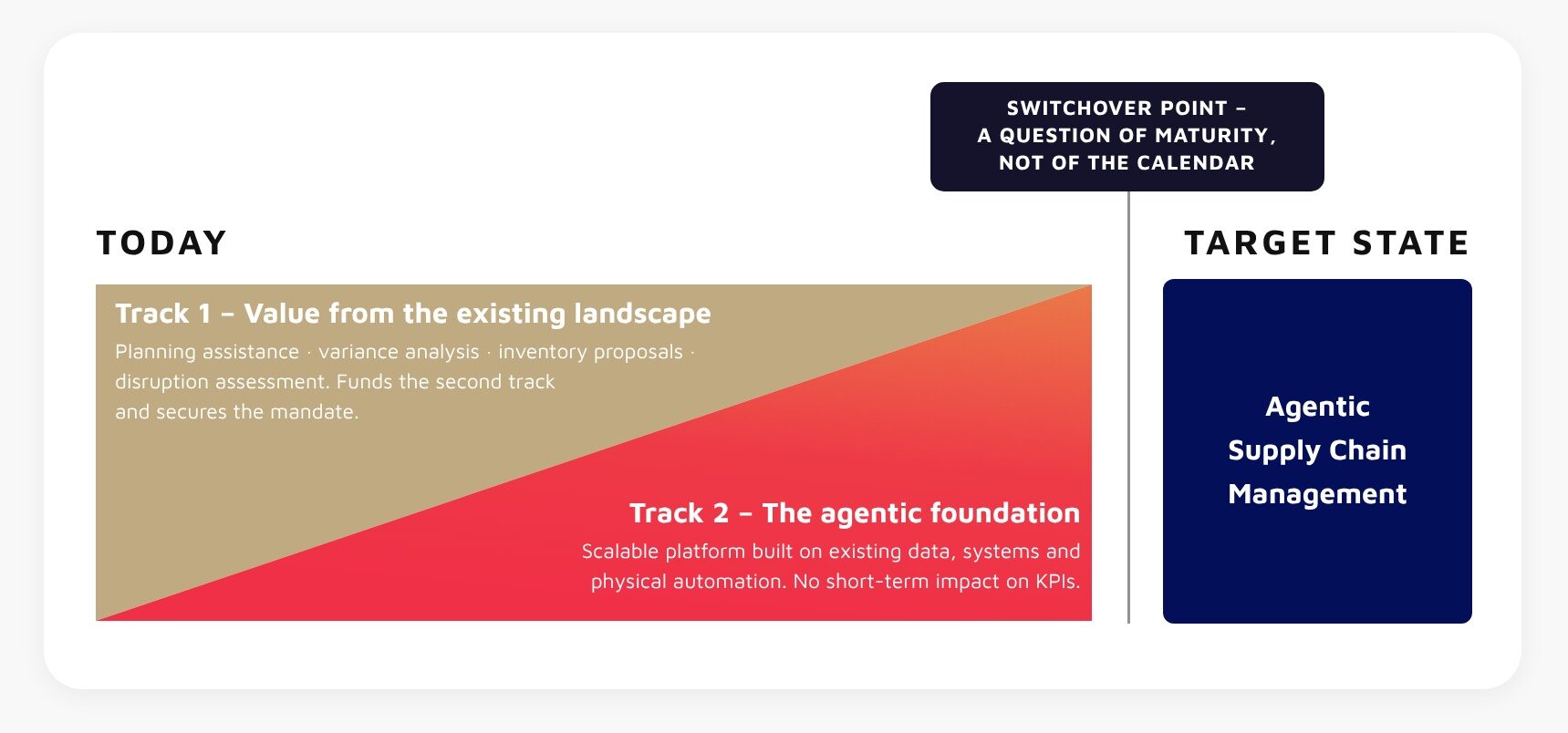
Two initiatives run in parallel until the agentic foundation can better support the work
| Horizon | What changes |
|---|---|
| By 2028 | Execution moves from stage 3 to stage 4: agents act within defined boundaries, for example in demand triage, planning runs, inventory recommendations, deviation assessment, deadline tracking, and invoice checks. Rules and the data foundation develop alongside them. |
| By 2030 | The decision-making layer changes: networks of agentic systems manage entire process chains and resolve competing objectives within set boundaries. According to Gartner, around 60% of supply chain software users will use agentic capabilities by 2030. |
| By 2035 | The function’s purpose changes: supply chain management designs decision-making frameworks instead of driving processes. The boundary between planning and execution disappears because both take place in the same layer of agents. |

BAUHAUS: Optimizing customer experience and logistics
From an app to a more efficient supply chain
BAUHAUS launches customer app and optimizes logistics
A customer app strengthens loyalty. valantic optimizes warehouse processes, plans a semi-automated warehouse, and introduces a logistics cost calculator to reduce costs.

Supply chain transformation at Rügenwalder Mühle
Higher performance through SCM optimization
A more professional supply chain at Rügenwalder Mühle
With valantic, Rügenwalder Mühle established a central SCM organization, standardized its S&OP process, and automated reporting. The result: greater transparency and predictability.

An efficient warehouse concept for Porta
A new model for an omnichannel warehouse
An efficient warehouse concept for Porta
With valantic, Porta evaluated an omnichannel warehouse as part of a logistics tender. The outcome: high seven-figure savings potential while maintaining scalability and service quality.

Optimizing PM International’s supply chain structure
Supply chain configuration with significant savings
Optimizing PM International’s supply chain structure
With valantic, PM International designed a target structure for its fast-growing supply chain network. The result: optimized transport and storage costs and fewer capacity bottlenecks.

Tailored S&OP process and inventory strategy for CHT
Greater efficiency through process optimization
Tailored S&OP process and inventory strategy
Specialty chemicals producer CHT worked with valantic on a tailored S&OP process and inventory strategy. The result: greater efficiency, lower storage costs, and higher service levels.

Valora reassesses its supply chain
A comprehensive SCM potential assessment
Valora reassesses its supply chain
With valantic, Valora assessed the supply chain performance of its central full-service supplier. The opportunities identified underpin process improvements and better purchasing terms.

valantic client references
Outstanding projects, exceptional clients
valantic client references
Explore all valantic client references.
AI use in logistics and supply chain management has more than tripled since 2023 (BVL-Trendstudie 2025/2026).
68%
of companies want to introduce or scale AI in the next five years (BVL-Trendstudie)
around 60%
of supply chain software users are expected to use agentic capabilities by 2030, up from around 5% in 2025 (Gartner)
over 40%
of agentic initiatives will be abandoned by the end of 2027, usually due to data, rules, and governance rather than the technology (Gartner)
This is precisely where our approach comes in.
AI in supply chain management describes an operating model in which people and AI agents jointly manage planning and control (also known internationally as Agentic Supply Chain or Supply Chain AI). People set goals and rules and decide on exceptions. Agents observe, plan, act, and coordinate, increasingly across functional and company boundaries.
Traditional automation and assistive AI support individual tasks but leave the underlying process unchanged. Agentic AI takes on entire process steps and acts independently within defined boundaries. The difference is how much work is actually delegated, from analysis alone to autonomous agents. AI also operates at different organizational levels across the supply chain, which may require organizational changes.
Planning-related tasks such as demand and inventory planning are furthest along: they are rules-based and data-intensive. The best way to prioritize is to consider how much of the work can be captured in rules alongside a demonstrable business case. Start with what can be governed by rules and creates value.
Rarely because of the technology. The most common bottlenecks are fragmented data, a lack of process standards, unclear governance, and no defined operational ownership. That is why the data foundation, decision rules, and governance should come before choosing a model or tool.
An autonomous supply chain does not emerge on a fixed date; it is the result of many iterations. Initial high-impact use cases can deliver time savings and better decisions in the short term while the scalable platform grows in parallel.
An agentic model is only as strong as its weakest dimension. The key question is not which maturity level you aspire to, but which dimension of your supply chain management currently lags furthest behind. We assess this with you, dimension by dimension, as a basis for your first decision rather than a ready-made program.
Want to explore the topic further?
The valantic white paper “Agentic Supply Chain Management” explains the agentic operating model across all SCM dimensions, outlines three horizons through 2035, and charts a path from the first use…

AI in procurement: how valantic applies it
From targeted assistance to an agentic procurement organization – data-driven, measurable, and ready for the future.

AI consulting: strategy, solutions & implementation
We do more than talk about AI – we make it ready for use. Our teams turn ideas into measurable results through a clear plan, pragmatic implementation, and visible business…

Dennis Goetjes
Partner
valantic

Gereon Küpper
Partner
valantic