Highlight

Successful together – our valantic Team.
Meet the people who bring passion and accountability to driving success at valantic.
Get to know usvalantic Viewpoint
Therapeutic Supplements Platforms connect science, practitioners, and patients, creating resilient, data-enabled growth opportunities in preventive health.
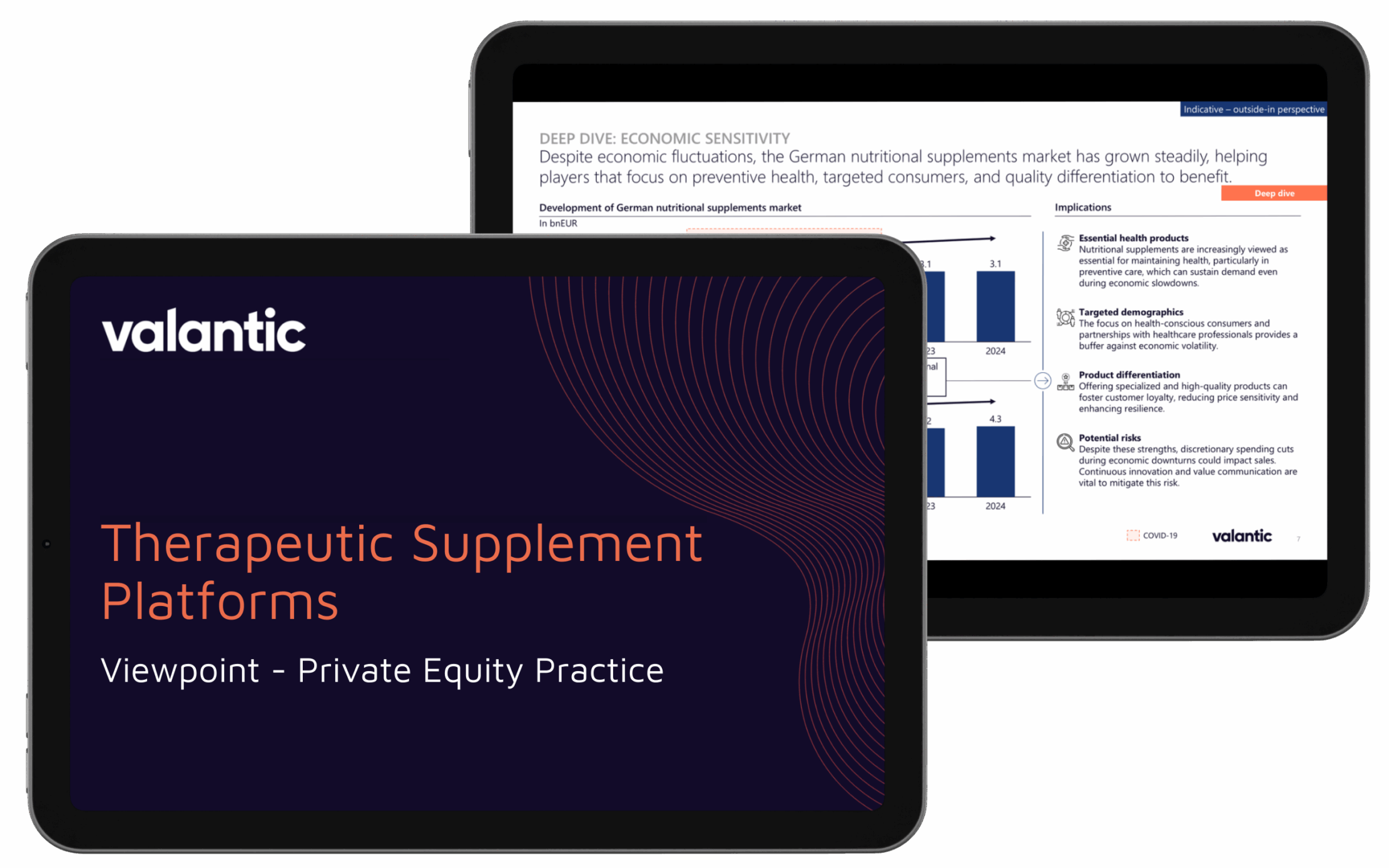
This is an excerpt of our viewpoint on Therapeutic Supplements Platforms. Get in touch if you would like to learn more about the market dynamics, business model, competitive landscape, and growth drivers in this market.

>50 product categories
across metabolic, gut, immune, and mental health
> 9% CAGR
of the global nutritional supplement market projected (2025-2028)
> $170 bn
global market volume for nutritional supplements
Executive Summary
Therapeutic Supplements Platforms sit at the intersection of preventive health, microbiome science, and practitioner-led care. Market leaders increasingly combine in-house research, clinical-grade formulations, and full value chain control to differentiate in crowded supplement shelves. The industry shows a clear shift from mass retail commoditization toward targeted, condition-specific solutions integrated into diagnostic concepts and therapy protocols.
Practitioner networks, academies, and educational content have become critical go-to-market levers, reinforcing trust and enabling premium pricing. At the same time, omnichannel access through D2C webshops, pharmacies, and therapist-driven models broadens reach and improves data capture across the seven-stage customer journey. Contract manufacturing and white-label services add an additional platform layer, allowing scalable participation in market growth. For investors, the key questions center on depth of clinical positioning, sustainability of premium price points, defensibility of product innovation, and the ability to extend into diagnostics and digital monitoring to unlock recurring revenues.
Practitioner-led Therapeutic Supplements Platforms create defensible demand by embedding products into trusted diagnostic and therapy concepts.
Vertically integrated players with in-house R&D and manufacturing are best positioned to sustain premium positioning and innovation.
Extending into diagnostics, digital guidance, and monitoring unlocks higher lifetime value across the full customer journey.

Khalid Ouaamar
valantic Managing Director
”The most attractive Therapeutic Supplements Platforms turn fragmented supplements shelves into integrated, data-rich therapeutic platforms.“
The market for Therapeutic Supplements Platforms is evolving from broad, mass-market vitamins toward targeted, condition-specific solutions anchored in science-based concepts. Leading players increasingly focus on gut health, immune resilience, metabolism, mental wellness, and healthy aging, often supported by microbiome and mitochondrial research. The customer journey spans seven distinct stages, from initial awareness and diagnostics to guidance, product selection, purchase, usage, and monitoring. Health-aware consumers and patients look for practitioner-backed recommendations, clear protocols, and transparent documentation rather than one-size-fits-all products. At the same time, digital channels and D2C webshops expand access beyond traditional pharmacies and clinics. Health and wellbeing brands, therapeutic specialists, and contract manufacturers all converge on platform-like models that integrate education, content, and community. This shift benefits players that can combine strong scientific narratives with intuitive user experiences and consistent, omnichannel presence.
Key Takeaways:

Therapeutic Supplements Platforms are propelled by several reinforcing market drivers. Rising health awareness and a stronger focus on prevention, especially around gut health, immune function, and chronic conditions, support sustained demand for high-quality supplements. During recent health crises, the broader nutritional supplements market proved resilient, as consumers prioritized self-care and immune support. Practitioner involvement is a key accelerator: medical doctors, therapists, and naturopaths increasingly integrate supplements into structured therapy concepts, often supported by diagnostic tests and frameworks that link microbiome and cellular health. This strengthens perceived efficacy and justifies premium pricing. Regulatory standards in Europe, with strict food law and ingredient rules, raise the bar for compliance, favoring professionalized, vertically integrated platforms. Finally, digital tools, from online education to compliance trackers, enable better adherence and outcome transparency, which in turn reinforces trust and repeat purchasing.
Key Takeaways:

The competitive landscape in Therapeutic Supplements Platforms can be structured into four archetypes. Mass retail brands, often private labels in drugstores and supermarkets, focus on affordable, standardized formulations with broad B2B distribution and limited therapeutic targeting. Health and wellbeing brands position themselves as premium lifestyle players, leveraging influencers, content, and D2C subscriptions to serve proactive consumers. Therapeutic and clinical brands, including names such as Orthomol, Biogena, Pure Encapsulations, and Heidelberg Chlorella, concentrate on condition-specific, science-backed formulations that are tightly integrated into practitioner protocols. Finally, contract manufacturing specialists like Sirio, Plantafood, and VP Vital Products provide white-label and manufacturing services to third-party brands, from startups to pharmacies and practitioners. Competitive intensity is rising, but differentiation through clinical concepts, practitioner communities, and integrated services is creating a distinct “therapeutic platforms” subsegment with higher barriers to entry.
Key Takeaways:

Typical Therapeutic Supplements Platforms span multiple steps of the value chain, from ingredient sourcing and in-house R&D to manufacturing, packaging, and distribution. Many leading players operate vertically integrated models that combine formulation, regulatory and quality management, and production under one roof, ensuring control over compliance and product consistency. On the commercial side, three primary channel models dominate: B2B distribution into pharmacies and retailers, practitioner-led D2T2C models where therapists trigger D2C webshop orders, and pure D2C models with subscriptions and bundles. Education and support, such as academies, webinars, and service portals, are integral parts of the business model, as they enhance correct product use and deepen practitioner relationships. Contract manufacturing and white-label services add a platform layer, allowing firms to monetize excess capacity and expertise while capturing additional margin pools along the same production backbone.
Key Takeaways:

Growth in Therapeutic Supplements Platforms increasingly comes from extending beyond core product sales into adjacent, higher-value activities. Along the seven-stage customer journey, several levers stand out. Early-intent capture through SEO, therapist content hubs, and targeted education improves funnel efficiency. Diagnostics, such as testing kits linked to tailored supplement matching, create personalized entry points and support higher conversion. Bundled protocols and subscription models simplify product selection and drive recurring revenues. Digital tools, including intake trackers, dosage reminders, and re-testing services, enhance adherence and close the loop between intervention and outcome. Players that orchestrate these levers within a coherent platform can increase customer lifetime value, deepen practitioner loyalty, and build defensible data assets that inform next-generation product development and targeting.
Key Takeaways:

Want the full breakdown? The full viewpoint on Therapeutic Supplements Platforms is available on request. The typical scope includes market size, market trends & drivers, competitive landscape, competitor groups, competitor benchmarks, explanation of the business model.

Khalid Ouaamar
Managing Director
Private Equity Practice

Christoph Nichau
Partner & Managing Director
Private Equity Practice

Jan Dingerkus
Partner & Managing Director
Private Equity Practice