Highlight

Successful together – our valantic Team.
Meet the people who bring passion and accountability to driving success at valantic.
Get to know usvalantic Viewpoint
The Testing, Inspection, and Certification (TIC) Market is evolving rapidly, driven by regulatory complexity, sustainability demands, and global trade reliance. Discover key trends shaping this fragmented yet high-potential industry.
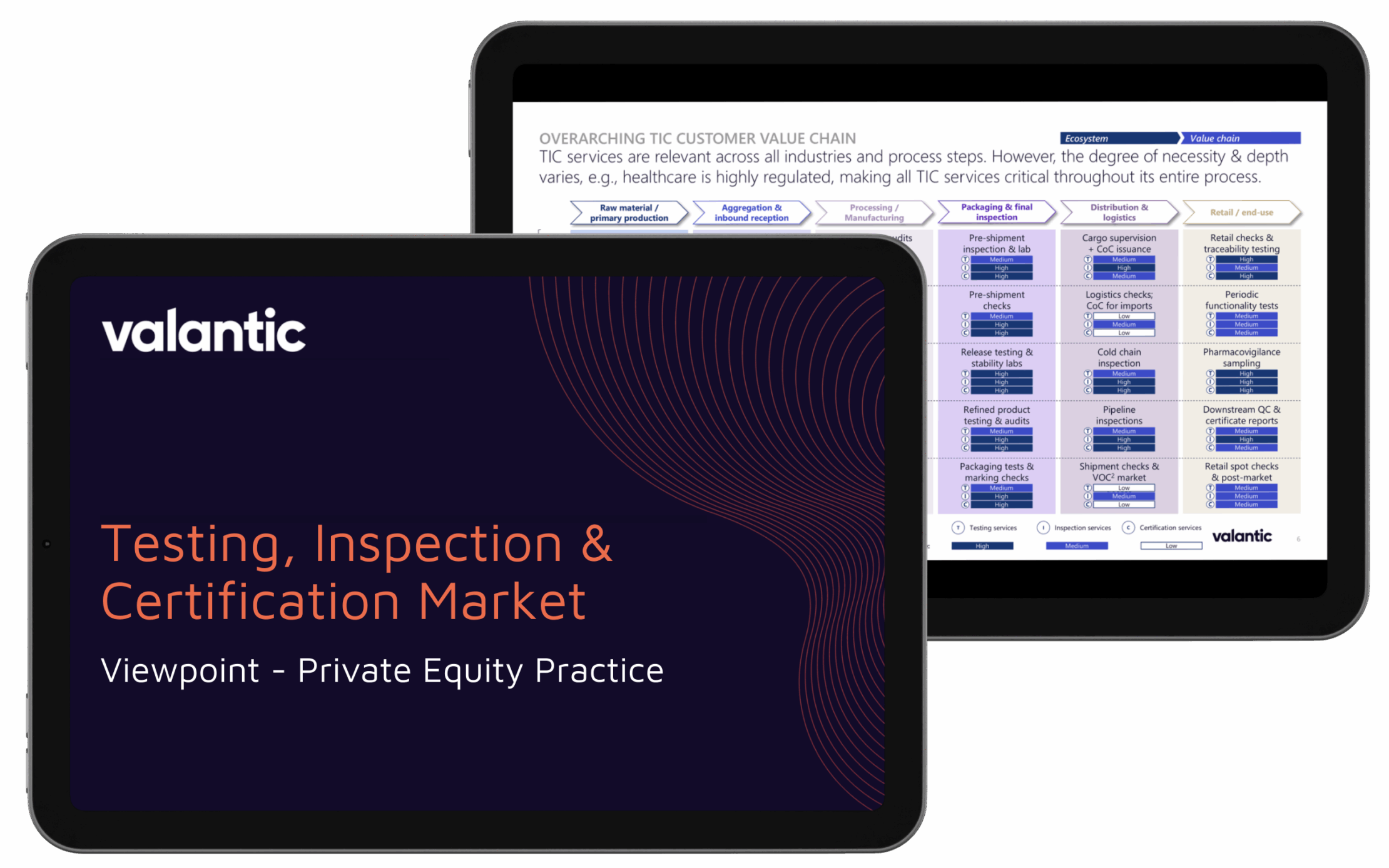
This is an excerpt of our viewpoint on the Testing, Inspection & Certification Market. Get in touch if you would like to learn more about the market dynamics, business model, competitive landscape, and growth drivers in this market.

~300bnEUR
Global TIC market size in 2024.
~53%
Outsourced Share of global TIC services.
~65%
Testing’s contribution to outsourced TIC market revenue in 2024.
Executive Summary
The global TIC market, valued at approximately 300bnEUR in 2024, is projected to grow at a CAGR of 4–6% through 2030 due to increasing regulatory complexity and demand for sustainability-related certifications. Approximately 53% of TIC services are outsourced to third-party providers, driven by cost-efficiency and scalability advantages over in-house operations. The market is highly fragmented with a substantial long tail of smaller TIC providers accounting for ~70% of the outsourced TIC market, leaving consolidation opportunities in a fragmented landscape with lead providers such as SGS, Bureau Veritas, or TÜV Rheinland.
Digital transformation is a pivotal growth driver, as IoT and AI adoption accelerates demand for real-time monitoring and predictive-analytics-based TIC solutions across sectors such as energy, healthcare, and consumer goods. Sustainability trends further amplify growth as industries seek ESG-aligned certifications to meet global standards. This creates attractive investment opportunities in emerging high-growth areas such as renewable energy and cybersecurity-related certifications, while traditional sectors like manufacturing and food & agriculture continue to provide steady, compliance-driven TIC demand.
Regulation, sustainability and digitalization underpin resilient, long-term TIC demand across industries
A highly fragmented landscape with a long tail of specialists offers strong consolidation potential.
New digital and ESG-driven services complement stable, compliance-led demand in core TIC sectors.

Jan Dingerkus
valantic Partner
”The TIC market thrives on regulatory complexity. Demand is set to rise as industries embrace stricter standards.“
The Testing, Inspection, and Certification market is undergoing a transformation driven by digitalization and sustainability. The adoption of IoT and AI technologies is enabling real-time monitoring, predictive analytics, and automation, which are improving efficiency across industries such as healthcare, energy, and consumer goods. Sustainability trends are pushing demand for ESG certifications as companies prioritize carbon reduction and supply chain transparency. Additionally, globalization of trade and stricter regulatory frameworks are amplifying the need for consistent quality assurance standards worldwide. These trends highlight the TIC sector’s pivotal role in ensuring compliance, safety, and sustainability in a rapidly evolving global economy.
Key Takeaways:
Regulatory complexity remains a key structural driver of growth in the TIC market. Stricter global regulations around safety, sustainability, and product quality are compelling businesses to invest heavily in compliance measures. In sectors like energy and food safety, adherence to international standards is critical to avoid penalties or loss of market access. Additionally, ESG-focused policies are fueling demand for green certifications in renewable energy projects and sustainable supply chains. The increasing fragmentation of supply chains further necessitates robust testing solutions to ensure conformity across borders. These factors collectively reinforce the market’s reliance on third-party TIC providers to meet evolving regulatory expectations efficiently.
Key Takeaways:

The TIC sector is highly fragmented, with the top 14 players capturing only around 30% of the outsourced market while smaller providers account for the remaining ~70%. Leading firms like SGS, Bureau Veritas and TÜV Rheinland operate across multiple industries with end-to-end service offerings, while specialized players excel in depth with more focused exposure to specific industries or regions. This fragmentation creates significant opportunities for consolidation, with the long tail in particular showing strong M&A activity to acquire specialized capabilities or expand into high-growth regions. At the same time, the competitive dynamics highlight opportunities for differentiation through digital innovation and advanced service portfolios that cater to emerging trends such as cybersecurity and sustainability-related certifications.
Key Takeaways:

Outsourcing accounts for approximately 53% of global TIC services due to its cost efficiency and scalability compared to insourced solutions (47%). Testing dominates outsourced revenues (65%), followed by inspection (25%) and certification (~10%). Outsourced providers leverage global networks, advanced tools, and standardized processes to offer scalable solutions that help businesses navigate complex regulatory landscapes efficiently. In contrast, insourced models are often chosen by cost-sensitive industries or those requiring complete control over proprietary processes. As businesses increasingly prioritize flexibility over fixed costs, outsourcing is expected to grow further—especially in sectors requiring multi-country regulatory compliance or specialized expertise.
Key Takeaways:

Emerging industries such as renewable energy certifications, cybersecurity solutions, and green building materials represent significant growth opportunities within the TIC market. As environmental regulations tighten globally under frameworks like the Paris Agreement or EU Green Deal, companies are increasingly seeking third-party validation of their sustainability initiatives through carbon footprint analysis or supply chain audits. Furthermore, digital transformation is opening new niches such as IoT-based monitoring systems that enable proactive risk management across industries like manufacturing or logistics. Strategic M&A activity targeting specialized firms with expertise in these areas will be critical for capturing value in high-growth segments.
Key Takeaways:

Want the full breakdown? The full viewpoint on the Testing, Inspection & Certification Market is available on request. The typical scope includes market size, market trends & drivers, competitive landscape, competitor groups, competitor benchmarks, explanation of the business model.

Jan Dingerkus
Partner & Managing Director
Private Equity Practice

Christoph Nichau
Partner & Managing Director
Private Equity Practice

Khalid Ouaamar
Managing Director
Private Equity Practice