Highlight

Successful together – our valantic Team.
Meet the people who bring passion and accountability to driving success at valantic.
Get to know usvalantic Viewpoint
The social care software market is experiencing robust growth, driven by demographic shifts, regulatory complexity, and increasing digital adoption. The market is highly fragmented, with significant opportunities for consolidation and regional expansion.
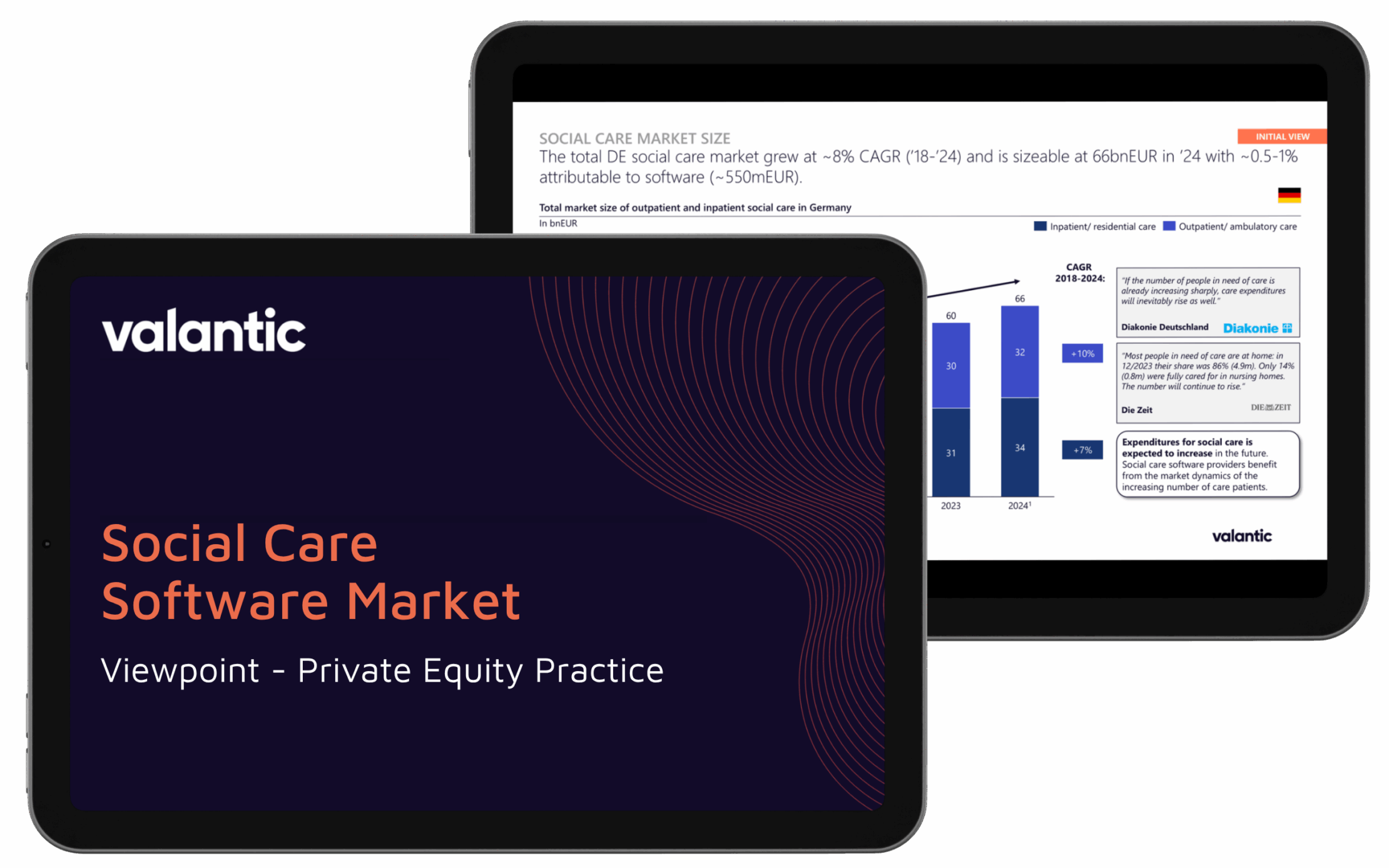
This is an excerpt of our viewpoint on the social care software market. Get in touch if you would like to learn more about the market dynamics, business models, competitive landscape, and growth drivers in this market.

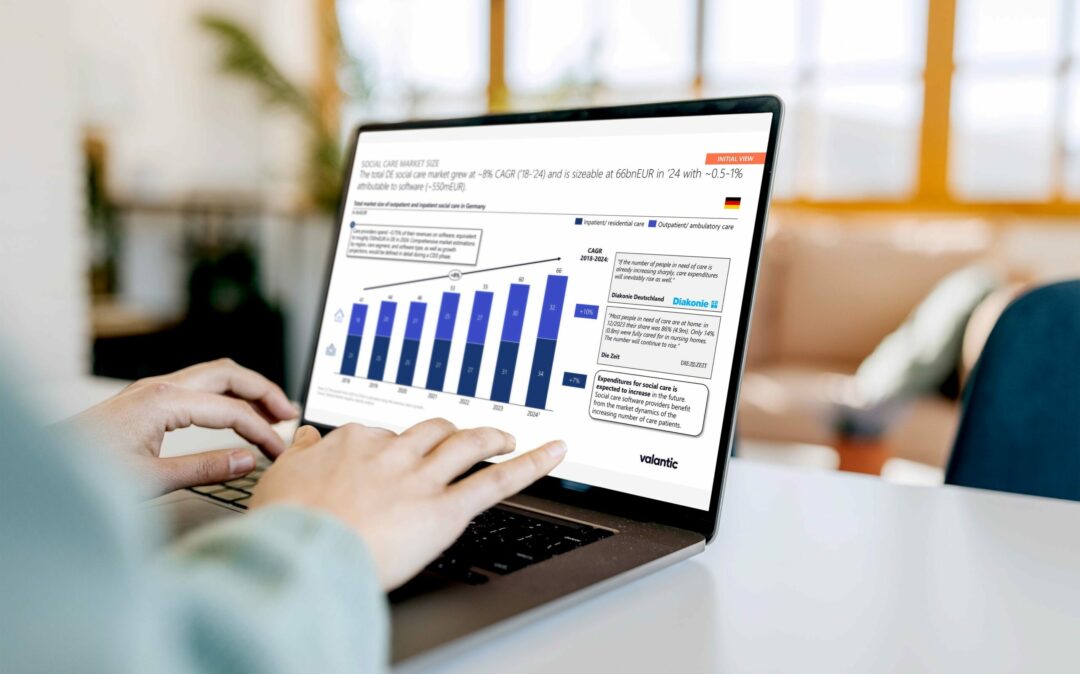
~8% CAGR
Growth rate of Germany’s social care market (2018–2024)
~550mEUR
Estimated size of the German social care software market by 2024
~85%
Share of German care patients receiving home-based care as of December 2023
Executive Summary
Social care software supports care organizations in managing everyday tasks such as documenting care activities, planning schedules, and creating reports.
The social care software market has been growing steadily, with Europe showing strong potential due to its aging population and increasing regulatory complexity. The German social care market alone grew at ~8% CAGR from 2018 to 2024, reaching a value of approximately 66 bnEUR in total expenditures. However, only about 0.75% of these revenues are currently allocated to software solutions, representing untapped potential for technology providers. The industry remains fragmented due to diverse regional regulations that create scalability challenges for providers.
Leading players typically adopt acquisition-led strategies to expand geographically while developing add-on modules and features that function as all-rounders and can be upsold across regions and customer segments. As digital adoption accelerates due to workforce shortages and compliance demands, opportunities exist in areas such as telecare solutions and AI-driven automation tools. Investors can leverage these trends by backing firms with strong customer lock-in mechanisms and scalable product portfolios.
Aging populations are driving long-term demand growth across Europe.
Fragmented regulations limit cross-border scalability but create local specialization opportunities.
Digital adoption is accelerating due to workforce shortages and compliance complexities.

Khalid Ouaamar
valantic Managing Director
”Regulatory diversity makes localized solutions essential but also creates opportunities for tailored product offerings.“
The social care software market is significantly shaped by demographic shifts, including a rapidly aging population and rising mental health challenges across Europe. In Germany alone, by 2035 roughly net 3 million additional people aged 65+ are expected, and countries such as Italy and France are experiencing similar growth in their elderly populations. These trends are driving demand for both professional care services and technology solutions that enhance operational efficiency. Workforce shortages further accelerate digital adoption, with care providers seeking tools to automate workflows and reduce administrative burdens. Additionally, regulatory frameworks across Europe are encouraging digital-first solutions to ensure compliance with complex documentation and reporting standards.
Key Takeaways:
Regulatory requirements remain a key driver of software adoption in the social care sector, as compliance becomes increasingly complex across Europe. For example, Germany’s §113 SGB XI enforces digital documentation standards for elderly care, while Finland’s Client Data Act (703/2023) mandates interoperability in IT systems. These regulations create opportunities for software providers offering compliant solutions tailored to national requirements. Meanwhile, advancements in AI are enabling automation of repetitive tasks like documentation and reporting, which reduces administrative workloads and enhances operational efficiency. With ongoing workforce shortages, automation tools are becoming critical in ensuring continuity of care delivery across regions.
Key Takeaways:

The competitive landscape for social care software remains fragmented due to diverse regional regulations and localized needs across Europe. Key players fall into four categories: end-to-end suite providers offering comprehensive solutions; specialist vendors excelling in specific domains; general health IT firms extending into social care; and cross-industry providers like ERP vendors with limited sector adaptation. Leading firms adopt acquisition-led strategies to expand geographically while addressing local regulatory challenges. For instance, integration challenges often prevent full product consolidation, making modular solutions essential for scalability across borders. This fragmented environment creates opportunities for firms capable of balancing regional specialization with broader scalability.
Key Takeaways:

Social care software providers primarily operate on subscription-based SaaS models complemented by licensing fees and project revenues from implementation services. Modular add-ons enable scalable solutions tailored to different regions’ regulatory requirements while increasing customer retention through product stickiness. For example, telecare platforms or quality management modules address specific needs across various segments such as elderly or youth care while enhancing operational efficiency. Providers often rely on partner ecosystems for non-core functionalities like recruiting or training integrations but maintain independent platforms as their core value proposition. This modular approach ensures flexibility while driving upselling opportunities across multiple customer segments.
Key Takeaways:

Key growth levers in the social care software market include geographic expansion via acquisitions, product innovation through adjacent modules, and entry into new customer segments such as mental health or rehabilitation services. For example, acquisitions remain vital for entering markets like France or Italy where regulatory expertise is critical for success. Product enhancements such as AI diagnostics or telecare solutions further differentiate providers from niche competitors while creating upselling opportunities within existing regions. Additionally, expanding into adjacent segments allows firms to leverage existing infrastructure to tap into new addressable markets effectively without significant structural changes.
Key Takeaways:

Want the full breakdown? The full viewpoint on the Social Care Software Market is available on request. The typical scope includes market size, market trends & drivers, competitive landscape, competitor groups, competitor benchmarks, explanation of the business model.

Christoph Nichau
Partner & Managing Director
Private Equity Practice

Jan Dingerkus
Partner & Managing Director
Private Equity Practice

Khalid Ouaamar
Managing Director
Private Equity Practice