Highlight

Successful together – our valantic Team.
Meet the people who bring passion and accountability to driving success at valantic.
Get to know usImagine that your business had a central location for all data—structured and unstructured, from SAP and non-SAP systems, integrated, qualified, and ready for real-time AI applications. That's exactly what SAP Business Data Cloud (BDC) promises. But is it really the game-changer you are hoping for, or just another name in the SAP universe?

54 %
see SAP BDC as a strategic element in data management
Data strategy is no longer optional; it's the key to the future viability of today's businesses, for anyone who wants to use generative AI productively and create value needs a consolidated database. That’s exactly where SAP BDC comes in: Instead of distributed data structures, it offers a consistent, semantically uniform data layer that functions across system boundaries. SAP BW, Datasphere & Co. were steps in this direction. However, SAP BDC is now changing the game, bringing together structured and unstructured data on a single platform.
With SAP Business Data Cloud, SAP combines key data functions in an open platform for the first time: Data integration, data modeling and data cataloging (SAP Datasphere), storage (SAP Object Store), analysis, planning & BI (SAP Analytics Cloud), and control (SAP BDC Cockpit) interact. It’s not just the combination that’s new, but above all the claim: There is now a harmonized, semantic data model across all sources.
SAP Business Data Cloud
SAP BDC – pioneering data & analytics product suite
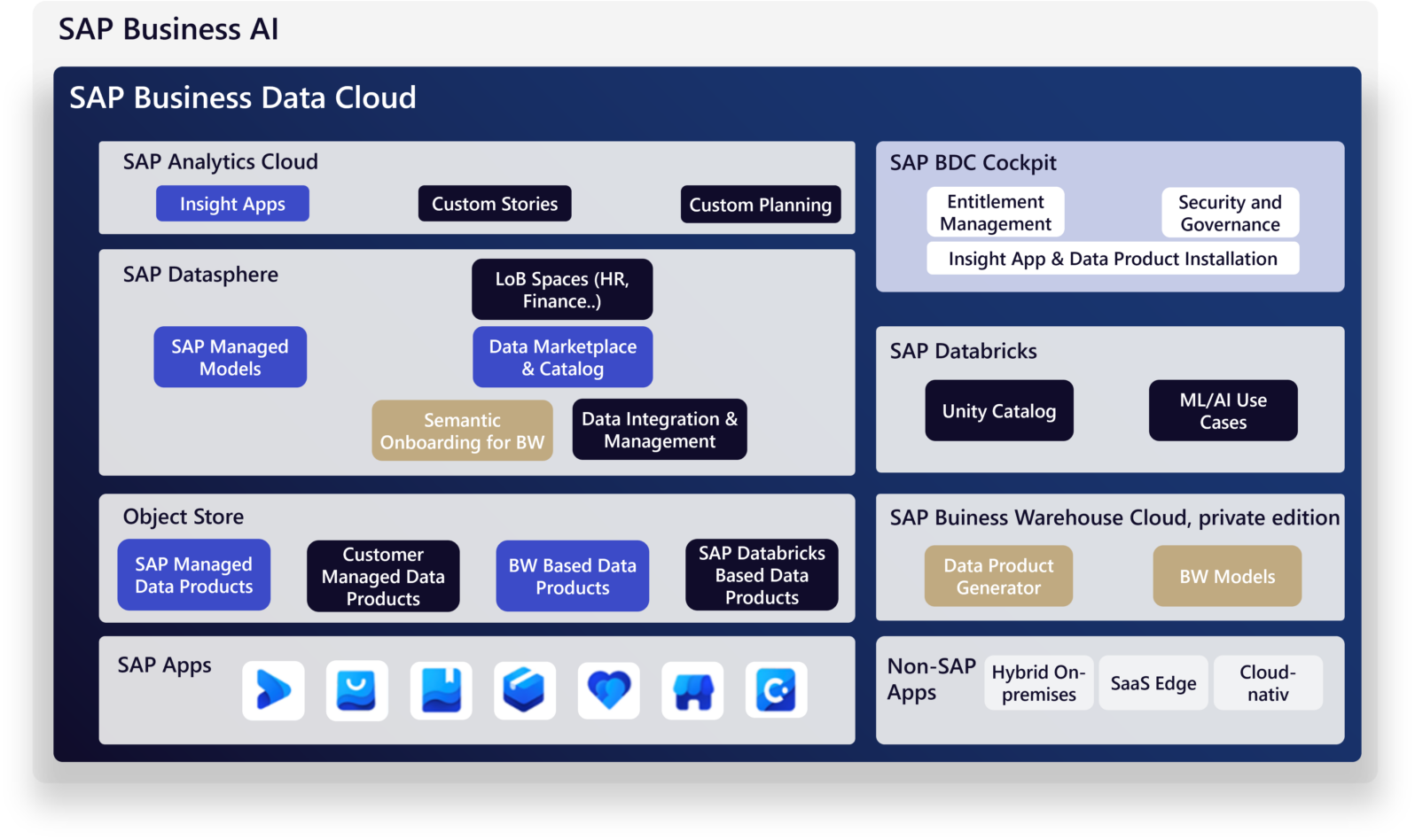
Source: SAP
SAP BDC has obviously hit a nerve. According to valantic’s SAP Study 2025, 54% of companies in the DACH region already see SAP BDC as an integral part of their future data architecture. Interest is particularly strong in the automotive industry (80%) and discrete manufacturing (59%).
Remarkable: Although SAP did not officially position Business Data Cloud as a strategic data platform until the beginning of 2025, 94% of the companies surveyed are already familiar with SAP BDC. That’s a clear sign of how strongly the topic resonates in the market.
Despite high approval, there are hurdles: In recent years, companies have invested in SAP Datasphere, SAP BW/4HANA or alternative platforms such as Snowflake. Today, 40% of respondents already use comparable solutions from other vendors.
SAP must therefore do two things: First, it must clearly differentiate itself from the competition, and second, provide a pragmatic migration path for existing customers.
What’s emerging today is the foundation for a new data logic: In the future, SAP services and SAP products will not require data transfer between different systems. Instead, they will access a common persistence layer. This eliminates the need to move data because it is delivered right where it is needed from the very start. This idea has clear advantages: Fewer redundancies, less storage, easier integration, and a significantly reduced data footprint. Especially in times of growing regulatory requirements and rising sustainability expectations, this architectural approach is becoming increasingly relevant.
SAP Business Data Cloud is more than a new label. It’s the answer to the biggest challenges of modern data architectures, such as fragmented data silos, lack of transparency, and lack of AI readiness. It offers not only technology, but a strategic architectural promise.
For IT decision-makers, this means that anyone who wants to not only test generative AI but also use it productively should take SAP BDC into account. It integrates existing systems and creates new degrees of freedom for data access and use, laying the foundation for real value creation in the AI age.
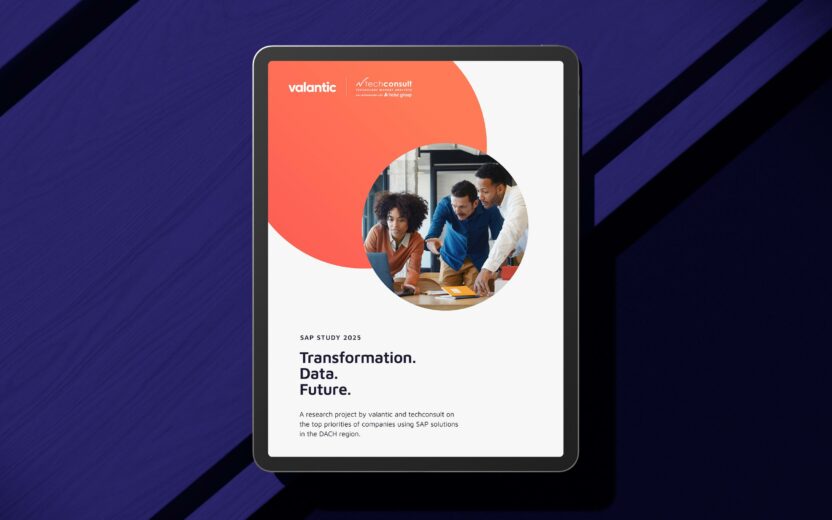
valantic SAP Study 2025
Since 2018, valantic has been surveyed top-class SAP experts about investment intentions and relevant business opportunities. Every year, valantic puts its finger on the pulse of the SAP community in the DACH region to find out where companies using SAP solutions currently stand in their digital transformation process, what course they are setting for the future, and what tasks they still have to complete.