Highlight

Successful together – our valantic Team.
Meet the people who bring passion and accountability to driving success at valantic.
Get to know usvalantic Viewpoint
Explore the dynamic Pharma Cold Chain Market, shaped by biopharma innovation, globalization, and regulatory pressures.
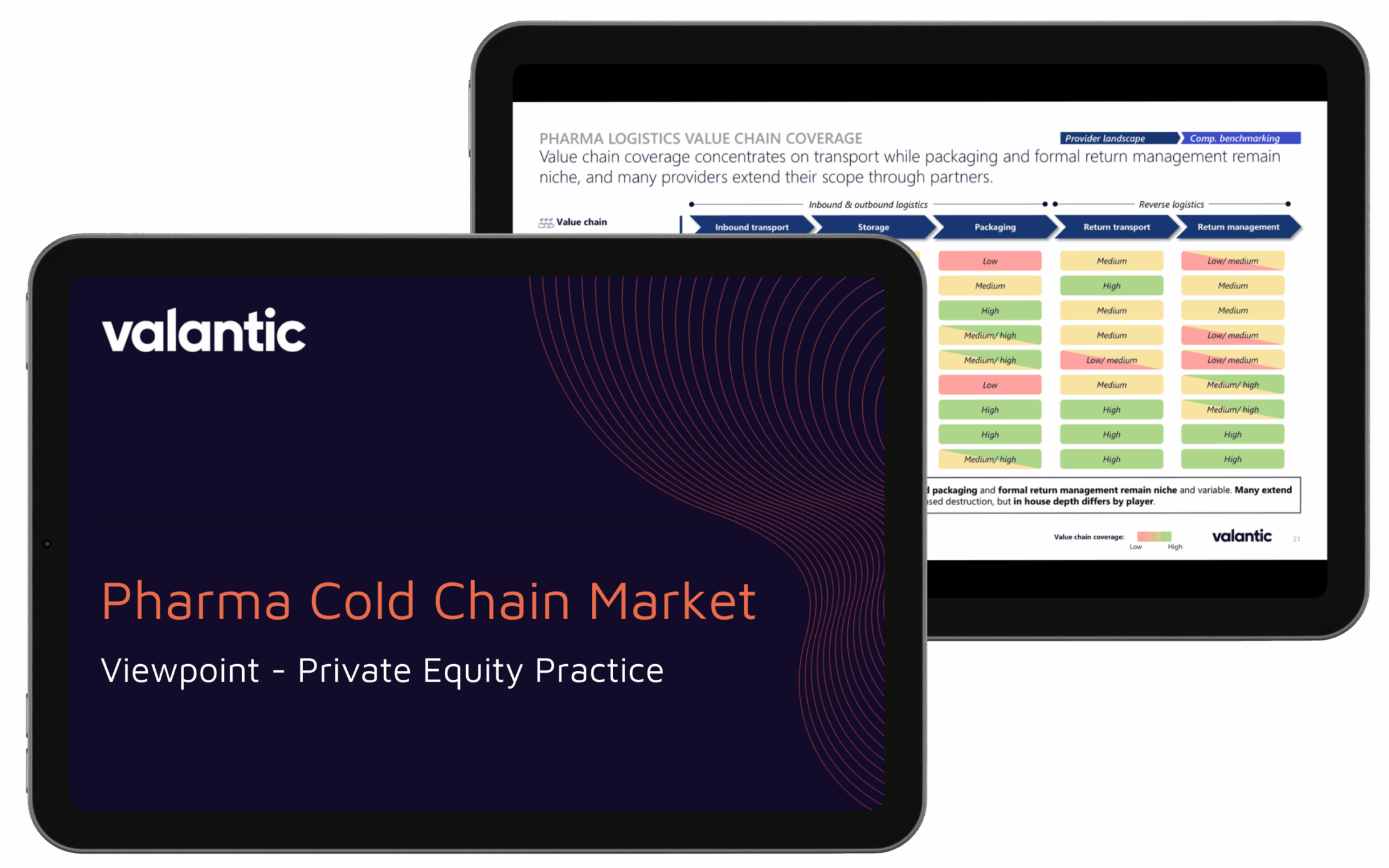
This is an excerpt of our viewpoint on the Pharma Cold Chain Market. Get in touch if you would like to learn more about the market dynamics, business model, competitive landscape, and growth drivers in this market.

~14% CAGR
for global cold chain market value (2019–2024)
~90%
of pharma shipments rely on air and ground transport
~7%
of EU freight turnover
Executive Summary
The pharma cold chain market is experiencing robust growth due to increasing biopharma innovation, globalization, and stricter regulations. This sector accounts for approximately 7% of Europe’s freight turnover, with pharmaceuticals contributing around 10–15% of total cold chain logistics. Industry players are leveraging air and ground transport solutions to meet the growing demand for temperature-sensitive biologics and advanced therapies.
Additionally, regulatory frameworks like GDP compliance drive adoption of high-value services such as active containers and controlled temperature shipments. Competitive dynamics reveal a fragmented landscape with specialized players offering niche services alongside global integrators expanding their healthcare capabilities. The market’s expansion is further supported by trends in warehouse outsourcing and rising adoption of innovative packaging technologies.ess spans high-growth digital models and resilient compliance-driven services.
Pharma cold chain market grew at ~14% CAGR from 2019–2024 due to biologics demand.
Air freight remains dominant for high-value shipments requiring tight temperature control.
Stricter GDP compliance drives adoption of active containers and premium services globally.

Khalid Ouaamar
valantic Managing Director
”Globalization accelerates cross-border complexity in the pharma cold chain ecosystem, favoring established networks.“
The pharma cold chain market is expanding rapidly, fueled by biopharma innovation and increasing demand for temperature-sensitive therapies. Global cold chain pharmaceutical sales grew at approximately 14% CAGR between 2019 and 2024, driven by biologics penetration, injectable formats, and advanced therapies like cell and gene treatments. Regulatory frameworks such as GDP compliance further accelerate market development by enforcing stricter quality standards. Additionally, globalization and manufacturing offshoring have increased the reliance on robust international air freight networks to ensure consistent temperature control across borders. While biologics dominate the market, there is also a shift toward advanced passive container solutions for cost-conscious lanes.
Key Takeaways:

Strong biopharma pipelines and regulatory pressures are the primary drivers of growth in the pharma cold chain market. The rise of high-value therapies such as mRNA vaccines and radiopharmaceuticals necessitates specialized logistics solutions like active containers with powered temperature control. Regulatory standards like GDP compliance push pharmaceutical companies to adopt premium services for controlled temperature shipments, ensuring quality throughout distribution. Emerging markets are also showing increased adoption of high-value logistics solutions, with new regulations expected to create additional opportunities in regions such as Latin America.
Key Takeaways:

The competitive landscape in the pharma cold chain market is shaped by specialization levels and international reach, with providers clustering into four distinct strategic groups.
Specialist pharma couriers such as trans-o-flex, Life Couriers, SK Pharma Logistics, PHSE, Santrans, and MED X PRESS focus on high-precision, time-critical and GDP-compliant services for clinical trials, radiopharma, and high‑value therapies.
Packaging and container specialists, including Envirotainer, CSafe Global, va-Q-Tec, Peli Biothermal, Softbox, SkyCell, Cold Chain Technologies, Tower Cold Chain and Dokasch, provide validated active and advanced passive solutions with global service support.
Healthcare end-to-end logistics providers like Cencora World Courier, BOMI Group, Movianto and Eurotranspharma manage comprehensive healthcare supply chains across warehousing, value-added services, and premium transport.
Global generalist logistics providers such as DHL, UPS, FedEx, DB Schenker, GLS, Hermes and DPD leverage their international networks to handle cross‑border complexity, while pharma remains a smaller, specialized segment in their broader portfolios.
Ongoing M&A, including acquisitions by DHL and UPS Healthcare, continues to drive consolidation and capability expansion across these groups.
Key Takeaways:

Pharma cold chain logistics require tailored solutions across inbound transport, storage, packaging, reverse logistics, and return management. Providers must meet stringent GDP-certified requirements while maintaining operational complexity due to cross-border flows and numerous handovers. Active containers with powered temperature control dominate long-haul routes, while advanced passive options cater to cost-sensitive lanes. Warehousing outsourcing is increasingly adopted by MedTech/pharma companies to reduce costs and leverage specialized service providers’ expertise.
Key Takeaways:

The pharma cold chain landscape offers significant growth opportunities through organic levers such as cross-selling premium services to existing clients or ramping up volumes with key accounts. Inorganic levers include M&A activity targeting regional specialists or capability-driven acquisitions that enhance service portfolios. Advanced packaging technologies such as phase-change materials enable scalable operations but require upfront investment in infrastructure. Despite these opportunities, margin pressures remain a challenge due to rising energy costs and labor inflation.
Key Takeaways:

Want the full breakdown? The full viewpoint on the Pharma Cold Chain Market is available on request. The typical scope includes market size, market trends & drivers, competitive landscape, competitor groups, competitor benchmarks, explanation of the business model.

Khalid Ouaamar
Managing Director
Private Equity Practice

Christoph Nichau
Partner & Managing Director
Private Equity Practice

Jan Dingerkus
Partner & Managing Director
Private Equity Practice