Highlight

Successful together – our valantic Team.
Meet the people who bring passion and accountability to driving success at valantic.
Get to know usvalantic Viewpoint
Rising sick-leave rates, underinvestment, and regulatory mandates are driving scalable opportunities in Occupational Health & Corporate Wellbeing.
This is an excerpt of our viewpoint on Occupational Health & Corporate Wellbeing. Get in touch if you would like to learn more about the market dynamics, business model, competitive landscape, and growth drivers in this market.

~79%
Prevention awareness across demographics
+6% CAGR
in German sick-leave rates (2019–2024)
~17%
of the required prevention spending is currently being invested.
Executive Summary
The Occupational Health & Corporate Wellbeing market is experiencing strong structural tailwinds due to rising sick-leave rates, increasing mental health burdens, and stricter compliance requirements for employers. German firms currently underinvest in prevention and wellbeing solutions, leaving a significant monetizable gap for scalable solutions like digital wellbeing platforms and hybrid providers. Meanwhile, regulation-driven demand ensures stable revenue streams for occupational health providers offering mandated services such as medical check-ups and risk assessments.
The competitive landscape remains fragmented, with few scaled integrators combining digital wellbeing, mental health, and occupational health services into unified ecosystems – creating opportunities for consolidation strategies. As employers increasingly recognize the ROI of workplace health programs, investment attractiveness spans high-growth digital models and resilient compliance-driven services.
German employers invest far below the required amount for effective prevention solutions, leaving a large monetizable gap.
Regulation-driven occupational health services provide stable revenue streams with limited cyclicality amid increasing mandates.
Scalable digital wellbeing platforms gain traction as mental-health burdens rise across industries globally.

Khalid Ouaamar
valantic Managing Director
”Employers increasingly view workplace health as essential unlocking value through reduced absenteeism and productivity gains.“
The Occupational Health & Corporate Wellbeing market is experiencing strong growth due to structural factors like rising sick-leave rates, increasing mental health burdens, and demographic shifts such as aging workforces. Employers are responding to these trends by expanding workplace health programs, driven by both economic incentives and regulatory mandates. The digital transformation of health models has further accelerated adoption, with platforms offering scalable solutions through analytics, virtual coaching, and hybrid delivery models. Awareness of prevention has risen significantly, with 79 % of individuals reporting increased focus on wellbeing since 2020. These developments have created a favorable environment for scalable solutions, particularly in digital wellbeing and mental health platforms.
Key Takeaways:
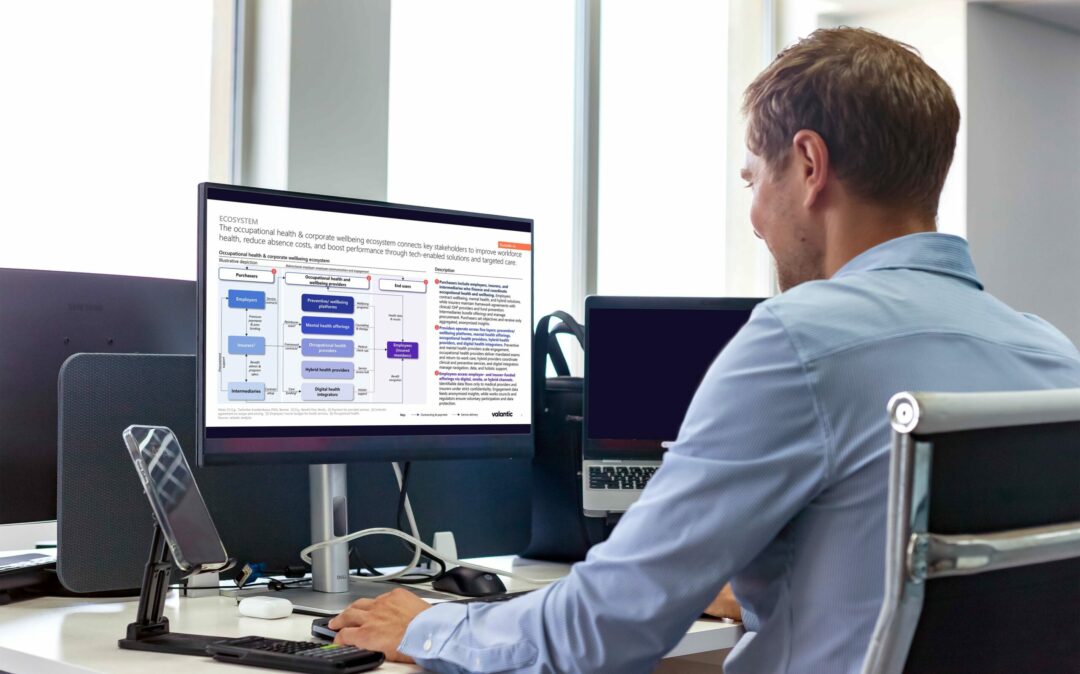
The market is characterized by a significant underinvestment gap, with employers spending only ~40–60 EUR on average per employee annually compared to the ~350 EUR that would need to be invested to achieve measurable outcomes. This gap presents clear opportunities for investors to capture value through scalable preventive and mental health offerings. Regulation further drives non-discretionary spending as stricter occupational-safety laws mandate compliance-linked services. Additionally, §20 SGB V establishes a legal basis and obligation for health insurers to fund workplace health promotion projects. Far more costs could actually be covered under §20 SGB V than are currently being utilized. The economic rationale for adoption is strong: corporate wellbeing programs yield +11 % productivity uplift and ~40 % lower turnover rates, reinforcing their value proposition for employers seeking sustainable growth and reduced absenteeism costs.
Key Takeaways:

The Occupational Health & Corporate Wellbeing market is structured around five distinct provider segments, each with different roles, economics, and scaling dynamics. Preventive and wellbeing platforms such as ClassPass, Sodexo, Wellhub, HUMANOO, Urban Sports Club, Vitality, and Benefit Systems focus on fitness, lifestyle, and engagement. They typically operate digital, subscription-based models with broad partner networks and differentiate via user experience and analytics.
Mental health offerings, including OpenUp, Unmind, ComPsych, Headspace Health, and Lyra Health, provide counseling and therapy via hybrid digital models, combining PEPM subscriptions with per‑use fees and competing on access, clinical quality, and measurable outcomes.
Occupational health services players like ias Gruppe, CorporateHealth, TELUS Health, B·A·D Gesundheitsvorsorge und Sicherheitstechnik, and Captain Safety deliver regulated on-site medicine, check‑ups, and return‑to‑work exams under fee‑for‑service or annual contracts, resulting in resilient but regionally bounded growth.
Hybrid health providers, for example Modern Health, Premise Health, PIMA Health Group, and Fresenius Helios, combine occupational medicine, preventive wellbeing, and mental health in coordinated hybrid models centered on continuity of care and holistic outcomes.
Finally, digital health integrators such as Personify Health, Optum, dacadoo, and WebMD Health Services aggregate multiple offerings into data‑driven ecosystems, acting as navigation hubs that orchestrate providers, manage engagement, and increasingly control the strategic interface to employers and employees.
Key Takeaways
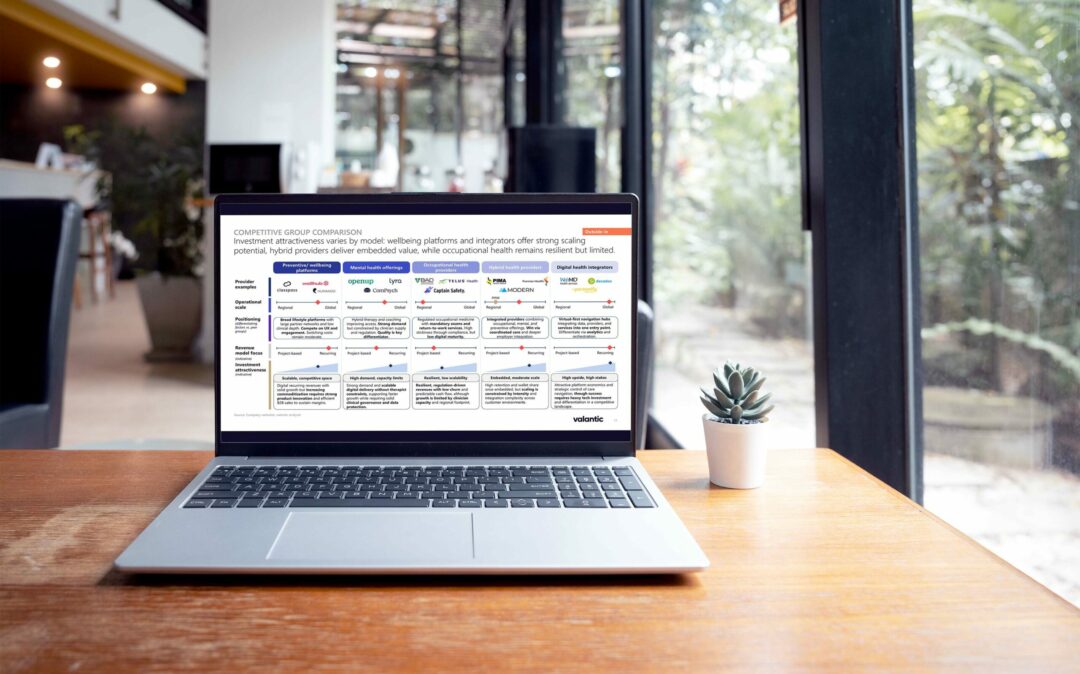
The Occupational Health & Corporate Wellbeing market is defined by recurring revenue models that ensure predictability and scalability across segments such as digital wellbeing platforms (PEPM subscriptions) and regulated occupational medicine (annual contracts). Preventive offerings leverage subscription-based engagement tools like fitness apps and counseling services, while hybrid providers integrate clinical care with digital navigation systems for seamless delivery across modalities. Revenue defensibility remains high due to regulation-driven demand tied to compliance mandates like ArbMedVV requirements in Germany. However, capacity constraints in clinician-led services limit scalability compared to digital-first models that exhibit lower marginal costs and higher margin expansion potential.
Key Takeaways:

Growth in the Occupational Health & Corporate Wellbeing market is fueled by structural gaps in employer spending. The potential to reduce absenteeism and its ~78bnEUR annual economic losses is likely to push employers to increase investment in prevention and corporate wellbeing. Some programs address these gaps through cost-effective delivery models that reduce absenteeism while enhancing productivity. Regulation continues to drive mandatory adoption of compliance-linked services, ensuring steady demand growth even during economic downturns. Consolidation strategies remain a key lever for achieving scale in this fragmented market, enabling investors to unlock synergies by combining regional service networks with scalable digital capabilities.
Key Takeaways:

Want the full breakdown? The full viewpoint on Occupational Health & Corporate Wellbeing is available on request. The typical scope includes market size, market trends & drivers, competitive landscape, competitor groups, competitor benchmarks, explanation of the business model.

Khalid Ouaamar
Managing Director
Private Equity Practice

Christoph Nichau
Partner & Managing Director
Private Equity Practice

Jan Dingerkus
Partner & Managing Director
Private Equity Practice