Highlight

Successful together – our valantic Team.
Meet the people who bring passion and accountability to driving success at valantic.
Get to know usvalantic Viewpoint
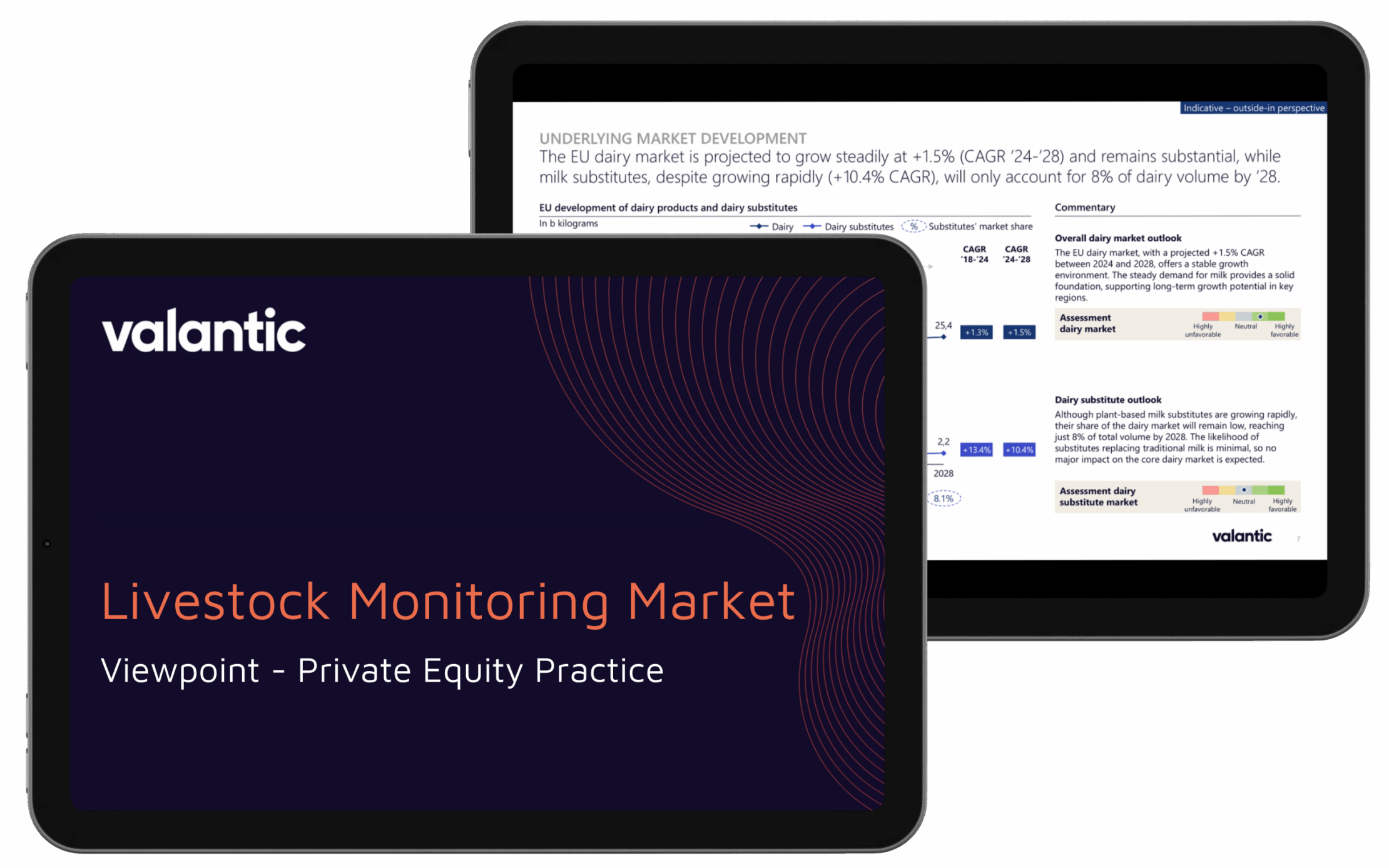
Livestock Monitoring is evolving rapidly, driven by technological advancements and shifting industry dynamics. Explore how leading players and emerging trends are reshaping farm efficiency and sustainability.
This is an excerpt of our viewpoint on Livestock Monitoring. Get in touch if you would like to learn more about the market dynamics, business model, competitive landscape, and growth drivers in this market.

~540000 Farms
Addressable TAM with high conversion potential
+2% CAGR
Global milk consumption through 2028
~3.7% CAGR
Growth of milk yields per cow globally
Executive Summary
Livestock Monitoring is witnessing significant growth as farms increasingly adopt precision technologies to enhance productivity and animal welfare. Industry-wide drivers include farm consolidation, higher milk production per cow, and regulatory pressures emphasizing sustainability. Solutions such as milking robotics, management software, and advanced health-tracking sensors are gaining traction among medium-to-large farms globally.
Competitive dynamics reveal market leaders focusing on integration while innovators push boundaries with AI-driven analytics. Typical business models range from hardware sales to SaaS subscriptions tailored for scalability across geographies and livestock verticals. Growth levers include expanded geographic coverage, new species applications, and advanced feature rollouts addressing pain points in herd management.
Farm consolidation drives demand for integrated monitoring solutions across regions.
Advanced analytics improve herd health while optimizing milk yield per cow globally.
Expanding into untapped geographies accelerates adoption of digital livestock tools.

Khalid Ouaamar
valantic Managing Director
”Farm consolidation amplifies demand for scalable livestock tracking solutions.“
The livestock monitoring market is undergoing a transformative shift, powered by digital solutions such as precision tracking and advanced analytics. Global dairy consumption continues to grow steadily at +2% CAGR through 2028, reinforcing the need for efficiency-driven technologies. Farm consolidation trends are creating larger herd sizes, amplifying demand for scalable and automated solutions. Additionally, sustainability pressures are encouraging farmers to adopt technology that enhances animal welfare while improving productivity. Solutions like intraruminal boluses and AI-driven health insights address these challenges by offering real-time data on herd health and performance. These advancements are helping farms achieve higher milk yields per cow while reducing disease prevalence and dependency on antibiotics.
Key Takeaways:

Efficiency improvements in farm management are driving the adoption of precision livestock monitoring solutions globally. Farmers face increasing feed costs and regulatory requirements that demand better animal health outcomes and sustainable practices. Higher milk yields per cow underscore the importance of data-driven health tracking to optimize production. Moreover, regulatory bodies across Europe have implemented stricter requirements around animal welfare, pushing farms toward adopting advanced technologies like smaXtec’s bolus system. These drivers collectively create a strong case for investing in scalable solutions that address operational pain points while improving herd health metrics.
Key Takeaways:
The competitive landscape in livestock monitoring is characterized by niche players specializing in precision tracking alongside large incumbents focused on milking robotics and management systems. Companies like smaXtec stand out with their advanced bolus technology that delivers unparalleled insights into herd health via real-time AI analysis. Meanwhile, incumbents such as Lely and GEA are leveraging their expertise in milking systems to expand into adjacent verticals but face barriers replicating the sophistication of intraruminal hardware. Strategic partnerships within the agtech space further intensify competition as diversified players integrate broader capabilities into their offerings. While incumbents remain influential due to scale, specialized providers dominate precision applications critical to farm efficiency gains.
Key Takeaways:

Livestock Monitoring solutions increasingly rely on hybrid business models combining hardware sales with SaaS subscriptions for long-term scalability. Providers like smaXtec offer intraruminal sensors paired with analytics platforms that generate actionable insights for farmers managing large herds. This model lowers implementation barriers by offering subscription-based access rather than high upfront costs, which remains a significant deterrent for smaller farms adopting digital tools. Integration into established Farm Management Information Systems (FMIS) further strengthens value propositions by ensuring compatibility across diverse farming operations globally. As data becomes central to decision-making in agriculture, these models enable providers to deliver continuous updates, predictive insights, and tailored recommendations that improve productivity over time.
Key Takeaways:

Significant growth opportunities exist within untapped geographies and new livestock verticals beyond dairy cattle. Expanding focus from DACH regions into North America or other mature dairy markets could unlock substantial potential given the rising demand for automation tools tailored to large-scale operations. Similarly, adapting existing technologies for other species such as pigs or sheep would broaden addressable markets while leveraging existing expertise in sensor development and analytics platforms. Additionally, ongoing feature innovation such as enhanced calving prediction or feeding optimization provides avenues for differentiating offerings further while addressing specific pain points faced by farmers globally. Together, geographic expansion and feature rollouts represent critical growth levers for scaling market presence effectively across regions and verticals alike.
Key Takeaways:

Want the full breakdown? The full viewpoint on Livestock Monitoring is available on request. The typical scope includes market size, market trends & drivers, competitive landscape, competitor groups, competitor benchmarks, explanation of the business model.

Khalid Ouaamar
Managing Director
Private Equity Practice

Christoph Nichau
Partner & Managing Director
Private Equity Practice

Jan Dingerkus
Partner & Managing Director
Private Equity Practice