Highlight

Successful together – our valantic Team.
Meet the people who bring passion and accountability to driving success at valantic.
Get to know us
Artificial intelligence is no longer just a promise of innovation, but a specific technology with clear business relevance. The proportion of companies that are already using AI as an integral part of their business processes now stands at 29%. Another 51% are using their first AI services in 2025, and the trend is still upward. In the previous year, the proportion of companies that dared to make their first attempts here was 26%. This demonstrates a significant increase in maturity compared to 2024, when most AI initiatives were still in the strategic planning phase.
These are the results of the current SAP Study 2025, which valantic conducted in cooperation with the research and analyst firm techconsult, surveying 201 business decision-makers from companies in the DACH region using SAP solutions.
The analysts at Gartner predict that by 2028, about one third of all enterprise software will be equipped with “agentic AI.” Agentic AI refers to AI agents working largely autonomously, which specialist users can adapt to their own challenges in order to increase their productivity, creativity, and efficiency. valantic largely concurs with Gartner’s assessment. However, success factors such as a high-quality database and intensive collaboration between business units are also important for turning AI into a true productivity and efficiency booster that generates real value for the entire company over the long term.
People who are using AI technologies are motivated above all by economic drivers. Process acceleration and cost savings are cited as the main motives by 51% of the participants of the valantic SAP Study 2025. Improved problem analysis (44%), safeguarding the future (42%), and targeted relief for employees (39%) also underscore that AI is perceived as a strategic lever for transformation in the SAP world.
According to the announcement at the last SAP Sapphire 2025 event in Orlando in May, SAP’s own AI assistant, Joule, is increasingly being integrated into all SAP cloud products – from SAP Analytics Cloud to SAP S/4HANA Public & Private Cloud and SAP SuccessFactors. Some of the most important Joule agents that are already ready for use are:
Sales & Service (Q2/2025)
Supply Chain (expected Q4/2025)
Spend Management (expected Q4/2025)
Finance & HR (expected Q3‑Q4/2025)
At Sapphire 2025, SAP announced that more than 34,000 customers are currently using SAP AI, an increase of 26% over the previous year. This includes companies such as Bosch, Goodyear, Samsonite, and Vodafone. With SAP Joule for Developers, Bosch has increased the productivity of its SAP programmers by 10% and reduced the costs for service scenarios by 70%. In addition, Joule for Developers enables service requests to be processed 30% faster, reducing the time previously required by about a third.
With its CX Agent, Bosch classifies millions of service tickets per year and forwards the requests to Sales Support, Technical Support, and Developer Support. The accuracy of the assignment has improved by 35% due to the use of the CX agent.
Another example from corporate practice: Vodafone has managed to create a uniform user experience across all business applications with its digital assistant AskHR, powered by Joule. AskHR answers 68% of all inquiries independently without the need for HR to act.
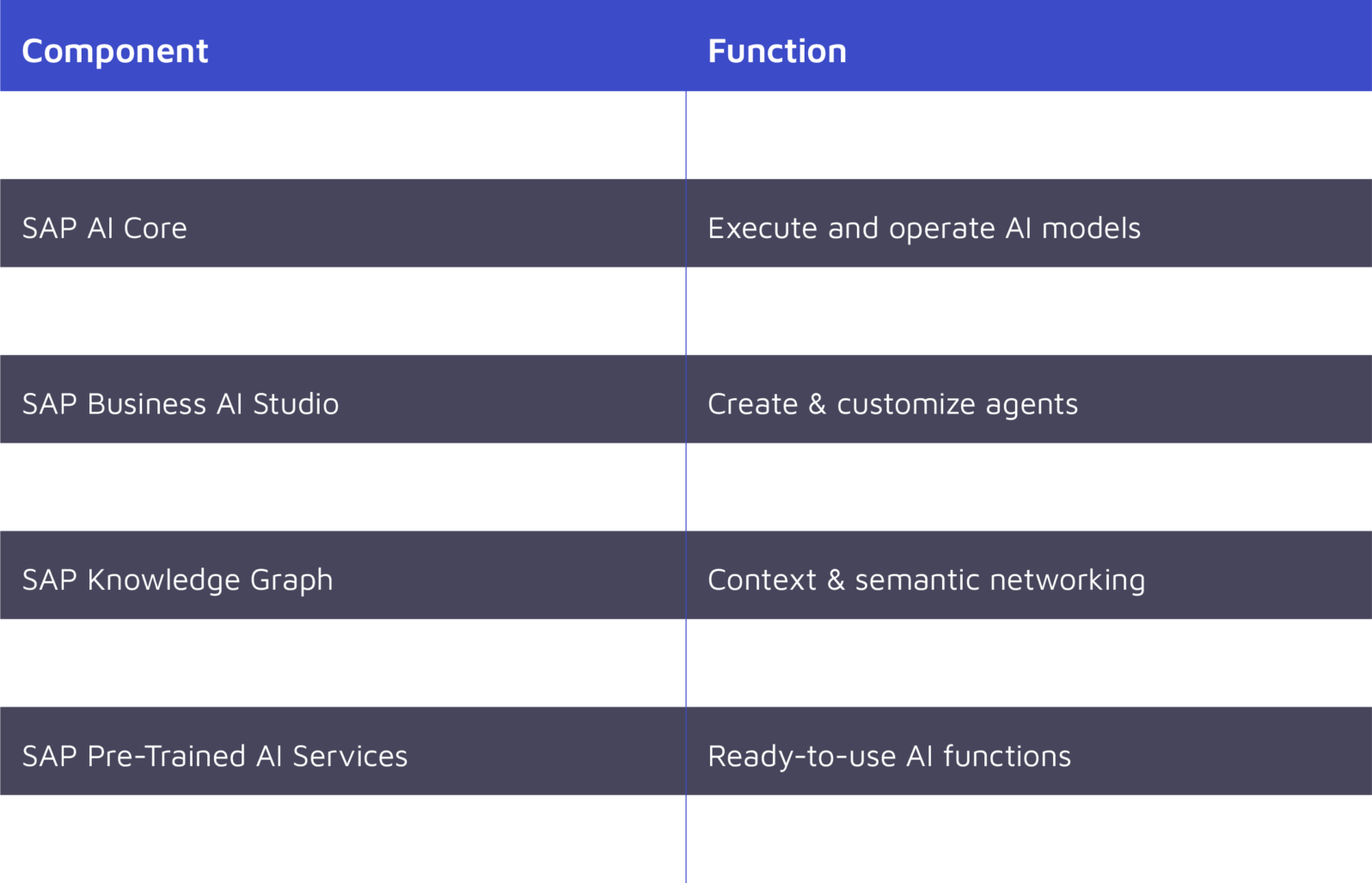
SAP AI Foundation, part of the SAP Business Technology Platform (BTP), is the comprehensive operating platform for AI in SAP environments. It combines models, workflows, data connectivity, and developer tools in an integrated platform to roll out AI-based solutions across the company. SAP AI Foundation includes a Generative AI Hub and the AI Launchpad, which allow developers to access a variety of large models (OpenAI, Meta Llama, Mistral, etc.), training infrastructure, and prompt tools – fully integrated into SAP environments.
The SAP AI stack at a glance
Artificial intelligence, however, is not just technology, but much more. Cross-departmental collaboration between specialist departments, technical and data teams is essential for the success of AI. Data silos must be dissolved and consolidated into a quality-assured, up-to-date data foundation. SAP has created a very good foundation for this with its recently introduced SAP Business Data Cloud (BDC).
Finally, it is important to anchor AI in the company’s long-term strategy and to provide it with specifically formulated goals (KPIs) that can measure progress. Last but not least, and this is perhaps the most important point, a company’s employees must be empowered to use AI in their daily work through training, AI support, and easy-to-use knowledge databases.

valantic SAP Study 2025
Since 2018, valantic has been surveyed top-class SAP experts about investment intentions and relevant business opportunities. Every year, valantic puts its finger on the pulse of the SAP community in the DACH region to find out where companies using SAP solutions currently stand in their digital transformation process, what course they are setting for the future, and what tasks they still have to complete.