Highlight

Successful together – our valantic Team.
Meet the people who bring passion and accountability to driving success at valantic.
Get to know usvalantic viewpoint
The HVAC (Heating, Ventilation & Air Conditioning) sector is structurally growing, service-led, and fragmented—offering prime ground for scalable investment platforms.
This is an excerpt of our viewpoint on the HVAC market. Get in touch if you would like to learn more about the market dynamics, business model, competitive landscape, and growth drivers in this market.

8%
CAGR for German non-residential HVAC sector from 2021 to 2025
90%
of EU buildings require HVAC upgrades by 2050
+50k
Local HVAC Providers across Europe
Executive Summary
The HVAC sector is seeing robust growth driven by structural market demand, favorable regulatory environments, and a fragmented competitive landscape conducive to consolidation. High-margin, recurring revenue streams emerge particularly from lifecycle services such as maintenance and system upgrades, significantly enhancing financial visibility and investor appeal.
Industrial segments—such as healthcare, pharmaceuticals, and data centers—command premium pricing due to complex requirements and mission-critical reliability needs. At the same time, escalating green regulations and skilled labor scarcity increase barriers to entry, positioning established, technically proficient HVAC providers as highly attractive targets for buy-and-build platforms aimed at regional consolidation and margin expansion through operational synergies.
Industrial HVAC segments generate high-margin, recurring revenues due to mission-critical systems and long-term contracts.
Strong regulatory incentives and subsidies reduce entry risk and improve investment timing certainty.
The fragmented HVAC market suits scalable buy and build platform strategies.


Jan Dingerkus
valantic Partner
”HVAC services offer stable, high-margin revenue in otherwise cyclical construction markets.“
Rising energy costs, labor scarcity, and ESG pressure are accelerating demand for smart HVAC systems with integrated controls, remote diagnostics, and predictive maintenance, shifting value toward service-heavy providers. In many Western European markets, replacement demand is becoming more predictable as installed systems reach end of life, supporting steady retrofit activity even when new construction slows. Data center expansion adds a second growth pocket, as operators require precise temperature and air-quality control paired with long-term service needs. Overall, these trends favor HVAC Buy and Build strategies that combine installation capability with recurring maintenance, monitoring, and automation to improve resilience and margin quality.
Key takeaways

Structural tailwinds are driven by tighter regulatory standards, rising temperatures, and the need to replace aging assets, all of which increase retrofit urgency across building portfolios. Climate targets and energy-efficiency requirements push building owners toward modern heating, ventilation, and cooling solutions, including heat pumps and improved indoor air quality. Public incentives accelerate decision-making by improving payback profiles and reducing upfront investment barriers. Meanwhile, persistent shortages of trained technicians and installers constrain capacity, extend project timelines, and raise the strategic value of scaled platforms with strong recruiting, training, and scheduling capabilities.
Key takeaways

Competitive Landscape: Fragmented providers enable HVAC Buy and Build consolidation
The HVAC market remains highly fragmented, combining global OEMs with a large base of local and regional service providers, which creates a wide consolidation funnel for Buy and Build investors. Global OEMs such as Daikin, Carrier, and Hitachi typically focus on equipment manufacturing and rely on partners for installation and lifecycle support. International platforms such as SPIE, Caverion, and Dussmann Group tend to cover broader service scopes, from planning and integration to long-term maintenance, and can act as consolidators. National specialists, including players such as Wolf, SEG, and AERO, often bring vertical depth or technical focus, while local installers such as Kältech, Frigotechnik, and DFKK represent the long tail of targets with narrower footprints.
Key takeaways

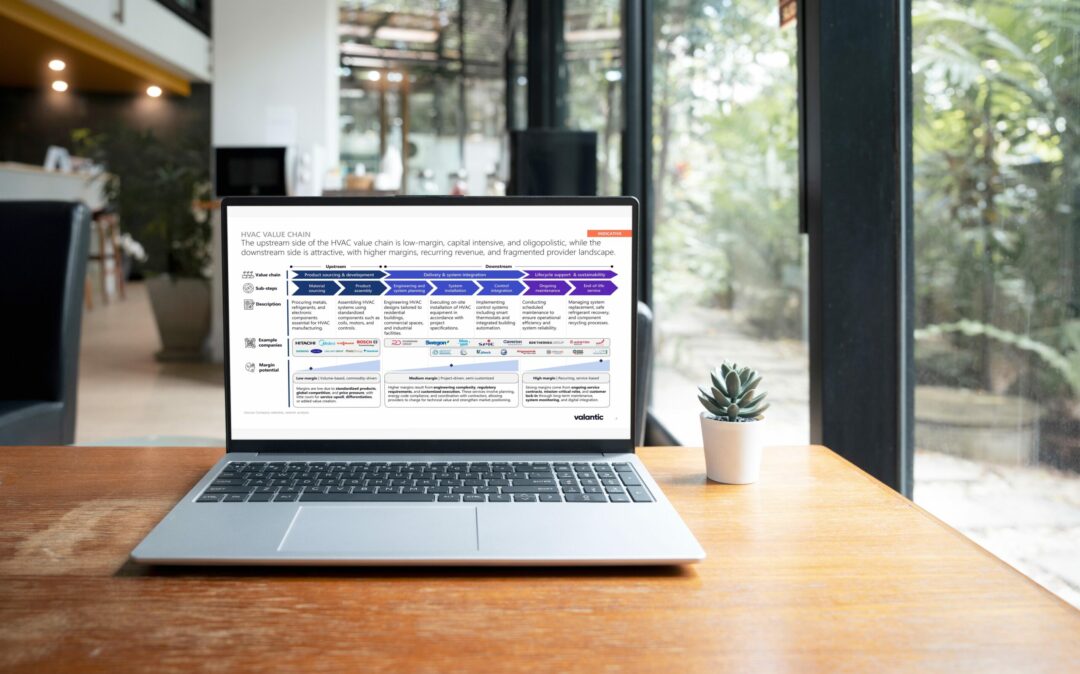
Across the HVAC value chain, upstream activities such as product sourcing and assembly tend to be more standardized and margin-pressured, while downstream engineering, integration, and lifecycle services are more defensible and typically more attractive for value creation. Installation is often project-based, which can drive uneven cash flows, but it is a critical entry point to win follow-on service. Service and maintenance models benefit from recurring job inflow, the ability to build long-term customer relationships, and meaningful digitalization potential, for example through automated dispatching, field-service workflows, and condition-based maintenance. In practice, the most attractive HVAC Buy and Build platforms combine strong execution in regulated or complex environments with the ability to convert projects into multi-year service relationships.
Key takeaways
Value creation in HVAC Buy and Build typically comes from building density in attractive regions, expanding service breadth, and professionalizing operations to handle higher volumes with scarce labor. Integration across design, installation, controls, and maintenance strengthens differentiation and increases share of wallet, especially in regulated or mission-critical end markets such as healthcare, pharma, and data centers. On the operational side, digitalization is a practical lever, enabling better scheduling, routing, documentation, and remote monitoring, which improves technician productivity and customer responsiveness. Finally, bundling HVAC with adjacent technical building services, especially electrical and automation, can increase cross-selling, reduce coordination friction on retrofit projects, and create a more scalable platform model.
Key takeaways
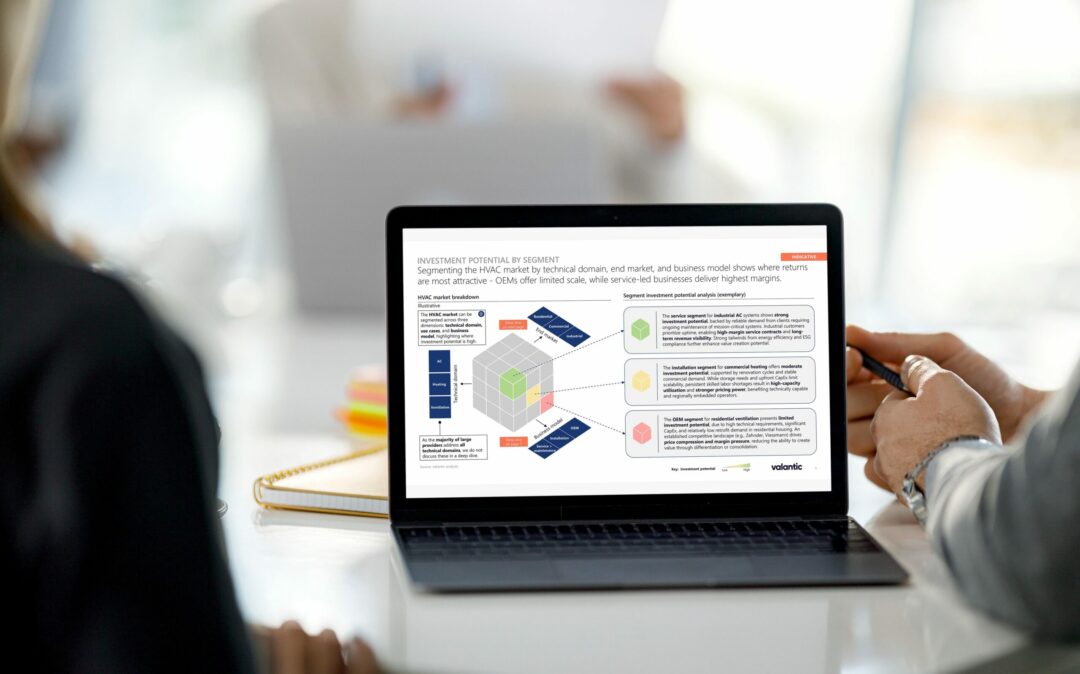
Want the full breakdown? The full viewpoint on the HVAC market is available on request. The typical scope includes market size, market trends & drivers, competitive landscape, competitor groups, competitor benchmarks, explanation of the business model, value chain and future growth levers.

Jan Dingerkus
Partner & Managing Director
Private Equity Practice

Christoph Nichau
Partner & Managing Director
Private Equity Practice

Khalid Ouaamar
Managing Director
Private Equity Practice