Highlight

Successful together – our valantic Team.
Meet the people who bring passion and accountability to driving success at valantic.
Get to know usvalantic viewpoint
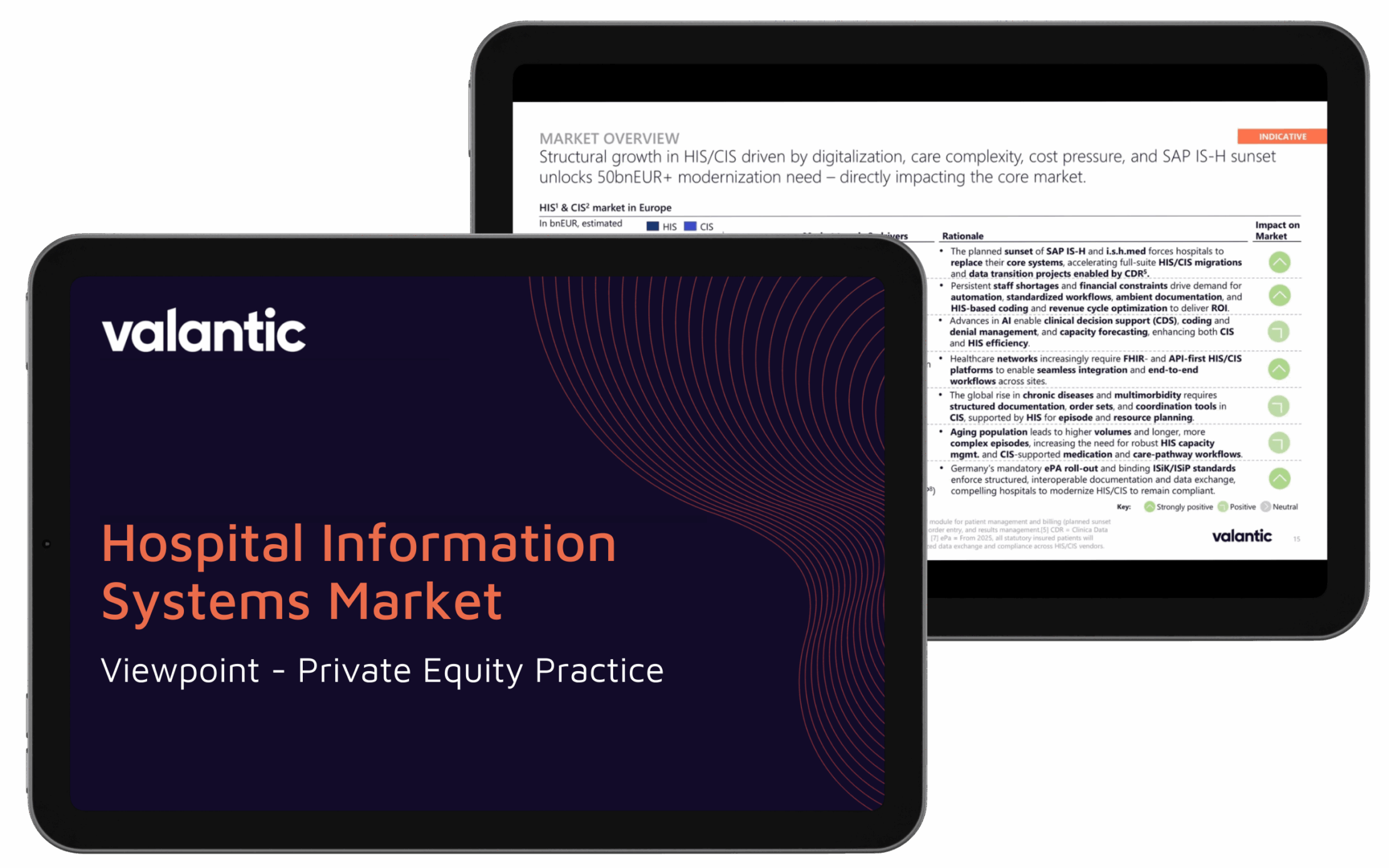
Hospitals in Europe are replacing outdated core hospital IT systems, prioritizing interoperability, clinical depth, and phased migrations.
This is an excerpt of our viewpoint on Hospital Information Systems. Get in touch if you would like to learn more about the market dynamics, business model, competitive landscape and growth drivers in this market.

€50bn
modernization need for infrastructure and clinical software in Europe
300
core HIS migrations in DACH as SAP IS-H / i.s.h.med support ends (2027–2030)
~11%
CAGR for Hospital Information Systems market until 2030
Executive Summary
European hospitals have to replace their old legacy systems amid the sunset of SAP IS-H and i.s.h.med between 2027 and 2030, combined with mandatory interoperability standards, accelerates a multi-billion-euro migration wave. Hospitals demand API-first, modular platforms that bridge legacy systems and enable phased, low-risk migrations. For investors, this market offers attractive recurring revenues, service pull-through, and consolidation opportunities.
Vendors that combined clinical credibility with modular flexibility and strong integration capabilities benefited most. The resulting market showed concentrated incumbency in Germany, strong regional suite leaders elsewhere in Europe, and specialized clinical point solutions competing for share-of-wallet around imaging, lab, perioperative, and medication safety. For investors, this created a multi-year, multi-billion migration wave with attractive recurring revenue, service pull-through, and platform roll-up angles.
SAP support deadlines compress refresh cycles, intensifying tenders
Buyers demand FHIR/API-first stacks and unified data layers
Phased migration strategies outperform big-bang replacements

Khalid Ouaamar
valantic Managing Director
”Europe’s HIS market is entering a €50 bn modernization wave, driven by SAP sunsets and new interoperability standards. The winners will be those that unite clinical credibility with modular flexibility and seamless data integration.“
European HIS buyers moved from grant-funded projects to core replacements as SAP IS-H and i.s.h.med sunsets (2027–2030) converged with interoperability mandates and national e-record rollouts. Hospitals prioritized FHIR-first platforms with unified data layers to integrate real-time clinical and administrative data. Aging populations and multimorbidity reinforced demand for care orchestration and medication safety, driving a ≈ €50 bn replacement wave with hundreds of DACH migrations.
Key Takeaways:
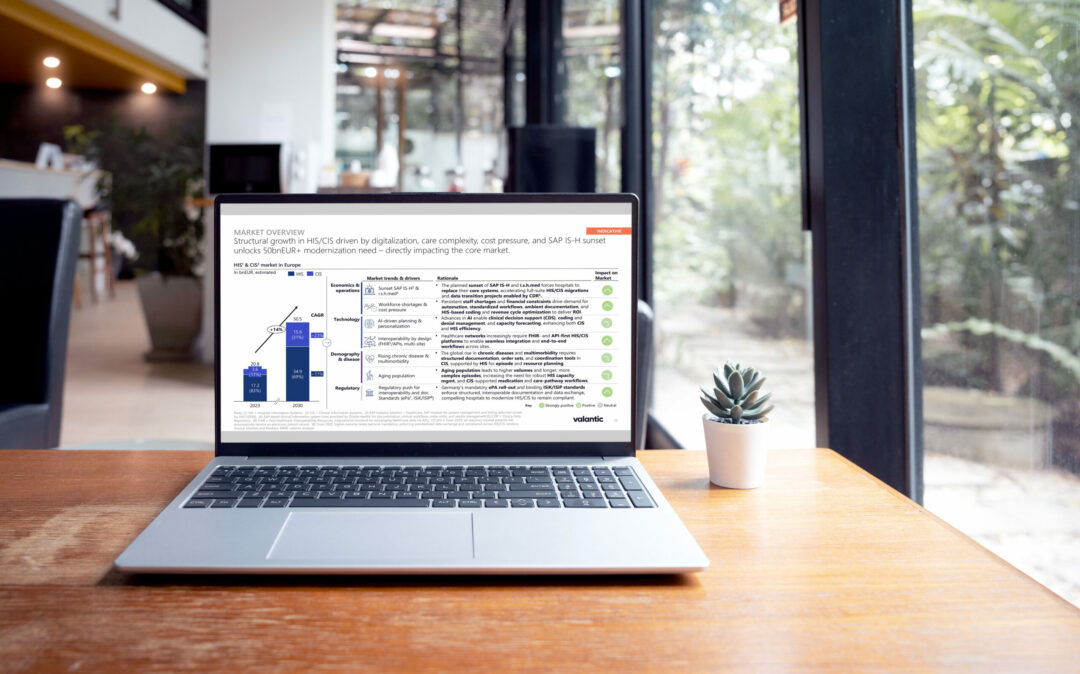
Workforce shortages drove demand for automation, standardized workflows, and revenue-cycle optimization. Interoperability mandates enforced FHIR/API-first designs, enabling data exchange across networks. Rising patient volumes and complexity reinforced the need for decision support and closed-loop medication. Budgets moved from grant-funded projects to core HIS replacements and cloud-ready platforms that cut costs and speed upgrades.
Key Takeaways:

The European HIS market is fragmented. In Germany, Mesalvo and CompuGroup Medical dominate with large installed bases, making them key challengers in the SAP migration wave. Across Europe, Dedalus has the broadest footprint but must improve modules and interoperability to compete in Germany. In the Netherlands, ChipSoft offers modern full-suites and uses SaaS rollouts to enter neighboring markets. Specialists like Philips, Dräger, Sectra, Oracle Health for i.s.h.med and SAP legacy systems remain strong in niches but lack full-suite breadth.
Key Takeaways:

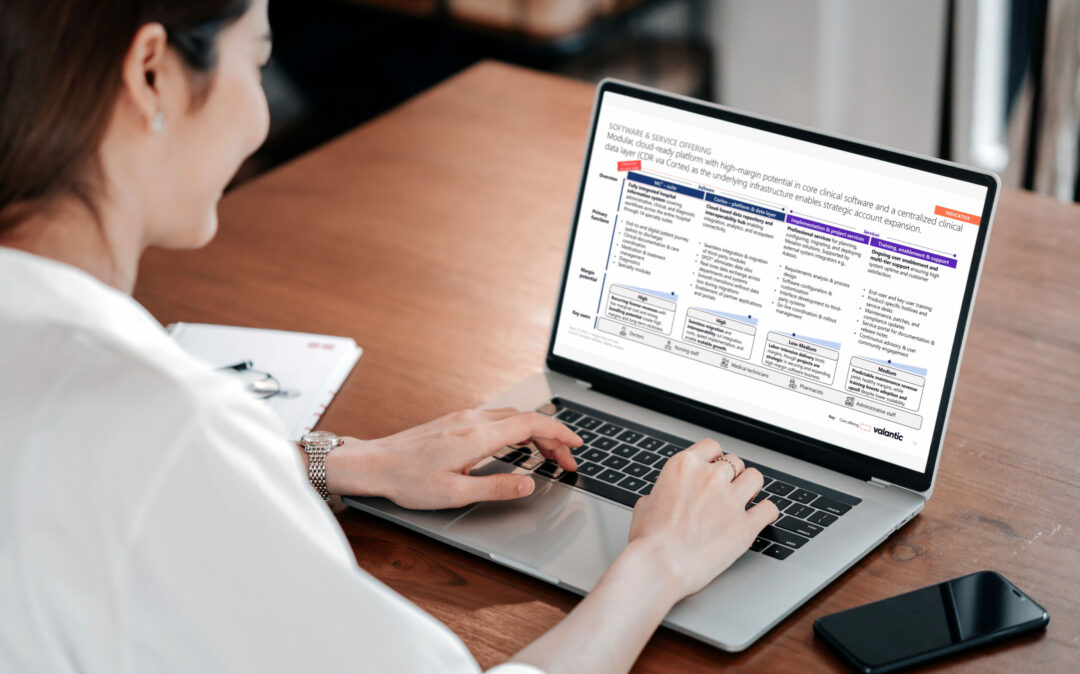
Most HIS/CIS vendors earn mainly from software, using primarily a mix of SaaS and managed services, like implementation, training, and support. The highest value lies in high-acuity modules such as perioperative, ICU, oncology, radiology – integrated via a unified data layer. While ADT, billing, and financials remain core, differentiation comes from clinical depth and interoperability. Cloud-ready designs and standardized rollouts further improve scalability, margins, and time-to-value.
Key Takeaways:
The strongest short-term lever is capturing SAP IS-H and i.s.h.med migrations in Germany, using proven migration playbooks and reliable partner capacity. Mid-term, vendors grow wallet share by adding high-acuity clinical modules, embedding AI into decision support and revenue cycle, and rolling out API-first architectures across networks. Operating models increasingly shift to SaaS and managed services, supported by standardized rollout templates and alliances with hyperscalers or major ERPs. Select bolt-on acquisitions help close module gaps and accelerate reach. Collectively, these moves prepare vendors for consolidation into global platforms or expansion into adjacent European markets.
Key Takeaways:

Want the full breakdown? The full viewpoint on Hospital Information Systems is available on request. The typical scope includes market size, market trends & drivers, competitive landscape, competitor groups, competitor benchmarks, explanation of the business model, value chain and future growth levers.

Christoph Nichau
Partner & Managing Director
Private Equity Practice

Jan Dingerkus
Partner & Managing Director
Private Equity Practice

Khalid Ouaamar
Managing Director
Private Equity Practice