Highlight

Successful together – our valantic Team.
Meet the people who bring passion and accountability to driving success at valantic.
Get to know usvalantic viewpoint
AI-powered healthcare staffing platforms are reshaping recruitment. Discover insights into growth trends, key players, and value creation.
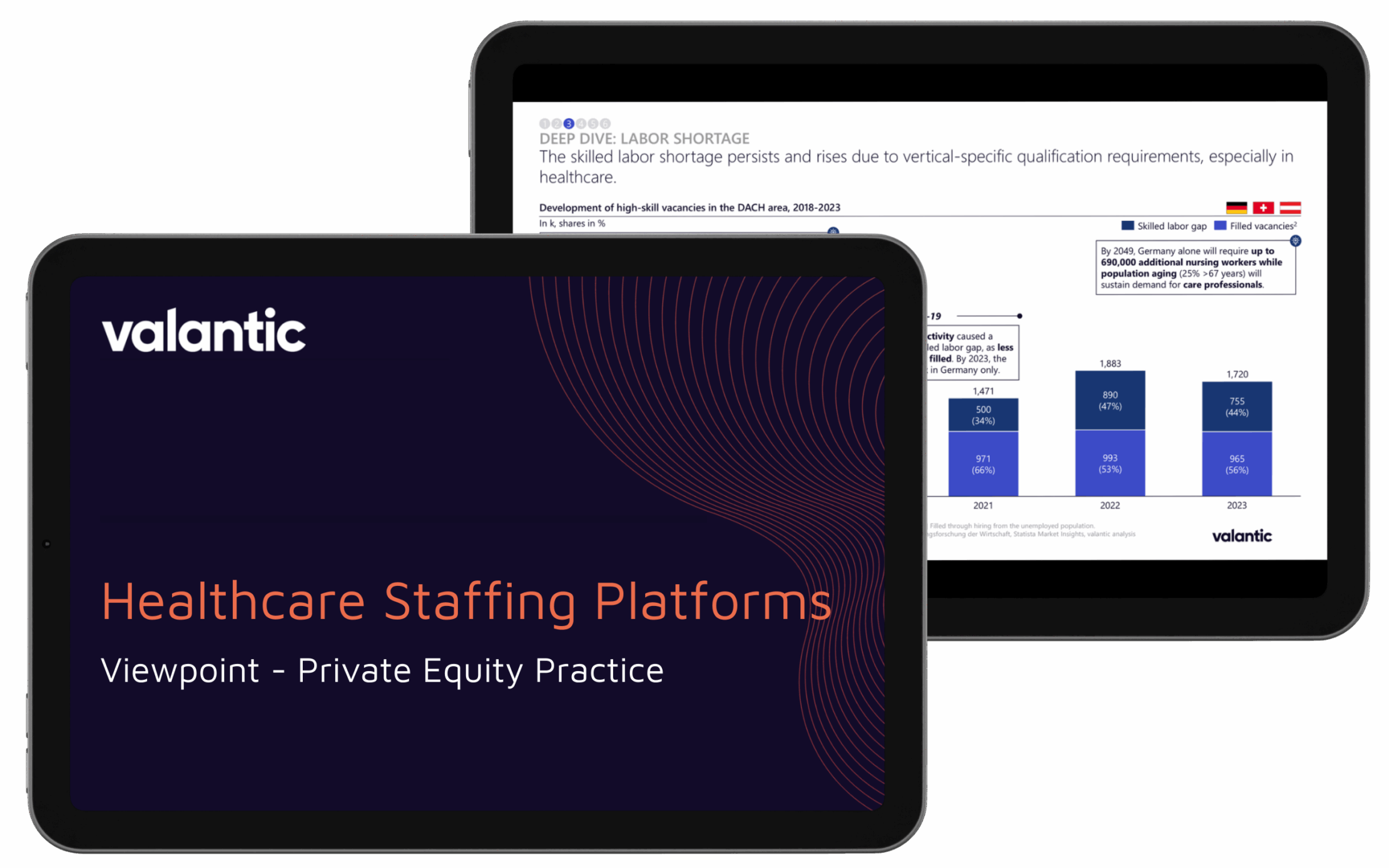
This is an excerpt of our viewpoint on Healthcare Staffing Platforms. Get in touch if you would like to learn more about the market dynamics, business model, competitive landscape, and growth drivers in this market.

690k
projected nursing shortage in Germany by 2049
5%
structural wage inflation p.a. in healthcare staffing
€4.3bn
government funding for digital infrastructure in healthcare
Executive Summary
Digital healthcare recruiting platforms operate in an environment of persistent labor shortages, rising care demand, and increasing regulatory pressure. Aging populations across DACH expand demand for healthcare services while the working-age population continues to shrink. Mandatory staffing ratios, wage floors, and collective agreements further increase hiring urgency and raise the cost of unfilled positions.
In this setting, digital, platform-based recruiting models gain relevance by shortening time-to-hire, improving access to scarce talent pools, and reducing execution risk for employers through success-based pricing. Competitive dynamics reflect a fragmented landscape of healthcare-focused digital platforms, traditional recruiting agencies, generalist job boards, and large staffing conglomerates. Digitally native players differentiate through vertical specialization, matching automation, and candidate-first processes.
Business models typically focus on permanent placements with scalable economics and limited downside risk. Value creation opportunities arise from expanding along the recruiting value chain, replicating healthcare-specific models into adjacent professions, and selectively entering new geographies. For investors, the sector combines structurally resilient demand, recurring usage patterns, and multiple levers for profitable growth.
Structural healthcare labor shortages sustain long-term demand for digital recruiting platforms.
Success-based models reduce client-side financial risk.
Regulatory developments enhance digital recruitment attractiveness.

Khalid Ouaamar
valantic Managing Director
”Our research shows digital staffing platforms dramatically improve hiring efficiencies amid rising market pressures.“
Demographic aging across DACH significantly increases demand for healthcare services while shrinking the domestic labor supply. Fertility rates remain below replacement levels, and the share of citizens aged 65+ continues to rise, driving sustained demand for nursing, residential, and ambulant care. At the same time, policymakers introduce or tighten mandatory staffing ratios in hospitals and long-term care, directly increasing recruitment needs. Wage inflation above 5 % p.a. further amplifies cost pressure, making prolonged vacancies economically unsustainable and accelerating adoption of digital recruiting platforms.
Key Takeaways:

Healthcare labor shortages result from qualification specificity, retirement waves, and limited domestic supply. In Germany alone, the projected nursing gap reaches approximately 690,000 professionals by 2049. High job mobility reinforces continuous recruiting demand, with roughly one quarter of care professionals changing roles annually. Liberalized immigration frameworks partially ease supply constraints but increase complexity, favoring platforms that aggregate, pre-qualify, and match candidates efficiently at scale.
Key Takeaways:

The competitive landscape remains fragmented, comprising healthcare-focused digital recruiting platforms, traditional recruiting agencies, job-advertising marketplaces, and multi-sector staffing conglomerates. Digital platforms such as Pflegia, Medwing, and similar peers focus on healthcare-specific talent pools and automated matching. Job boards like Indeed and LinkedIn monetize via postings and CV access, offering scale but limited curation. Traditional agencies emphasize human-led search, while staffing groups such as Adecco or Randstad many verticals, with only one minor subset being care. Differentiation centers on vertical depth, automation, and pricing transparency.
Key Takeaways:

Leading digital healthcare recruiting platforms typically operate candidate-first or reverse-recruiting models, enabling employers to pitch roles to pre-qualified professionals. Monetization focuses on success-based placement fees, often combined with refund mechanisms that reduce employer risk. Leading concentrate on sourcing, screening, and matching, while involvement in upstream services such as workforce planning and downstream onboarding remain limited
Key Takeaways:

Leading platforms pursue geographical expansion via strategic M&A, exemplified by recent market activities across Europe. Additionally, adjacent healthcare role recruitment and interim staffing solutions offer significant growth opportunities. For example, integrating shift apps for short-term staff matching provides new revenue streams and market segments.
Key Takeaways:

Want the full breakdown? The full viewpoint on Healthcare Staffing Platforms is available on request. The typical scope includes market size, market trends & drivers, competitive landscape, competitor groups, competitor benchmarks, explanation of the business model, value chain, and future growth levers.

Khalid Ouaamar
Managing Director
Private Equity Practice

Christoph Nichau
Partner & Managing Director
Private Equity Practice

Jan Dingerkus
Partner & Managing Director
Private Equity Practice