Highlight

Successful together – our valantic Team.
Meet the people who bring passion and accountability to driving success at valantic.
Get to know usvalantic Viewpoint
Statutory incident reporting, recurring accreditation audits and new cyber security rules such as the EU’s NIS2 directive make quality and risk management software hard to cut for care providers. Daily clinical use and EHR integration create high switching costs and recurring revenue.
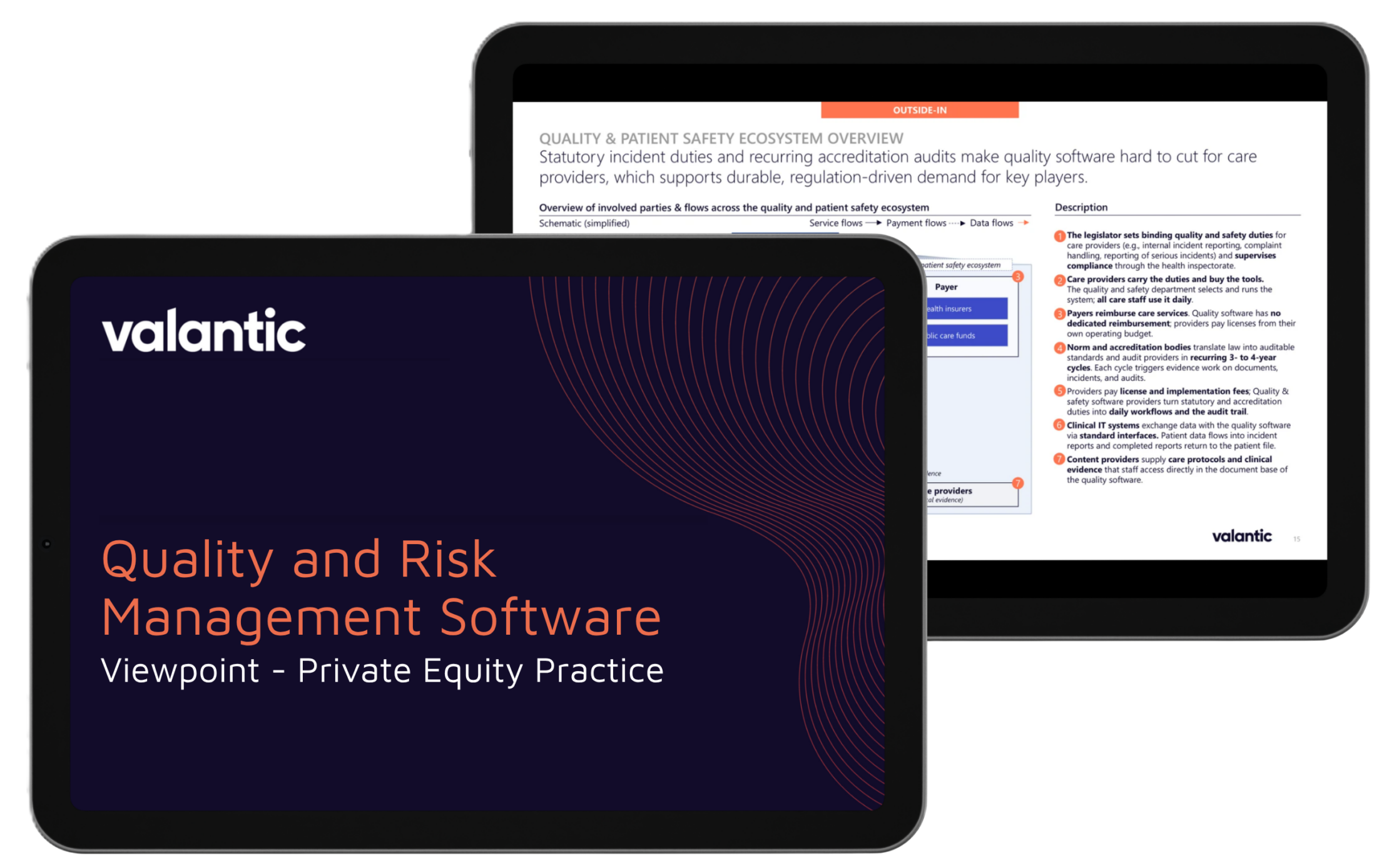
This is an excerpt of our viewpoint on quality and risk management software for care providers. Get in touch if you would like to learn more about the market dynamics, business model, value chain, competitive landscape and growth drivers in this market.


15+ deals
Acquisitions and platform deals by quality and risk software groups since 2020, led by PE-backed platforms
~270k care workers
Expected staffing gap in Dutch care by 2034
3-4 years
Accreditation audit cycles that trigger recurring compliance work
Executive Summary
Quality and risk management software has become core infrastructure for hospitals and long-term care providers. Legal duties to report incidents and handle complaints, recurring accreditation audits and new cyber security rules make it hard to cut, even under budget pressure. Demographic change and staff shortages push providers toward tools that save time on documentation, audits and root-cause analysis. On the vendor side, AI is turning into a purchasing criterion, SaaS subscriptions are replacing on-premise licenses and modular suites let customers start small and expand.
Competition is split between care-specific patient safety specialists, cross-industry QMS and IMS suites and the status quo of SharePoint and in-house tools. PE-backed platforms are consolidating the cross-industry segment, while care-focused vendors remain rare. Growth comes from deeper use in the installed base, new care settings beyond hospitals and selective expansion abroad.
Statutory incident duties and recurring accreditation audits make care quality software hard to cut.
Daily clinical workflows and EHR integration create high switching costs and sticky recurring revenue.
PE-backed platforms consolidate cross-industry suites, while care-specific vendors remain rare.

Khalid Ouaamar
Managing Director, Private Equity Practice
”Our analysis shows that care-focused quality platforms are among the scarcest assets in a consolidating field.“
Quality and risk management software for care providers is going through several structural shifts at once. AI is becoming a purchasing criterion: buyers expect tools to search protocols in plain language, summarize incident reports and draft root-cause analyses. At the same time, horizontal tools such as Microsoft Copilot commoditize generic search and summaries, so differentiation moves toward care-specific workflows and incident data. The shift from on-premise licenses to SaaS subscriptions lifts recurring revenue and price per customer, although the Dutch debate on US cloud dependence may add procurement questions. Modular suites let providers start with one workflow, typically incident reporting, and add modules as needs grow. Consolidation adds pace, led by PE-backed platforms.
Key Takeaways:
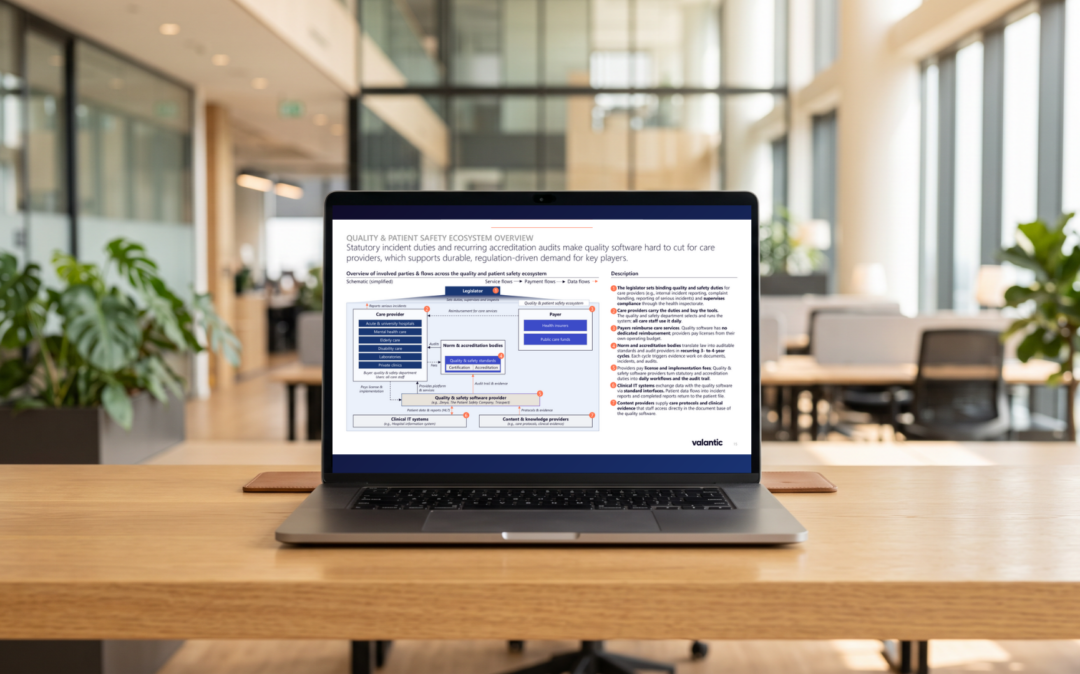
Demand for quality and risk management software in care is driven mainly by regulation, and that makes it unusually resilient. In the Netherlands, the law requires every care provider to report incidents and handle complaints, and reports of serious incidents to the health inspectorate keep rising. Norm and accreditation bodies audit providers in recurring 3–4-year cycles, and each cycle triggers evidence work on documents, incidents and audits. The compliance scope is widening too: NIS2 has applied in Belgium since 10/2024 and in the Netherlands since 08/2026, and NEN 7510 information security certificates need the 2024 update by 02/2027. Demographics add structural pressure. The Netherlands expects a gap of up to ≈270k care workers by 2034, while the population aged 80+ doubles to ≈1.8m by 2045. This raises demand for time-saving tools, although tight budgets and limited staff capacity can slow implementations. Quality software has no dedicated reimbursement, so providers pay licenses from their own operating budgets.
Key Takeaways:
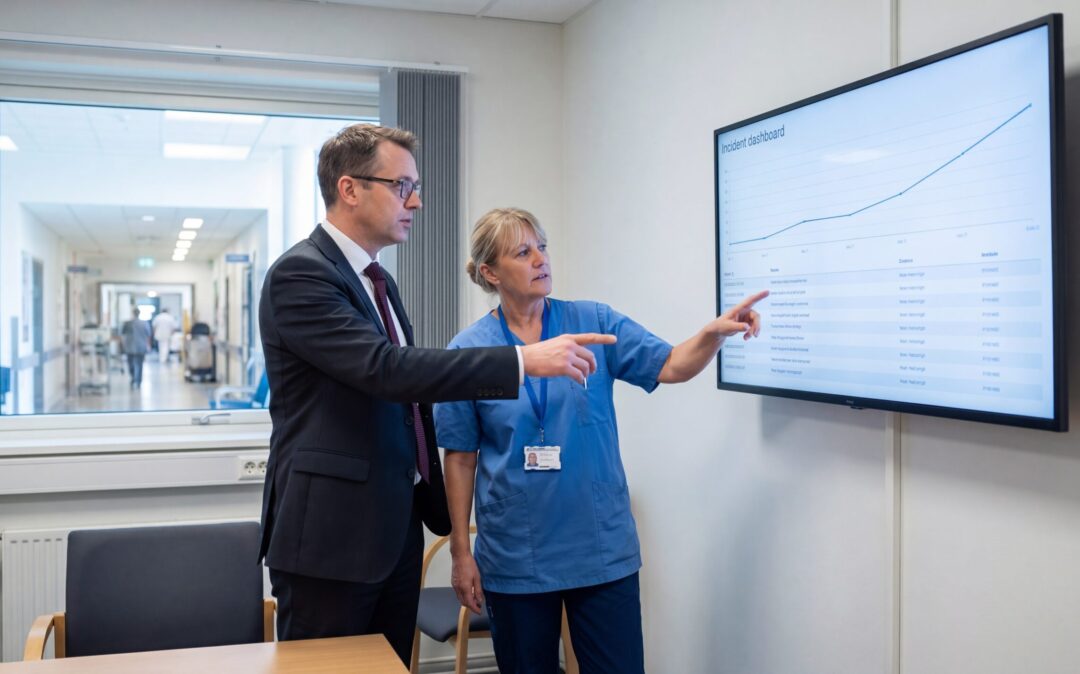
The competitive field for quality and risk management software in care splits into three groups. Care-specific quality and safety suites are built around incident reporting, risk and complaints at hospitals and long-term care providers. International players such as RLDatix and symplr add workforce, credentialing and compliance modules and focus on the US and UK, while Benelux specialists such as The Patient Safety Company (part of symplr since 2020), Triaspect and Zenya offer incident-led suites anchored in Dutch care law. Cross-industry QMS and IMS suites are built around norms, documents, processes and audits rather than patient safety. Internationally, Ideagen, MasterControl and Octave serve manufacturing and life sciences, with only Ideagen running a dedicated healthcare product. In DACH, ConSense, peak avenue, Ariadne and Babtec serve the mid-market, all with recent PE deals. The third group is manual and in-house: SharePoint, M365 and own builds remain the status quo in smaller care organizations.
Key Takeaways:


Jan Dingerkus
valantic Partner & Managing Director
”In quality software, we consistently see that workflow depth and cloud readiness determine a long-term market position. “
Vendors of quality and risk management software typically run a modular B2B SaaS model. Customers license individual modules along the quality cycle, from document control and incident reporting to audits and risk management, and AI functions are becoming part of the offering. Recurring subscription revenue is complemented by one-time implementation and interface fees and by repeat consulting and training. Certificates such as ISO 27001 and NEN 7510, norm content and dashboards are table stakes: they keep new entrants out but do not set vendors apart. The moat lies in daily workflow execution and in integration with hospital EHR systems via standard interfaces such as HL7. When all care staff use a system every day, replacing it means retraining the whole hospital.
Key Takeaways:

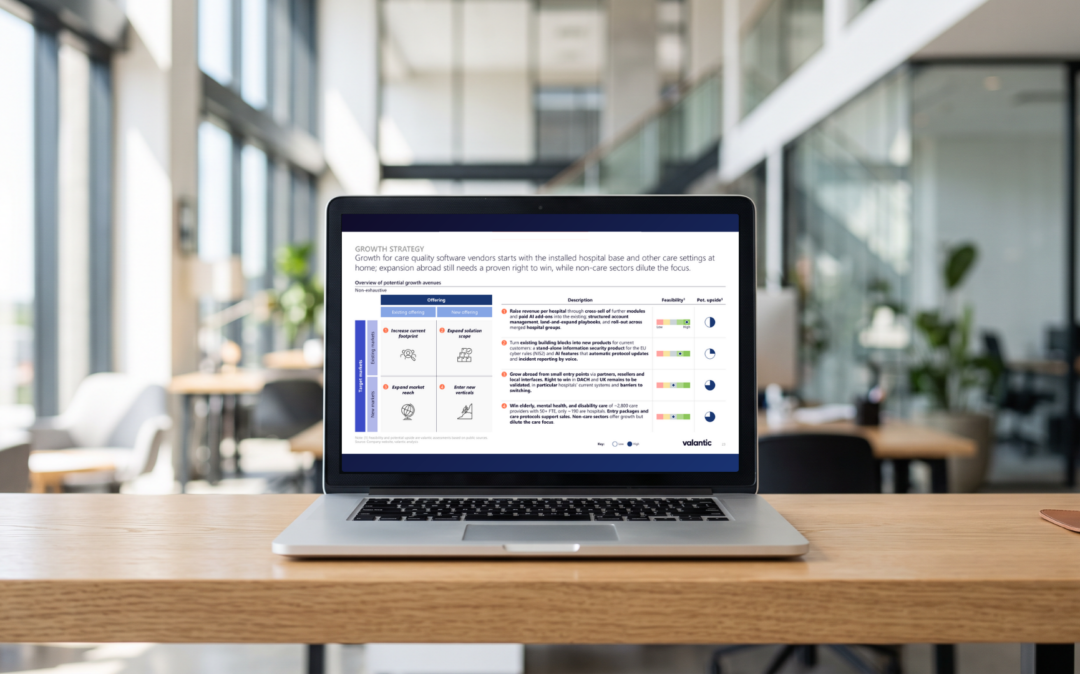
In mature markets such as the Netherlands, most hospitals already run quality and risk management software, so growth increasingly comes from deeper use, new products and new care settings. In the installed base, additional modules and AI functions raise revenue per customer, and hospital mergers widen the user base. New cyber security rules create demand for information security functions alongside patient safety. Beyond hospitals, elderly, mental health and disability care offer volume: in the Benelux, only ~190 of ~2,800 care providers with 50+ FTE are hospitals. International expansion remains an option, but the right to win against established EHR and suite vendors abroad needs validation in each market.
Key Takeaways:
Want the full breakdown? The full viewpoint on Quality and Risk Management Software is available on request. It covers market trends and drivers, the quality and patient safety ecosystem, the value chain, the competitive landscape with competitor benchmarks, and M&A activity.

Khalid Ouaamar
Managing Director
Private Equity Practice

Jan Dingerkus
Partner & Managing Director
Private Equity Practice

Christoph Nichau
Partner & Managing Director
Private Equity Practice