Highlight

Successful together – our valantic Team.
Meet the people who bring passion and accountability to driving success at valantic.
Get to know usvalantic Viewpoint
The market concerning Healthcare IT System Houses is driven by increasing digitalization, regulatory compliance, and the need for scalable IT solutions. Explore competitive dynamics and growth levers in this expanding sector.
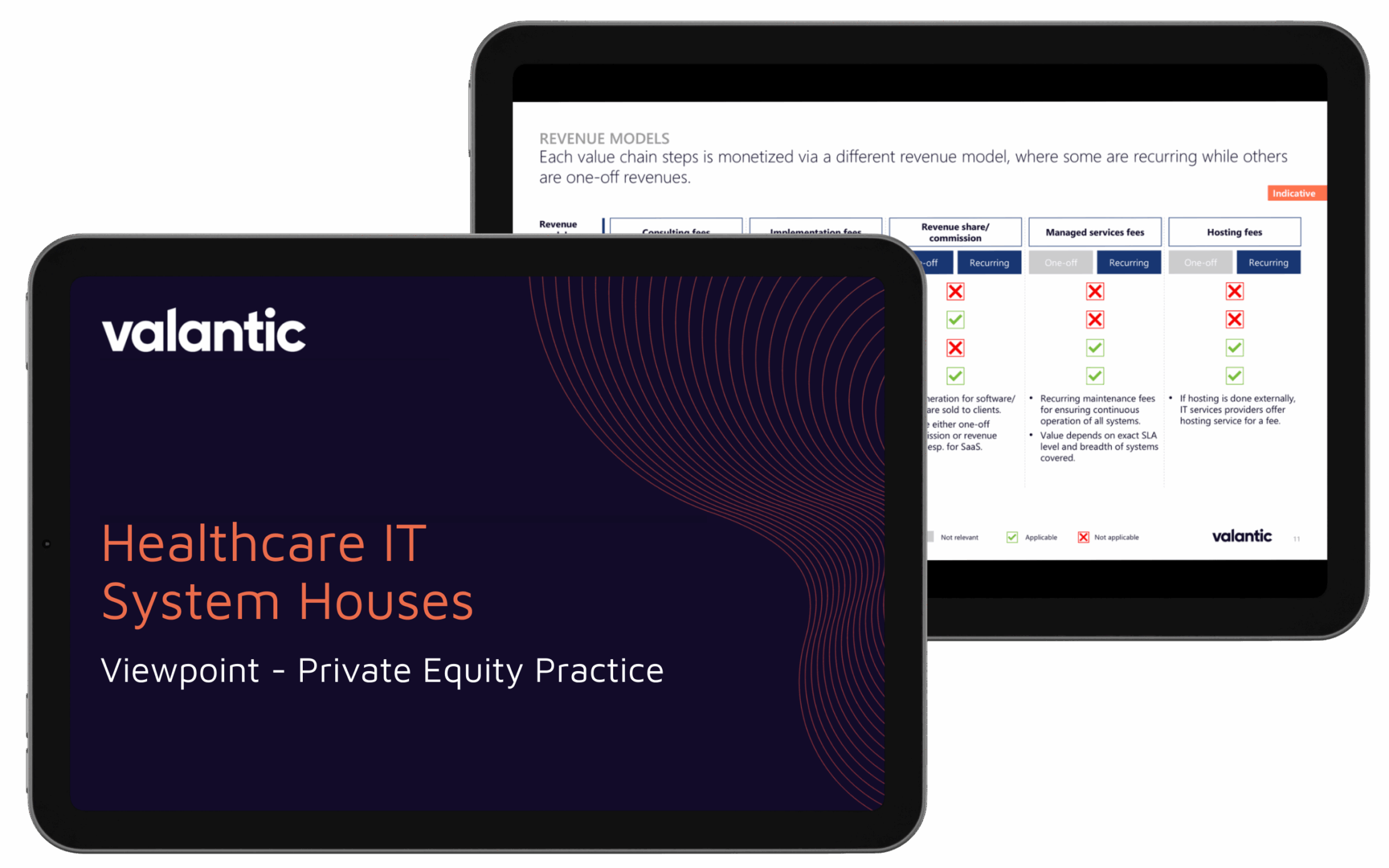
This is an excerpt of our viewpoint on Healthcare IT System Houses. Get in touch if you would like to learn more about the market dynamics, business model, competitive landscape, and growth drivers in this market.

~135k
outpatient practices across Germany
up to 70%
market share held by SMBs
~38%
practices affected by cyber incidents
Executive Summary
Healthcare IT System Houses are undergoing significant transformation due to increasing digitalization, stricter regulatory requirements, and generational changes among practice owners. Key growth drivers include the push for secure telematics infrastructure, public funding incentives like TI-Pauschale, the rising cybersecurity risks that necessitate professionalized IT environments and the structural shift towards larger practices, especially medical care centers (“MVZs” in Germany).
The market remains highly fragmented, with SMBs holding a dominant share and consolidation opportunities evident among regional providers. Business models are evolving toward recurring revenue streams from managed services, hosting fees, and compliance-driven solutions. Competitive dynamics highlight scalable generalists alongside niche specialists in areas like dental and radiology. Investment attractiveness varies based on operational scale and specialty focus, with regional players offering high upside potential through consolidation efforts.
Generational shifts among practice owners drive outsourcing demand for scalable IT solutions.
Regulatory mandates create sustained demand for compliant managed-service environments across healthcare practices.
Fragmented market structure offers significant consolidation opportunities for regional providers and niche players.

Khalid Ouaamar
valantic Managing Director
”Digital workflows are now standard. Providers must offer tailored solutions to capture growing demand.“
Healthcare IT System Houses are experiencing rapid growth driven by the digitalization of practice workflows, generational change among practice owners, and regulatory pressures. Practices increasingly adopt digital records, e-prescriptions, and patient portals, creating demand for integrated IT systems and ongoing support. Younger, digitally native successors are modernizing infrastructures and outsourcing IT needs to scalable managed-service providers. Regulatory mandates such as KBV IT-security guidelines further compel practices to invest in compliant systems. Public funding programs like TI-Pauschale reduce cost barriers and stabilize demand for IT services. However, smaller practices lag behind in digital readiness, slowing adoption rates in rural areas.
Key Takeaways:

Stricter regulations and rising cybersecurity threats are reshaping the Healthcare IT Services Market. KBV directives enforce continuous upgrades and certified managed environments, which anchor long-term service contracts for external providers. At the same time, interoperability requirements between practice management systems, telematics applications, and connected medical devices are steadily increasing. This adds technical complexity to practice IT and further boosts demand for end-to-end management across hardware, software, and interfaces. Practices face mounting risks from ransomware and data breaches, raising willingness to pay for professionalized, proactively monitored IT environments. Public funding schemes such as the TI-Pauschale help reduce investment barriers and stabilize demand for compliant infrastructures. While underlying demand remains largely non-cyclical, recurring regulatory and technology events, such as operating-system end-of-life, trigger sizable one-off hardware replacement cycles in practices. These events create pronounced revenue spikes for Healthcare IT system houses on top of their stable managed-services base.
Key Takeaways:

The competitive landscape in the Healthcare IT Services Market is highly fragmented, combining scalable national platforms, vertical specialists, and regionally anchored system houses. Scalable generalist platforms such as Bechtle and CompuGroup Medical operate as multi-regional providers, delivering standardized managed services, central helpdesks, and broad on-site coverage. Large-scale specialty leaders, including VisionmaxX, Curagita, Plandent, IT Ärzte and Informatics, focus on individual clinical verticals like dental or radiology, where deep workflow expertise and certified device or software integrations create high switching costs and strong customer loyalty. Below this tier, a broad group of regional broad-scope providers, such as Hoenicke, Sysmedo, Optimit, Schlenotronic, Numera IT, Lendeckel IT and QIT Systeme, serve outpatient practices across multiple specialties and often additional SMB segments. For many practices, geographical proximity of technicians remains an important but not exclusive selection criterion, since fast on-site support and stable local relationships are still valued alongside scalable service models. Numerous small niche players, particularly in dentistry and radiology, further extend the long competitive tail and underline the significant consolidation potential in small and mid-sized segments.
Key takeaways:

Healthcare IT system houses typically cover the full value chain from solution design through implementation to ongoing operation and upgrades. Along this chain, they generate revenues via software services, one-time project work, managed services, and hardware sales. Software services include, for example, first-level support for practice management systems, telematics applications, and security solutions, often billed as service contracts or support packages. One-time, project-based revenues arise from activities such as the installation and configuration of IT devices, network setups, or migration projects when practices modernize their infrastructures. Managed services form a core, recurring pillar, covering areas like IT security, backups, monitoring, and ensuring general system availability in line with regulatory requirements. In addition, providers earn hardware revenues from selling desktops, servers, network components, and physical TI connectors. This mix of recurring and project-based income, combined with mission-critical service delivery, creates a resilient business model with attractive opportunities to grow share of wallet per practice.
Key takeaways:

Growth levers for Healthcare IT providers stem from increasing cybersecurity awareness, regulatory compliance mandates, and generational shifts among practice owners favoring outsourced solutions. Consolidation within fragmented regional markets offers significant upside potential for scalable platforms capable of delivering standardized services across multiple geographies or specialties. Additionally, the expansion of software ecosystems and connected medical devices amplifies demand for interoperability solutions that further integrate healthcare workflows while driving upselling opportunities in consulting and managed services alike.
Key Takeaways:

Want the full breakdown? The full viewpoint on Healthcare IT System Houses is available on request. The typical scope includes market size, market trends & drivers, competitive landscape, competitor groups, competitor benchmarks, explanation of the business model.

Christoph Nichau
Partner & Managing Director
Private Equity Practice

Jan Dingerkus
Partner & Managing Director
Private Equity Practice

Khalid Ouaamar
Managing Director
Private Equity Practice