Highlight

Successful together – our valantic Team.
Meet the people who bring passion and accountability to driving success at valantic.
Get to know usvalantic viewpoint
Digitized workflows, PE-backed roll‑ups, and aging demographics shaped a resilient, premium‑led “Dental labatory platform Germany” thesis.
This is an excerpt of our viewpoint on the Dental Labatory Platforms Market in Germany. Get in touch if you would like to learn more about the market dynamics, business model, competitive landscape and growth drivers in this market.

~5900
dental labs in Germany (2023)
24%
of lab owners are 55+, often selling due to no in-house successor
3%
CAGR forecast for prosthetic market volume.
Executive Summary
Germany’s dental lab market remained fragmented, yet consolidation advanced as independents faced succession gaps and wage‑driven cost pressure. Larger platforms captured procurement advantages, standardized digital workflows, and pushed hybrid hub‑and‑spoke setups to raise utilization. Demand was underpinned by an aging population and continued outsourcing from dental practices, while digital case intake and CAD/CAM production improved remake rates and cycle times.
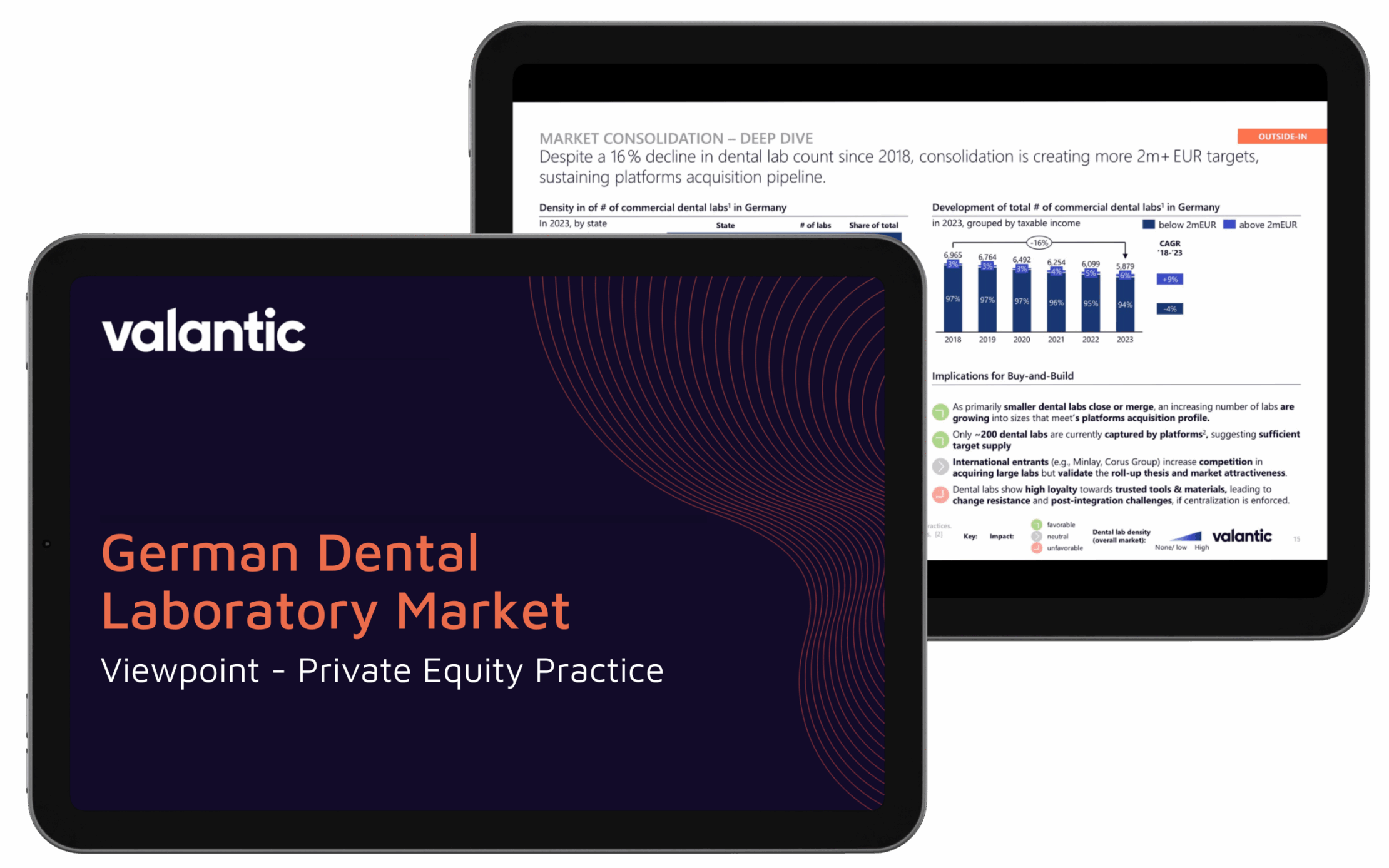
Successful platform operators focused on premium, made‑in‑Germany prosthetics and implant restorations to defend pricing and quality. Some even established SaaS‑style portals emerging as a low‑touch layer for case handling and billing. Despite a 16 % drop in lab count since 2018 to roughly 5,879 labs in 2023, the pool of mid‑sized targets >2 mEUR taxable income grew about 9 %, sustaining acquisition funnels. Key risks included talent scarcity, reimbursement exposure to statutory systems, and technical disruption from 3D printing, which primarily affected low‑complexity, aesthetic work.
Consolidation lifted scale benefits, widening the margin gap versus small independents.
Digital workflows became a retention moat and future SaaS monetization path.
Aging demographics and outsourcing supported steady volume, near‑GDP growth.
Khalid Ouaamar
valantic Managing Director
”Consolidation is inevitable – the winners will master both high-value prosthetic manufacturing and digital process optimization.“
Germany’s lab universe shrank by 16 % from 2018 to 2023, to ~5,900 labs, while the share of mid‑sized targets increased, reflecting roll‑up activity. Practices outsourced more work as staffing tightened, and digitized case intake, CAD/CAM, and portal workflows became the new standard. Market volume was expected to track GDP, with growth skewed to premium restorations and implants. Platforms prioritized hub‑and‑spoke models, routing complex cases to regional centers. Talent scarcity remained a constraint, amplified by ~24 % of master technicians being 55+.
Key Takeaways:
Consolidation compressed the long tail of micro‑labs.
Digital readiness became a prerequisite for dentist loyalty.
Premium, “made in Germany” positioning defended pricing.
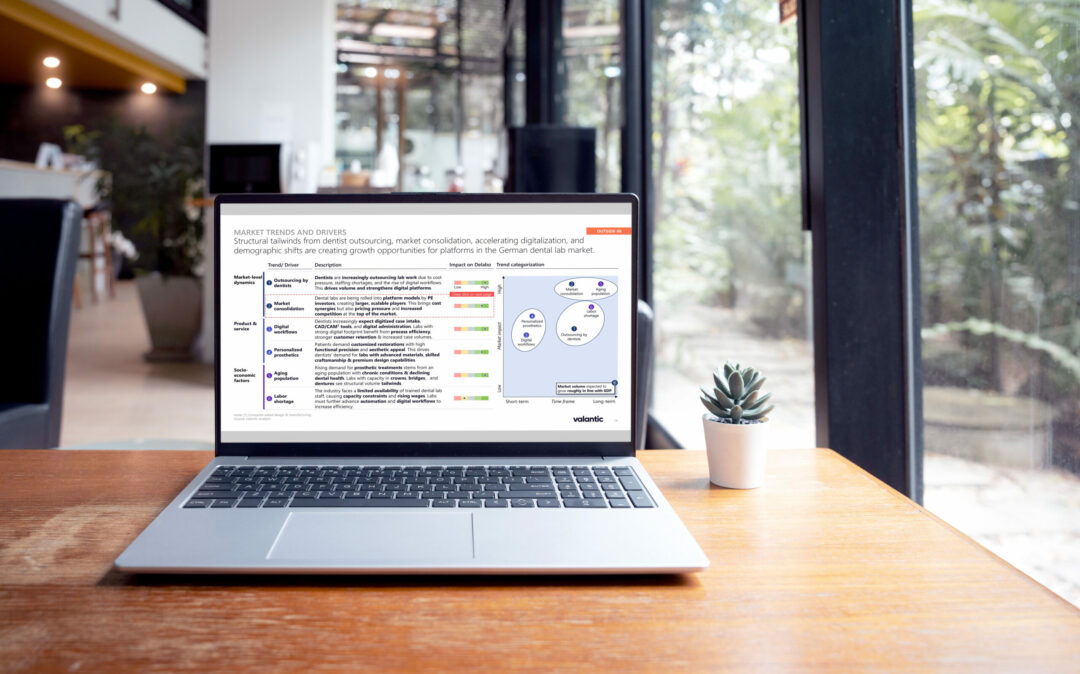
An aging population lifted demand for crowns, bridges, and dentures. Outsourcing from practices rose due to wage inflation and scarce technicians, pushing volume to external labs. Digital workflows, from intraoral scans to centralized case management, reduced errors and remake rates. Digital portals streamlined intake, logistics, and billing, and created optionality for SaaS fees over time.
Key Takeaways:
Aging and chronic conditions increased restorative need.
CAD/CAM standardization improved quality and throughput.
Portals lowered administrative friction and supported analytics.
The field split into consolidated premium chains, regional premium groups, independent craft labs, hybrid on‑/offshore models, in‑house labs of dental corporates, and global low‑cost providers. Premium chains combined national coverage, digital infrastructure, and full‑service portfolios. Regional groups emphasized craftsmanship and local ties but lacked purchasing scale. Hybrids sourced production abroad while planning in Germany to serve price‑sensitive segments. In‑house labs internalized demand for large practice groups, and offshore volume players competed on standardized, low‑margin products.
Key Takeaways:
National chains chased standardization and brand‑level quality.
Regional groups leveraged proximity and bespoke service.
Hybrids competed mainly on price, not depth of service.
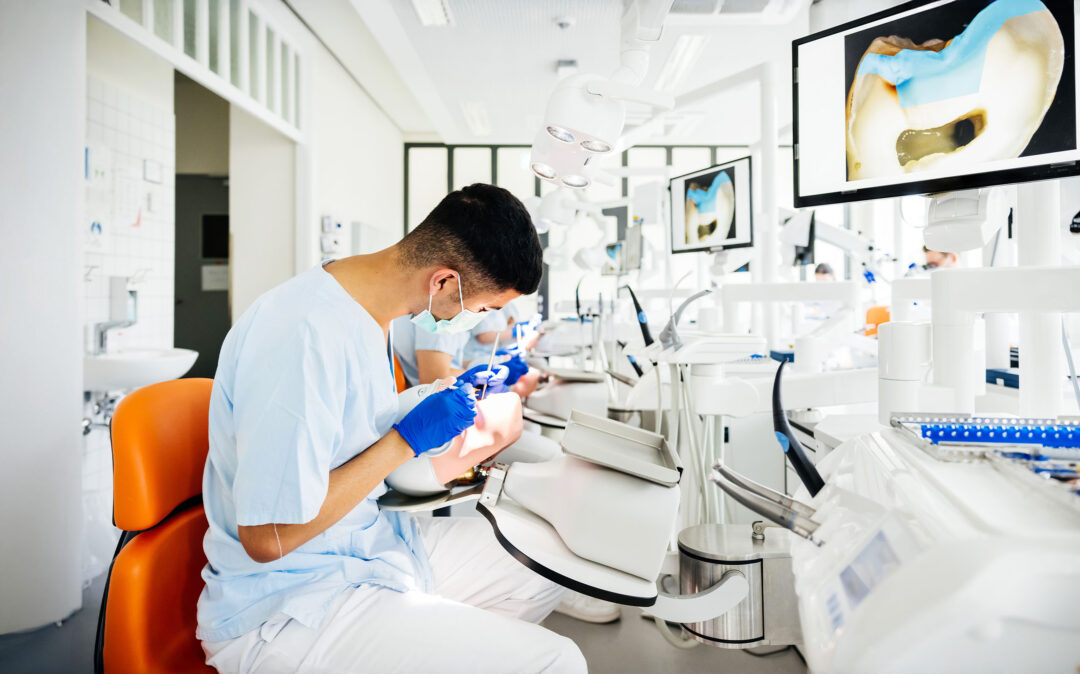
Successful platforms centralized high‑impact steps, such as digital design, QC standards, and procurement, while keeping dentist‑facing craftsmanship local. Case intake and after‑sales remained near the practice to protect relationships, whereas CAD/CAM, materials sourcing, and manufacturing followed central standards to raise utilization. Leading players use digital portals to enable digital file exchange, logistics tracking, and invoicing, turning them into a foundation for potential monetization in the future.
Key Takeaways:
Processes are centralized where scale and quality metrics improve most.
Aesthetic finishing and fit coordination stay local to protect craftsmanship.
Portal usage is built first, with module monetization following later.
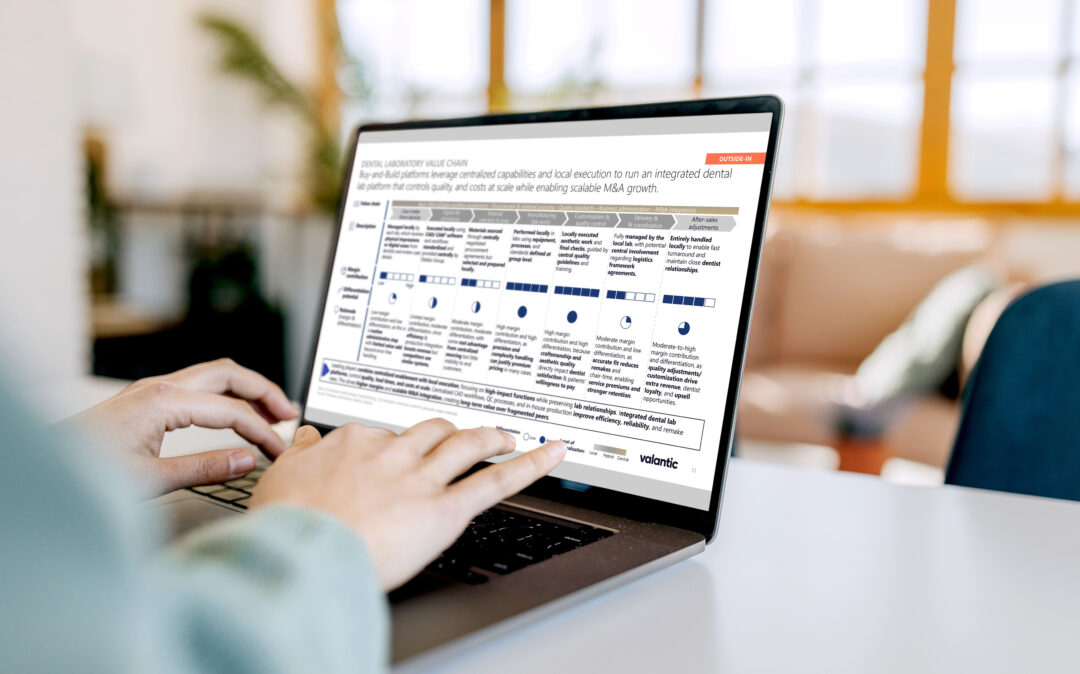
Acquisition pipelines stayed robust despite fewer labs overall, because mid‑sized targets grew ~9 % YoY to ~330 in 2023. Whitespace remains in underpenetrated regions, particularly in parts of Eastern and Northern Germany. Near‑adjacent expansion to Austria and Switzerland offered higher self‑pay exposure. Over time, platform portals could evolve into low‑touch SaaS stacks for case handling, billing, and analytics.
Key Takeaways:
Regions with thin coverage and high dentist density offer strong growth potential.
Post-merger playbooks for procurement and CAD/CAM are systematically implemented.
Digital monetization potentials are explored for future scalability.
Want the full breakdown? The full viewpoint on the German Dental Laboratory Market is available on request. The typical scope includes market size, market trends & drivers, competitive landscape, competitor groups, competitor benchmarks, explanation of the business model, value chain and future growth levers.
Christoph Nichau
Partner & Managing Director
Private Equity Practice
Jan Dingerkus
Partner & Managing Director
Private Equity Practice
Khalid Ouaamar
Managing Director
Private Equity Practice