Highlight

Successful together – our valantic Team.
Meet the people who bring passion and accountability to driving success at valantic.
Get to know usvalantic viewpoint
Growing patient demand, limited specialist availability, and rising self-pay willingness fuel premium adoption in eye surgery laser equipment.
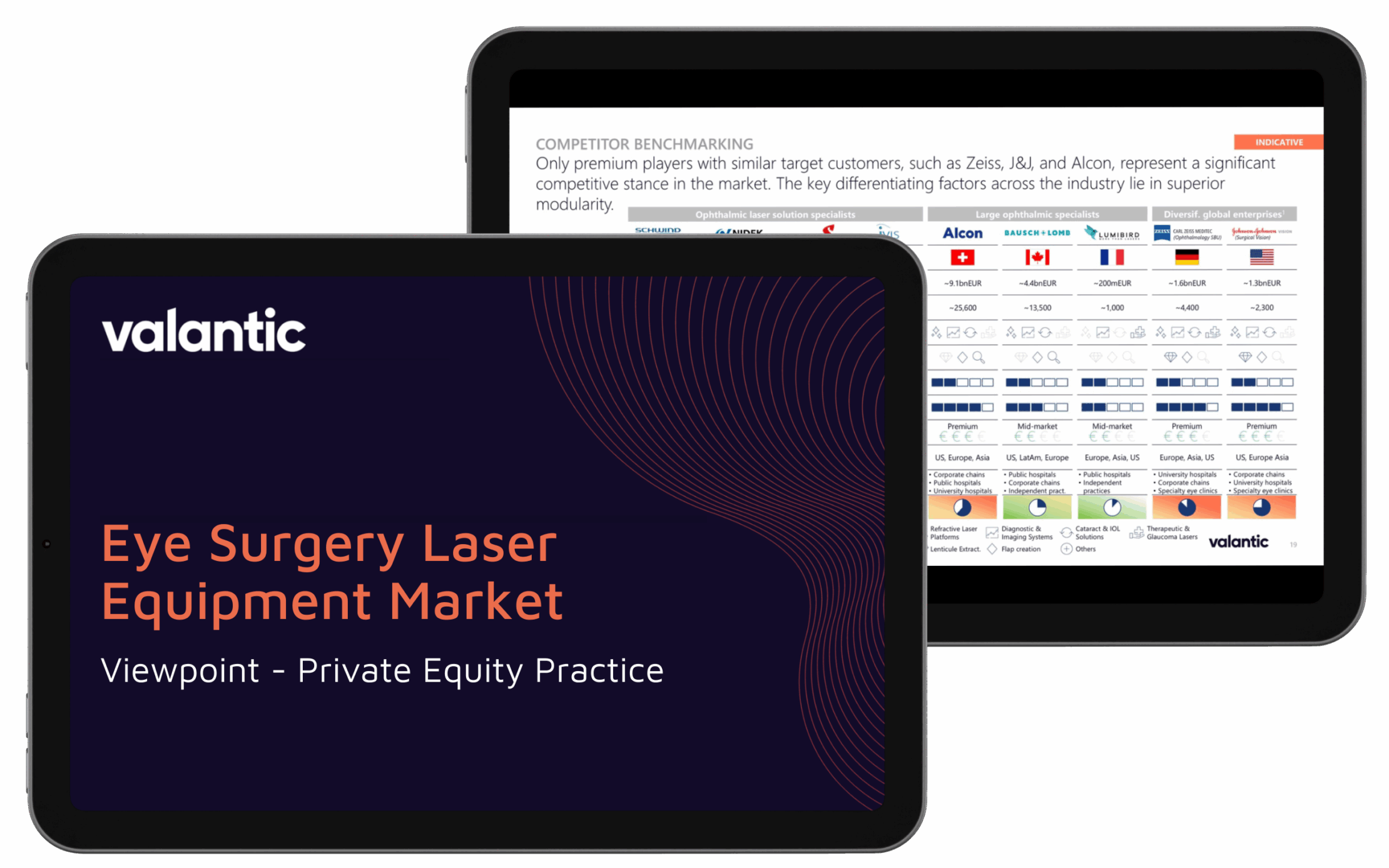
This is an excerpt of our viewpoint on the Eye Surgery Laser Equipment Market. Get in touch if you would like to learn more about the market dynamics, business model, competitive landscape and growth drivers in this market.
€1.25bn
global revenue for refractive surgery devices in 2023
50%
global myopia prevalence projected by 2050
20%
CAGR between 2020 and 2025 for leading players in this segment
Executive Summary
The eye surgery laser equipment market remains structurally attractive, underpinned by demographic tailwinds, the global myopia surge, and growing self-pay demand for minimally invasive, bladeless procedures. Premium adoption increasingly centers on integrated ecosystems spanning diagnostics, planning software, excimer and femtosecond platforms, with recurring revenue streams from upgrades and services enhancing resilience.
The industry is moderately concentrated, with a few global leaders and several specialized challengers competing on software-enabled personalization, open modular architectures, and service depth. Growth is strongest in East and Southeast Asia, with additional potential in premium Central and Eastern Europe and selected Latin American urban centers where self-pay willingness rises. Regulatory complexity, especially MDR and FDA, raises barriers, favoring well-prepared players. Near-term upside stems from femtosecond adoption, lenticule techniques, presbyopia solutions, and software upgrades that increase recurring revenues and stickiness across the installed base.
Premium growth concentrates on bladeless, modular platforms.
Asia drives demand, eflecting extreme myopia prevalence and rising self-pay.
Competitive edge shifted toward software, AI planning, and service depth.

Khalid Ouaamar
valantic Managing Director
”Growth is driven by both demographic tailwinds and patients’ willingness to self-pay for premium procedures for eye surgery.“
Patients increasingly opted for bladeless femtosecond techniques and precise excimer corrections, favoring integrated ecosystems that link diagnostics, planning software, and lasers in one workflow. The refractive surgery devices market was estimated at about 1.25 bn EUR in 2023, excluding disposables, leaving headroom from patient interfaces and software upgrades. East and Southeast Asia drove demand, supported by >80 % myopia among young adults and rising middle-class self-pay. At the same time, EU MDR and FDA rules raised the bar for smaller entrants but rewarded compliance-ready platforms. Premium centers gravitated to modular systems offering compact footprints, interoperability, and stepwise upgrade paths across excimer, femtosecond, and planning modules.
Key Takeaways:

The most powerful demand driver remained the global myopia epidemic, expected to affect ≈ 50 % of the population by 2050. Alongside this, aging populations increased cases of presbyopia and corneal disease, expanding the addressable market. Patients in Asia and parts of Europe demonstrated a high willingness to self-pay for advanced outcomes, reinforcing the importance of premium positioning. At the same time, AI-enabled planning software raised expectations for precision, consistency, and speed in outcomes. Stricter MDR and FDA frameworks increased entry costs, but also rewarded players with integrated, evidence-backed platforms capable of meeting high regulatory standards.
Key Takeaways:

The refractive surgery devices market is moderately concentrated. Diversified leaders such as J&J Vision, Alcon, Carl Zeiss Meditec, and Bausch + Lomb set standards with full ophthalmology portfolios, bundled ecosystems, and heavy R&D.
Specialists like Schwind, Ziemer, Nidek, Ivantis/IVIS, and Lumibird challenge this dominance by focusing on corneal and refractive niches. Schwind stands out with a modular, open platform and premium positioning, allowing clinics to customize workflows, maximize ROI, and benefit from intensive training and support.
The competitive battleground increasingly centers on AI-driven planning tools, recurring revenues from disposables, and digital integration, with Asia and Central & Eastern Europe providing the most immediate growth opportunities.
Key Takeaways:

Business models combined one-off device sales with growing recurring layers from disposables, licenses, and service contracts. While capital equipment remained central, clinics valued ecosystems that spanned diagnostics, planning software, and surgical execution, enabling smoother workflows and standardized outcomes. Modular architectures allowed clinics to expand from excimer to femtosecond platforms step by step, while also adopting software modules over time. This improved ROI and deepened customer stickiness. Still, dependence on third-party diagnostics highlighted strategic trade-offs between openness and control. Postoperative care largely remained outside the advanced technology stack, leaving potential for untapped future revenue streams.
Key Takeaways:
Growth opportunities were strongest in East and Southeast Asia, where high myopia prevalence and self-pay demand created sustainable volume. Premium Central and Eastern Europe and select Latin American markets added further momentum. Software upgrades, AI-enabled planning, and workflow optimization increased differentiation and improved loyalty, while new procedures such as lenticule extraction and presbyopia correction expanded the addressable market. Regulatory readiness provided a competitive edge in accelerating entry into complex jurisdictions. Finally, scaling training programs and distributor partnerships supported broader adoption, while targeted M&A in diagnostics or therapeutics offered optionality to expand into adjacent value pools.
Key Takeaways:

Want the full breakdown? The full viewpoint on the Eye Surgery Laser Equipment Market is available on request. The typical scope includes market size, market trends & drivers, competitive landscape, competitor groups, competitor benchmarks, explanation of the business model, value chain and future growth levers.

Christoph Nichau
Partner & Managing Director
Private Equity Practice

Jan Dingerkus
Partner & Managing Director
Private Equity Practice

Khalid Ouaamar
Managing Director
Private Equity Practice