Highlight

Successful together – our valantic Team.
Meet the people who bring passion and accountability to driving success at valantic.
Get to know usMunich, March 26, 2026: AI is no longer a trend in retail. The current C-Level survey Digital Excellence Outlook 2026 – AI at Scale by valantic and Handelsblatt Research Institute (HRI) shows that retail and consumer goods (CPG) are among the leaders in AI maturity in an industry comparison, with 45 percent even seeing themselves as AI pioneers. Nevertheless, economic effects and a measurable ROI fall short of expectations because AI is not yet sufficiently integrated into core processes and business models.

”Two thirds of retailers are already using AI - but only one in three companies is achieving measurable added value with it. This gap is not a technology problem. It arises where tools are introduced but decision-making structures, processes and people remain unchanged. If you want to change this, you need to invest not only in technology but also in radical clarity: about priorities, about responsibilities and about how much the organization really needs to change.“
How do companies in the DACH region envision the future with AI? The new C-Level study provides a cross-industry assessment. Compared to the overall results, which are based on a quantitative and qualitative survey of 1,000 executives and IT managers, the detailed analysis of the retail and CPG segment has some special features.
For example, the more than 100 retailers surveyed are more skeptical about the investment trend: 83 percent are convinced that “the AI investment boom will end before 2030 because many companies will not be able to derive real business benefits from the technology” (66 percent in the overall result). Nevertheless, retail executives recognize the economic potential and importance of AI: 78 percent agree with the statement that AI will increase overall economic productivity and stimulate economic growth by 2030. Around 80 percent also expect to lose their competitiveness without AI in core processes.
In order to determine AI maturity, respondents were asked for a self-assessment. A high level of maturity (“AI pioneer”) indicates companies that already use AI comprehensively and strategically in several business areas, have anchored it in their business strategy and have built up corresponding AI skills. In this self-assessment, the retail sector occupies a top position in the industry comparison with 45 percent in the pioneer profile (compared to 36 percent of the total).
The question of how significant the benefits of Applied AI are is also answered slightly more positively by retail organizations than the study average. Time savings ranked first at 75 percent, followed by increased efficiency (72 percent) and quality improvements (69 percent). However, the productively measurable added value varies depending on the AI use case. On this topic, respondents assessed the relevance of several use cases, their implementation within their companies, and the benefits derived from them.
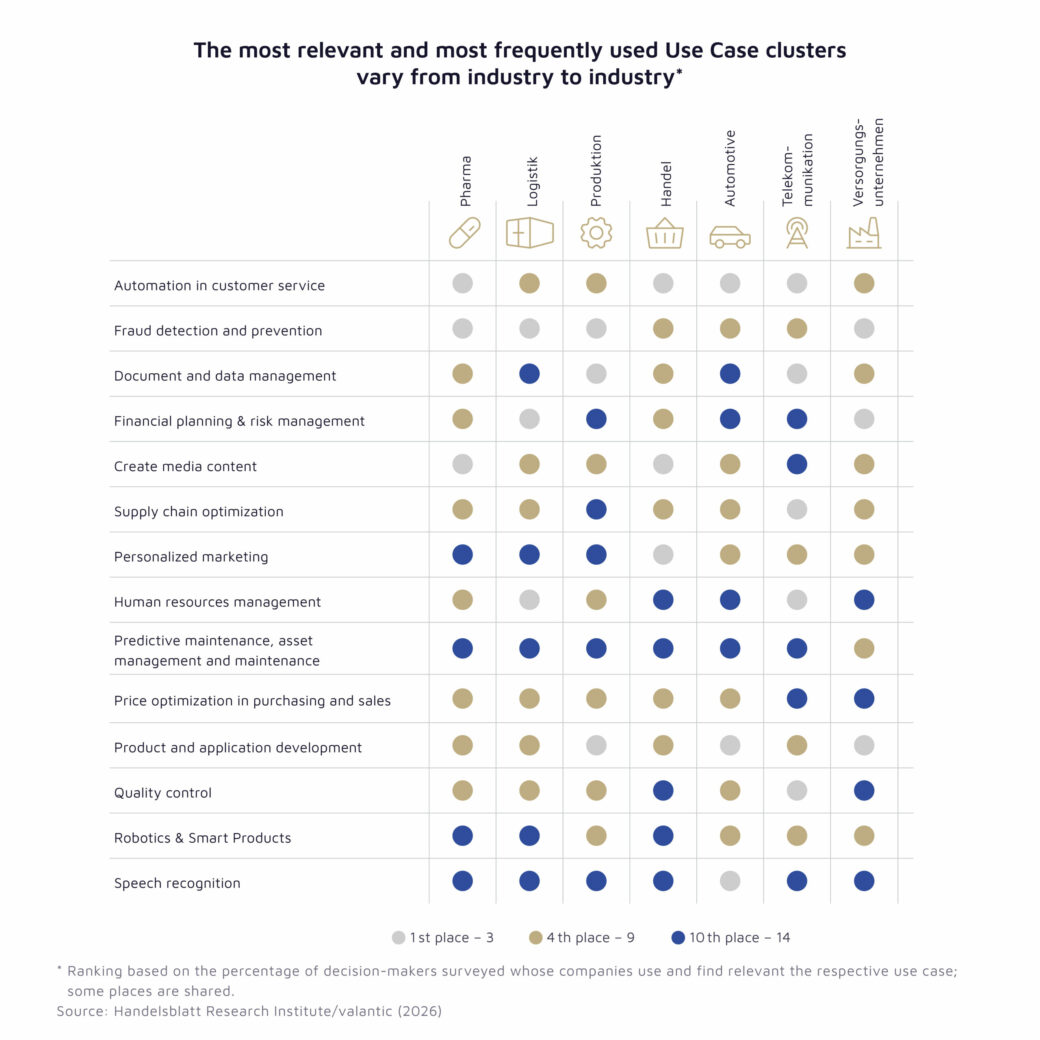
The five strongest use cases in the industry where respondents are already achieving measurable benefits turned out to be supply chain management, fraud detection, price optimization, document management, and personalized marketing.
Around 65 percent of retailers use AI for supply chain optimization and inventory planning, of which 34 percent recognize added value. The benefits of AI applications for fraud detection and prevention are rated just as highly, with more than 60 percent using them. In terms of impact, these two use cases exceed the study average, which indicates that retailers are more advanced in operational, margin-specific applications than other sectors.
57 percent of respondents rely on AI-supported price optimization in purchasing and sales, of which around 32 percent see real added value. Document and data management ranks fourth in retail: of the 69 percent who use such applications, 30 percent have seen measurable effects. AI for personalized marketing is also widespread at around 60 percent, with 29 percent recognizing added value.
The survey also focused on factors that, according to respondents, determine the success of AI initiatives. The most important factors for retail organizations are a quality-assured, trustworthy data basis and clear governance structures for data and AI, followed by modular and scalable AI systems, empowering employees to work with AI and visible support for AI initiatives from management.
83 percent are also convinced that companies that invest in ethical, transparent and well-managed AI will be more successful by 2030 than those that rely solely on speed and automation. 70 percent agree with the statement that creativity, empathy and ethical judgment will become the most valuable human skills, while analytical and operational tasks will be largely automated.
When it comes to digital sovereignty, the retail sector is also taking a reflective approach: More than half (52 percent) currently see a high level of dependency on non-European cloud and AI providers, which 65 percent rate as critical. 83 percent are already taking countermeasures that are primarily human-centered: Here too, executives see empowering employees by building up AI expertise as a key lever. It underlines the fact that digital sovereignty is a management task, not just an IT issue.
The results of the Digital Excellence Outlook 2026 are based on a quantitative and qualitative survey. In quantitative terms, 1,000 executives from companies in the DACH region were surveyed, including more than 100 managers from retail and CPG. The quantitative survey was supplemented by eight exclusive in-depth interviews with executives from international companies, including DAX, MDAX and SMI groups.
In addition to retail, the study, which was conducted in collaboration with the market research institute techconsult, focused on C-level voices from the automotive, pharmaceutical, production, logistics, telecommunications, and utilities (electricity, gas and water) sectors.
The study is freely available: Digital Excellence Outlook 2026 – AI at Scale

Source: valantic
Julia Saswito, Senior Vice President CX & Lead of the Retail & CPG Practice, valantic
Source: valantic
Retail companies see the greatest potential for AI primarily in the automation of customer service, the creation of media content, and personalized marketing.