Highlight

Successful together – our valantic Team.
Meet the people who bring passion and accountability to driving success at valantic.
Get to know usMunich, April 22, 2026: Digital sovereignty is high on the agenda of companies in the DACH region: According to a recent study by valantic and the Handelsblatt Research Institute (HRI), 90 percent of the 1,000 decision-makers surveyed have already taken action or are planning measures to strengthen their digital independence. Another result of the C-Level survey Digital Excellence Outlook 2026: Organizations with a high level of maturity in the use of artificial intelligence are taking a particularly determined approach to the topic of digital sovereignty.
Current geopolitical conflicts and the tense relationship between Europe and the US administration have recently made many managers aware of the risks that can arise when critical data, platforms and technologies are predominantly in the hands of a few non-European players. Digital sovereignty is rapidly gaining strategic importance – a trend that the joint study by valantic and HRI clearly confirms with regard to the attitudes and measures of European companies.
The study results show: The majority of companies in the DACH region have not only recognized the urgency, but have already taken action. The clear majority of the decision-makers surveyed reported that concrete steps to increase digital independence have either already been taken in their organizations or are currently being implemented or planned. Only one in ten participants stated that they had neither taken any measures nor were exploring corresponding initiatives. This is a clear signal that doing nothing when it comes to digital sovereignty has become the exception.
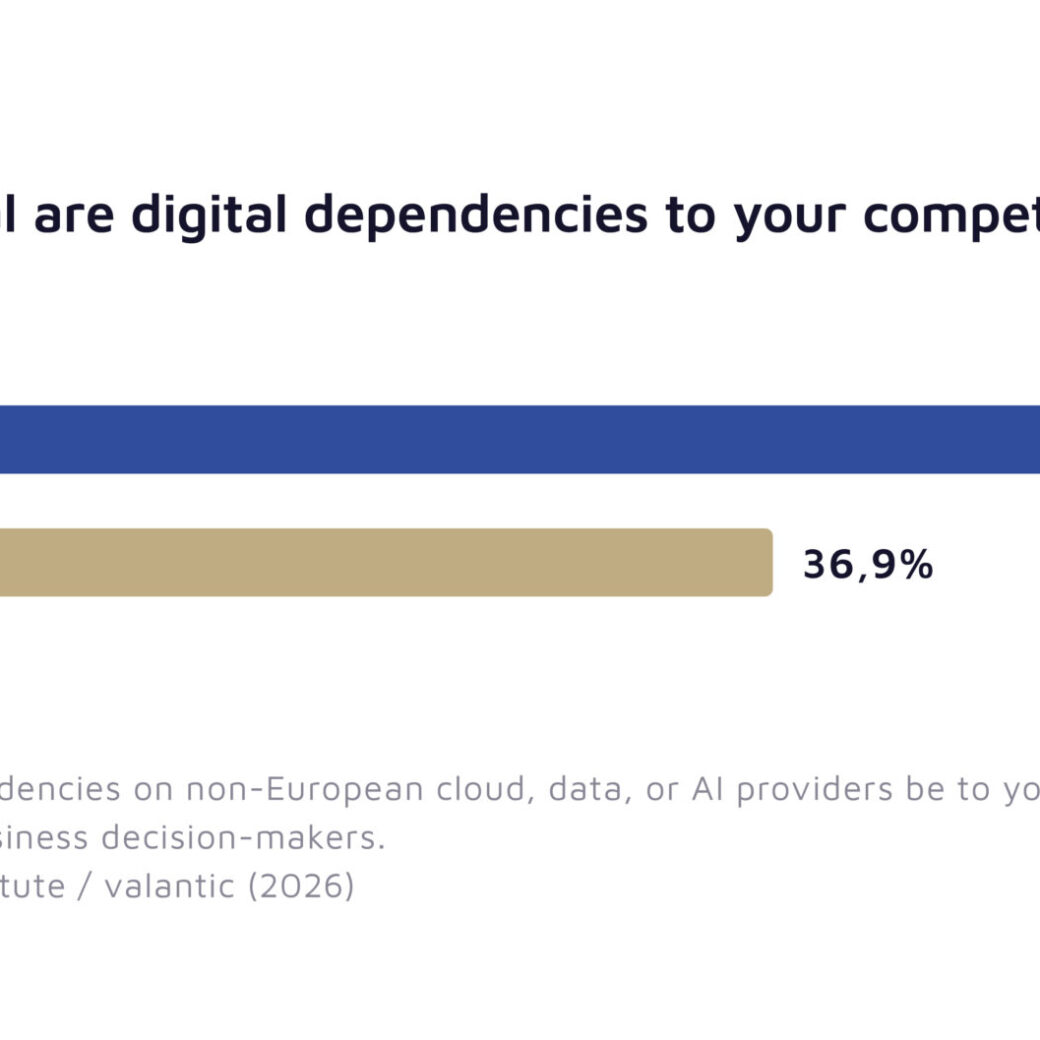
In many cases, DACH companies are also pursuing digital sovereignty not with individual measures, but with a whole bundle of strategic and operational initiatives. The pressure to act is clearly felt to be great: Almost two thirds of respondents consider their digital dependency to be critical for future competitiveness.
To meet this challenge, companies are primarily focusing on central data and infrastructure levers: Around two out of three companies are already actively pursuing concepts of company-wide data classification and residency policies. Almost a third have already fully established these requirements (29 percent), while another third (38.3 percent) are currently working on their implementation.
In terms of infrastructure, 69 percent have placed a clear focus on EU data residency and location for primary storage and backups, meaning that corresponding concepts have already been introduced or are currently being implemented. A similarly high proportion use EU-based alternatives and sovereign cloud offerings or are currently introducing them (66.2 percent).
At the same time, more and more companies are relying on their own key management systems and BYOK (Bring Your Own Key) concepts. 28.3 percent have long since implemented such models, while a further 36.5 percent are in the process of introducing them. It is clear that where data is stored, under which jurisdiction it is processed and how technological dependencies on non-European providers can be reduced is of growing importance to those surveyed.
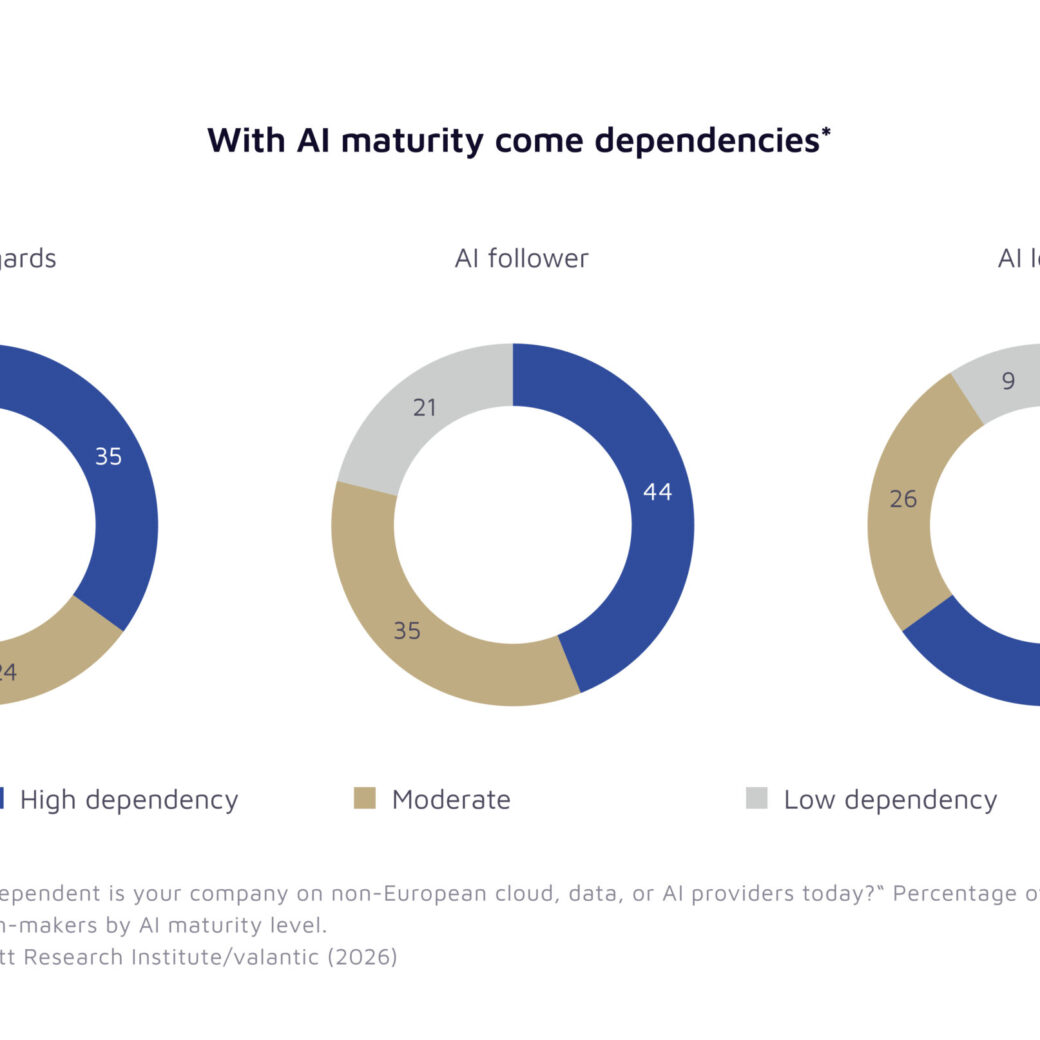
According to the study, companies with a high level of AI maturity* take a particularly critical view of their dependency on non-European cloud, data and AI providers – and draw clearer consequences from this than the rest. While only around a third of companies with a low level of AI maturity consider their own dependency to be high (35 percent), this figure is almost two thirds (65 percent) for AI pioneers.
This awareness translates into decisive action: The degree of implementation of measures to strengthen digital sovereignty is significantly higher among AI pioneers than among the other respondents. The focus is primarily on active investment in their own data and AI infrastructures in Europe as well as cooperation with European technology and cloud providers; participation in national or European initiatives complements this approach.
“Increasing digital sovereignty is high on the management agenda of DACH companies,” says Laurenz Kirchner, Managing Director and Head of the AI Practice at valantic. “Especially against the backdrop of geopolitical tensions and the strong role of non-European cloud and AI providers, the pressure to actively manage dependencies is growing. The AI pioneers in particular are sending a clear signal: those who invested in AI early on are now very consciously dealing with issues of control over data, infrastructure and encryption technologies – and deriving concrete investment decisions from this.”
The results of the Digital Excellence Outlook 2026 are based on a quantitative and qualitative survey. In quantitative terms, 1,000 corporate decision-makers from Germany, Austria and Switzerland (DACH region) with more than 100 employees were surveyed, with one third having more than 1,000 employees. Approximately eleven percent of the companies surveyed have more than 5,000 employees. The quantitative survey was supplemented by eight exclusive in-depth interviews with managers from international companies – including DAX, MDAX and SMI groups.
Most of the interviewees were C-level managers. The focus is on the automotive, pharmaceutical, retail, production, telecommunications, logistics and utilities (electricity, gas and water) sectors.
*In order to determine the AI maturity of the companies, the respondents were asked for a self-assessment: A high level of AI maturity was characterized by the fact that companies have already explicitly anchored AI transformation in their business strategy and have built up extensive expertise in the use of AI within their own organization.
Click here to view the full study report free of charge:
AI at Scale: The study at a glance – Digital Excellence Outlook 2026
Source: valantic
Companies with a high level of AI maturity report significantly higher digital dependencies than the rest.
Source: valantic
Almost two thirds of respondents consider their digital dependency to be critical for future competitiveness.

Source: valantic
"Increasing digital sovereignty is high on the agenda of the executive floors of DACH companies," says Laurenz Kirchner, Managing Director and Head of the AI Practice at valantic.