Highlight

Successful together – our valantic Team.
Meet the people who bring passion and accountability to driving success at valantic.
Get to know usEffectively increasing success - the role of production logistics
Production logistics is at the heart of efficient material flow control and optimization in the manufacturing industry. It forms the backbone of every successful production operation, as it enables the seamless planning, control and optimization of material flows. Through the targeted coordination of resources, it makes a significant contribution to reducing costs, shortening throughput times and improving on-time delivery. As a result, production logistics is playing an increasingly central role in the efficiency and competitiveness of companies along the entire supply chain in a globalized economy.

Production logistics in detail
Production logistics focuses on the areas of material procurement, warehousing, production planning and control as well as transportation and shipping. Its primary objectives are to increase efficiency, reduce inventories, meet delivery deadlines on time and increase process flexibility. It serves as a link between suppliers, production facilities and customers and makes a decisive contribution to ensuring the long-term success of a company. Its central tasks include
Analysis of material requirements
Coordination of suppliers
Monitoring material flows
Continuous optimization of processes
The main objective is to ensure that the production process runs smoothly in order to reduce costs and strengthen the company’s competitiveness. By precisely analyzing material requirements and working closely with suppliers, production logistics achieves a continuous supply of the required materials. Monitoring material flows ensures that the right quantities are available in the right place at the right time. By optimizing production processes, production logistics aims to increase efficiency and minimize bottlenecks, resulting in an overall improvement in the performance of the entire production chain.
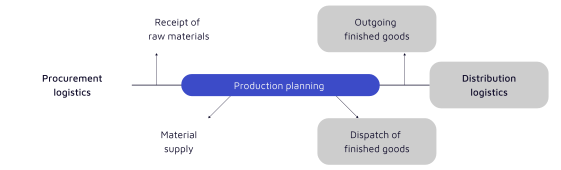
Production logistics represents the link between procurement and distribution logistics and thus bridges the gap between the receipt of raw materials and the dispatch of finished goods. In the area of procurement logistics, production logistics acts as an interface by ensuring the supply of materials for the production process. This process includes core tasks such as the precise planning and implementation of material procurement and effective coordination with suppliers. At the distribution logistics level, production logistics takes over the finished goods from production and prepares them for dispatch. In particular, this also includes storage, picking products and optimizing transport routes for delivery to customers or interim storage facilities.
The close integration of the two core areas ensures a seamless flow of materials along the entire supply chain.
Optimized production logistics offers companies numerous advantages that have a positive impact on their success. Targeted optimization can not only increase your competitiveness, but also improve profitability. You also benefit from:
Production logistics is a crucial area for companies, but one that can present a variety of challenges. From the complexity of the supply chain to quality assurance, companies face various hurdles that need to be overcome. But with the right solutions, these challenges can be tackled successfully. Below, we present a few challenges with our solutions:

Complexity of the supply chain
Supply chain complexity refers to the multitude of variables and factors involved in the process of sourcing, manufacturing and delivering goods or services. They include, for example, fluctuating demand, legal regulations and geopolitical events. In particular, these aspects result in bottlenecks, delays, increased costs and inefficient processes.
Solution: To overcome this challenge, the implementation of SCM (Supply Chain Management) systems and ERP (Enterprise Resource Planning) software is crucial. SCM systems provide a holistic view of the supply chain and improve the planning, coordination and monitoring of material flows. ERP software supports companies in integrating various business processes, including production, procurement, sales, finance and human resources.

Warehousing and inventory management
This area focuses on the effective management and control of stock levels in order to avoid overstocking. However, this core task can be complicated by issues such as inaccurate forecasting, inefficient warehouse processes or unpredictable fluctuations in demand.
Solution: Using inventory management software helps your company to monitor and manage stock levels efficiently. It offers precise inventory analysis, automated procurement processes and optimized storage space. It would also make sense to use the just-in-time (JIT) principle. This approach is based on the goal of only procuring or manufacturing products when they are actually needed, in order to avoid large inventories and still ensure timely deliveries.

Transportation and logistics
The challenge in this area is to plan routes efficiently in order to deliver products on time and at low cost. However, unpredictable events such as complex delivery routes and poor traffic conditions can make planning more difficult, which can lead to delays.
Solutions: Technologies such as telematics and GPS systems enable you to obtain real-time information about the location of vehicles, allowing you to identify and respond flexibly to traffic disruptions. This allows the transportation process to be designed efficiently.

Communication and coordination
The exchange of information between different teams and partners in the supply chain is based on clear and comprehensible communication. If this is not the case, misunderstandings can arise, which usually result in delays or errors.
Solution: Establishing clearly defined communication channels and using collaboration platforms helps to share information transparently and effectively, assign tasks and monitor progress accurately. These steps promote relationships and collaboration with each other and ensure smooth production processes.

Quality control
A company’s products and services must meet the increasing and changing requirements of customers and the defined standards. Quality deficiencies not only lead to customer dissatisfaction, but also to increased costs.
Solution: By implementing quality management systems, you can carry out regular checks to ensure the consistent quality of your goods. In addition, training employees and suppliers is crucial to create awareness of quality standards and ensure that everyone involved understands and adheres to the required procedures and processes.
Do you have questions about production planning and control? Get in touch with us!
Our company offers first-class solutions in the field of production logistics to help you achieve greater efficiency and higher profitability. With a comprehensive approach to planning, controlling and optimizing material flows, we help your company to reduce costs and optimize your delivery reliability. From the analysis of material requirements to the coordination of suppliers and the continuous optimization of processes, we support our customers to ensure that their production processes run smoothly.


Efficient production – the art of batch size optimization
Batch size optimization helps to reduce production costs and make processes more efficient. The aim is to achieve a good balance between set-up and storage costs.

Gereon Küpper
Partner
valantic

Dennis Goetjes
Partner
valantic