Highlight

Successful together – our valantic Team.
Meet the people who bring passion and accountability to driving success at valantic.
Get to know usOptimize logistics & warehouse management
Outsourcing refers to a company’s strategic decision to outsource certain tasks or processes to external service providers.
Taking logistics as an example, it would be possible to outsource transport logistics to a service provider if the company’s own fleet of vehicles is closed down, or to outsource warehouse operations. If service providers are commissioned with certain company processes, they can be responsible for the planning, execution and optimization of activities in the supply chain.
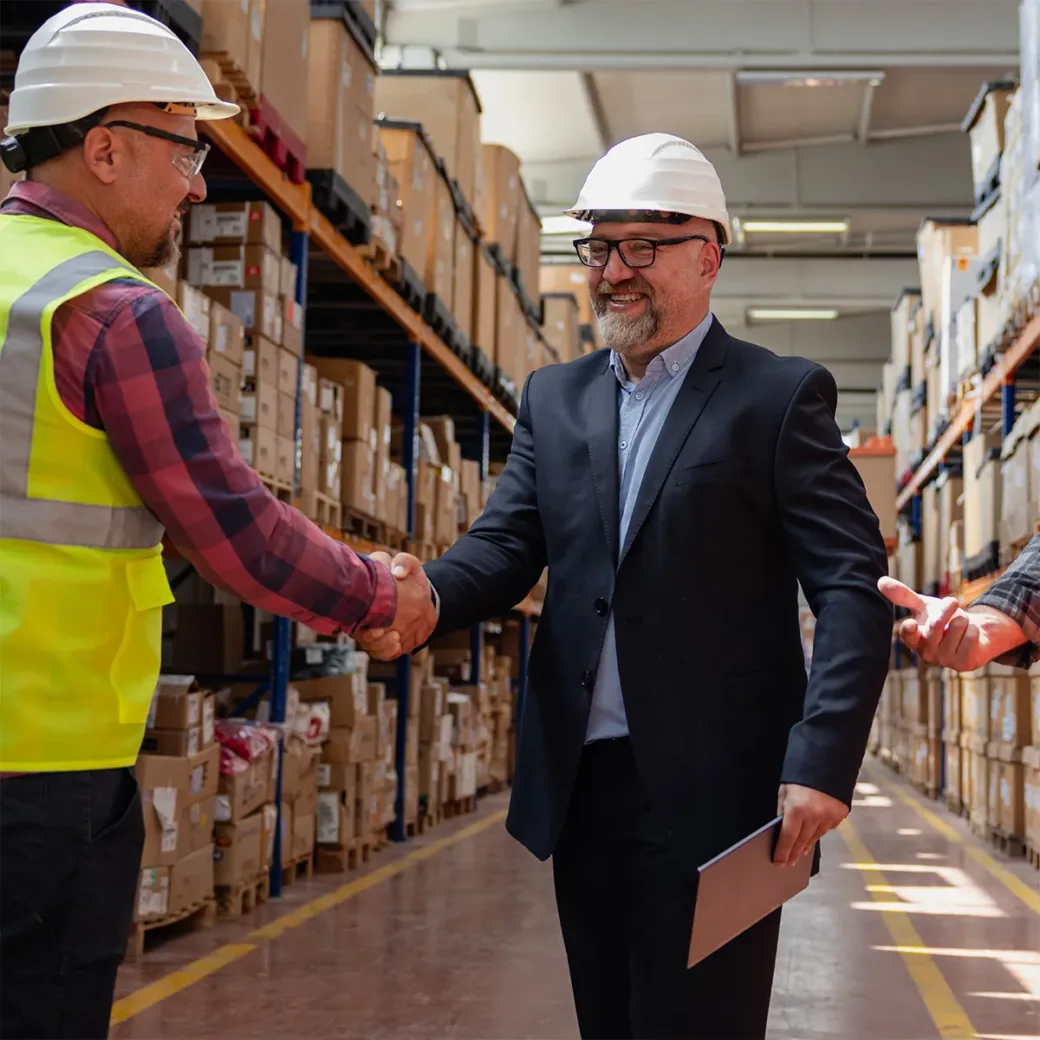
The decision as to which activities should be outsourced depends heavily on a company’s current corporate goals, market conditions (complexity, globalization) and core competencies.
By outsourcing logistics processes, companies can conserve their internal resources, concentrate on their core business and benefit from the experience and expertise of service providers. The economic goal behind this is primarily to reduce costs.
By outsourcing tasks such as warehousing, transportation, customs clearance and inventory management to logistics service providers, companies can draw on their specific expertise. These service providers not only have experience in optimizing logistics processes, but can also negotiate better conditions with transport service providers, for example, and achieve synergy effects.
Logistics outsourcing requires careful and individual planning, taking into account the company’s specific requirements and objectives. If a company decides to outsource, it can choose between two outsourcing models:
The success of logistics outsourcing lies in careful and individual planning. Every company has specific requirements and objectives that need to be taken into account. Deciding which logistics functions should be outsourced and which outsourcing model is most suitable requires a thorough analysis.
Overall, logistics outsourcing offers a strategic opportunity to increase a company’s overall performance by drawing on the expertise of external service providers and using internal resources more efficiently.
For many companies, the decision to outsource logistics processes is a strategic step that should be taken after careful analysis and consideration. The suitability of logistics outsourcing depends largely on the size, type and sector of a company.
Companies with complex supply chains and different geographical (warehouse) locations can benefit significantly from logistics service providers with a global presence. Not only can they realize cost savings, but they can also optimize supply chain efficiency, improve product quality and allow the company to use its own resources to optimize other areas. The separation of peripheral processes enables a more effective use of capacities and promotes concentration on the company’s strategic strengths.
For companies that are subject to seasonal fluctuations, outsourcing logistics processes can offer crucial flexibility. External service providers are better able to adapt to fluctuations and adjust resources accordingly without disrupting internal processes. Another reason for logistics outsourcing is the lack of availability of internal resources, expertise or technology for efficient logistics processes. External service providers can provide cost-effective resources and bring with them specialized expertise and state-of-the-art technologies.
The decision to outsource logistics requires intensive analysis and clear criteria. Factors such as the complexity of the supply chain, the desired risk reduction, the lack of internal resources, the volatility of demand, the improvement in service quality, profitability in various areas and the desired expansion and growth all play a decisive role.
In a successfully implemented customer project, a furniture company decided to outsource the omnichannel warehouse, which plays a central role in the efficient supply of stationary stores and online customers, to an external service provider. The decision-making process was part of a careful make-or-buy decision and involved several crucial steps:
Market analysis and identification of potential service providers
To begin with, a detailed market analysis was carried out to identify potential service providers. Criteria such as experience in the retail sector, omnichannel expertise, geographical reach and reputation were taken into account.
Implementation of the tender
Based on the market analysis, a tender was carried out in which the requirements of the furnishing company were clearly defined. Potential service providers were invited to submit their expertise and proposed solutions.
Negotiations and contract conclusion
After a thorough examination of the offers received, intensive negotiations followed. The focus was not only on costs, but also on service quality, flexibility and scalability. Following successful negotiations, a detailed contract was concluded.
Implementation and realization of the benefits
The implementation phase was crucial for the transition from internal to external logistics processes. A detailed plan was developed to ensure that the transition could take place smoothly. This included training for employees, the integration of IT systems and the optimization of processes.
The switch to logistics outsourcing resulted in significant savings for the furniture company. By using the specialist service provider, the company was able to implement more efficient warehouse processes, significantly increase its flexibility and benefit from the service provider’s economies of scale.
The decision to outsource logistics processes has both advantages and disadvantages. It is crucial to weigh these up carefully in order to make an informed decision.
Cost benefits through economies of scale
By working with logistics service providers, companies can benefit from economies of scale that lead to cost savings.
Free capital through elimination of investments
Outsourcing logistics functions enables companies to free up capital, as investments in warehouses, vehicle fleets and technologies are no longer required.
Increasing flexibility
Logistics outsourcing increases the flexibility of companies as they can adapt more quickly to changing market conditions and fluctuations in demand.
Access to know-how and advanced technologies
External service providers bring specialized know-how and advanced technologies that can contribute to the optimization of logistics processes.
Increasing efficiency and service quality
Cooperation with experienced logistics partners can increase efficiency in the supply chain and lead to an optimization of service quality.
Dependence on external partners
The outsourcing of logistics processes creates a dependency on external partners, which harbors risks in terms of reliability and dependability.
Potential loss of control over quality standards
Companies can run the risk of losing control over compliance with their quality standards if these are not adequately secured through contracts and monitoring.
Potential loss of control over the supply chain
Outsourcing can lead to a loss of direct control over the supply chain, which could impair the ability to react in certain situations.
It is important to emphasize that the advantages and disadvantages depend heavily on the individual situation, the company’s objectives and the choice of the right partner. A thorough analysis and a clear strategic direction are crucial in order to make the most of the advantages of logistics outsourcing and counteract possible disadvantages.
Before selecting a suitable partner, the company’s long-term goals and specific requirements should be carefully considered. In this context, logistics outsourcing can offer significant benefits, such as cost savings and increased flexibility. However, it is crucial that outsourced activities support the company’s long-term goals. Transparent communication and clear contracts are necessary to minimize potential disadvantages such as dependency on external partners.
Our supply chain design services include a variety of strategic solutions designed to support your business objectives and optimize your logistics processes.
Do you have questions about outsourcing your logistics? Feel free to contact us!

Dennis Goetjes
Partner
valantic

Gereon Küpper
Partner
valantic