Highlight

Successful together – our valantic Team.
Meet the people who bring passion and accountability to driving success at valantic.
Get to know usEffective ESG reporting in the age of CSRD: Precision and strategic foresight open the way for finance teams to transform processes and exceed stakeholder expectations. The journey to sustainability excellence starts here.

Materiality analysis has become an indispensable tool for companies as it provides a means of identifying and prioritizing sustainability issues within their business operations. In a complex working environment that is subject to constant change, it provides a structured method for differentiating from the competition and thoroughly identifying sustainability opportunities & risks. Based on the systematic and holistic assessment of the interrelationships between all business activities and sustainability issues, companies can efficiently optimize their strategies and make informed decisions. The materiality analysis thus enables an improved understanding of both internal and external challenges. As a result, sustainability risks can be minimized and opportunities and strengths made transparent. This helps companies to differentiate themselves from the competition.
By assuming economic responsibility and increasing transparency through the analysis, companies not only promote their credibility in general, but also the trust of the relevant stakeholders.
The materiality analysis therefore not only aims to minimize risk, but also to improve your company’s competitiveness and reputation and, as a central component of corporate reporting, is a cornerstone of strategic alignment and creditworthiness.

Carsten Schäffner
Manager Corporate Performance Management, valantic GmbH
”Sustainability in corporate reporting is not a trend, but an indispensable reality. The CSRD sets a new standard for transparency and responsibility. The materiality analysis is not just a tool, but a strategic guide that helps us to identify and communicate the truly relevant issues. In this way, we create added value that goes far beyond compliance with regulations.“

Dr. Lukas Stumpf
Manager, HÖVELER HOLZMANN CONSULTING GmbH - a valantic company
”The materiality analysis is the link between sustainability and business success. It helps us to translate the requirements of CSRD into clear action steps that are of real value to both stakeholders and the company itself - pragmatically, effectively and on a par with key financial figures.“
According to CSRD
The Corporate Sustainability Reporting Directive (CSRD) marks a significant step towards increased transparency and accountability of companies with regard to their sustainability performance. It requires companies to apply a dual materiality perspective in their reporting process. This means that they must consider both the impact of their activities on the environment and society (so-called “outside-in” perspective) and the impact of environmental and social issues on the company itself (so-called “inside-out” perspective).
Integrating both perspectives into the materiality analysis enables companies to prioritize sustainability issues, taking into account both the greatest external impacts and the most significant internal influences. This dual approach promotes a deeper understanding of how sustainability affects business strategy, risk management and operational performance. The stakeholder-oriented approach of the dual materiality analysis ensures that companies must enter into dialog with customers, employees and investors in order to understand and incorporate their perspectives.
To successfully implement the materiality analysis in accordance with the CSRD guidelines, the following steps are crucial:
Identification of suitable stakeholders
…and central internal and external knowledge carriers in order to gain a comprehensive understanding of the relevant topics.
Identification of potentially relevant sustainability topics
…using industry standards and benchmarks and taking into account the CSRD topic list.
Conducting interviews and materiality assessments
…with internal and external stakeholders to assess the environmental, social and financial aspects. The impact of your company on the environment and society (inside-out) is considered, as is the impact of sustainability issues on the company’s financial situation (outside-in).
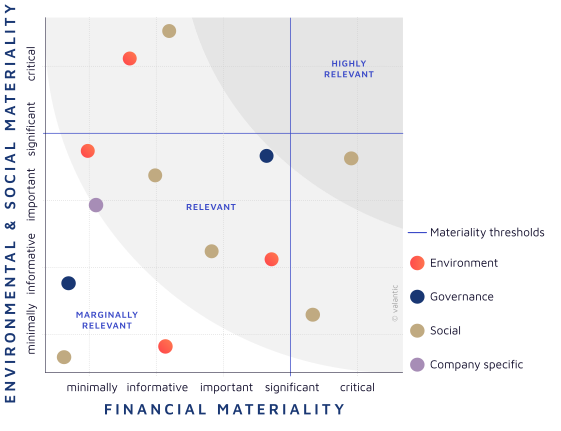
Definition of materiality thresholds
…taking into account strategic interests, content coherence and benchmarks in order to clearly define the relevant topics.
Creation of a materiality matrix
…for the clear presentation of material and reportable sustainability topics.
Derivation of disclosure obligations
…for the first CSRD report, including the definition of responsibilities for reporting.
According to ISO
The following ISO standards, particularly in the area of sustainability and corporate governance, require a materiality analysis as an essential component of compliance and to promote business activities:
ISO 14001
Standard for environmental management systems: This standard requires the recognition of significant contributions. These primarily include environmental impacts that are significant and under the control of your organization. A materiality analysis would be crucial here as it enables the setting of environmental objectives and the development of measures to reduce the identified environmental impacts.
ISO 26000
Guideline for the social responsibility of organizations: This guideline requires the inclusion of a materiality analysis as part of the process of identifying and prioritizing all relevant issues that affect the area of social responsibility. By analyzing stakeholder expectations, you can align your business practices with them and thus strengthen the trust of all parties involved.
The importance of materiality analysis in various sectors of the economy

The materiality analysis obligation applies to all companies across all sectors that are affected by the CSRD Directive or have ISO certifications, as the materiality analysis is a requirement of the Directive and the standards. It serves to provide companies with a customized roadmap, whereby sustainability is not just seen as an isolated issue, but as a strategic success factor.
Sustainability issues are prioritized with the systematic involvement of relevant stakeholders, resulting in a clear focus on the most important challenges and opportunities. By identifying strengths and sustainability risks, companies can make effective investment decisions and allocate resources to the various sustainability areas in a targeted manner.

By taking a holistic approach, the materiality analysis has established itself as a suitable instrument, particularly for managing investments in sustainability.
In addition, the materiality analysis highlights a company’s holistic contribution to sustainability and identifies unique selling points and competitive advantages in the area of sustainability. By identifying internal strengths and potential, organizations can positively differentiate themselves from the competition and strengthen their reputation as a responsible and future-oriented company.
Whether in manufacturing, the service sector or trade – every industry is confronted with challenges and potential in the area of sustainability.
The relevance of the materiality analysis is therefore given across all sectors, but it varies depending on the industry, as the key sustainability issues can vary. Based on the specific requirements and sustainability issues of the individual sectors, the materiality analysis identifies individual opportunities and sustainability risks for each industry and thus helps them to determine suitable strategies for the successful implementation of sustainable practices.
The key to success
Relevant factors for an effective analysis
The success of a materiality analysis depends on various factors that must be considered with great care. These include in particular
Stakeholder analysis can be used to identify relevant stakeholders and their specific expectations. Taking the individual needs of stakeholders into account when making decisions can promote satisfaction, which ensures a stronger bond with the individual parties.
Companies are obliged to assess a large number of sustainability issues in the areas of social, environmental and governance in relation to the complex market situation, their own business model and strategic relevance.
All technological, political and social developments should be taken into account. The evaluation should be carried out both inside-out (impact of corporate actions on the environment and society) and outside-in (short, medium and long-term effects of sustainability issues on the company itself). In order to gain an overview of this complex situation and identify key sustainability issues with certainty, tailor-made interviews, a precise inclusion of key knowledge carriers and an in-depth analysis of corporate sustainability data are required.
Internal conflicts of interest, for example between short-term profit targets and long-term sustainability, can influence the success of a materiality analysis.
Through transparent discussions and constructive management of such conflicts, companies can develop an integrative approach that promotes long-term value creation and stakeholder satisfaction.
Another key component is the company’s ability to transform the findings of the materiality analysis into concrete action plans and strategic measures.
This requires clear commitment on the part of management, precise objectives and effective internal communication that enables smooth implementation.
Understanding risks, exploiting potential, securing competitive advantages
Prioritization
The materiality analysis is indispensable for companies as it helps them to identify and prioritize important aspects within their business activities.
Well-founded decisions
Through a thorough evaluation of economic, social, ecological and corporate management issues, well-founded decisions can be made and existing strategies optimized.
Analyze challenges & strengths
The analysis uncovers both internal and external challenges and strengths and focuses on all relevant parties for the respective company.
Recognize risks & potentials
On this basis, risks can be reduced and potentials identified, allowing the company’s unique selling points to be worked out and its overall competitiveness to be increased.
Meeting regulatory requirements
The method is required or recommended by numerous regulatory requirements and standards, such as the CSRD Directive and the ISO standards, in order to meet the sustainability criteria and serves as a means of effective stakeholder communication and sustainability management.
Strengthening leadership & communication
Successful implementation requires strong management commitment and effective internal communication.
We look forward to working with you to develop sustainable strategies for the future.

Marco Fuhr
Managing Consultant
valantic

Jan Laakmann
Partner
valantic

Dr. Jens Lehnen
Principal
valantic

Sebastian Badaghlou
Partner & Managing Director
valantic