Highlight

Successful together – our valantic Team.
Meet the people who bring passion and accountability to driving success at valantic.
Get to know usThe CSRD makes sustainability measurable – and a real opportunity for companies to assume responsibility and strengthen trust. Now is the time to anchor sustainability strategically.

What is behind the EU directive?
The Corporate Sustainability Reporting Directive (CSRD) is an EU directive that brings about a significant change in sustainability reporting for European companies. It requires sustainability information to be integrated into the management report and treated at the same level as financial reporting, including verification by auditors.
The CSRD improves the comparability and transparency of sustainability performance, allowing companies to be assessed more clearly in terms of their sustainability performance by stakeholders such as investors, customers, authorities and NGOs.
What impact does CSRD have on companies?
From 2024, over 39,000 EU companies will have to integrate their sustainability reports into the management report in accordance with the European Sustainability Reporting Standards (ESRS).
The CSRD is intended to make reporting more transparent and reliable, raise it to the level of financial reports and thus promote sustainable business and social responsibility. To this end, companies must systematically record and disclose up to 1,200 data points, including Scope 3 emissions.
Non-compliance can result in penalties of up to 5% of turnover, while compliance can lead to incentives and competitive advantages.

Dr. Jens Lehnen
Principal, valantic GmbH
”The CSRD is more than a guideline - it is a promise to the future. Our in-depth knowledge of materiality analysis enables companies to think beyond compliance and embed sustainability at the core of their business strategy.“
ESG in focus
The CSRD requires reporting in accordance with the European Sustainability Reporting Standards (ESRS). These are divided into three main areas: environmental, social and governance (ESG):
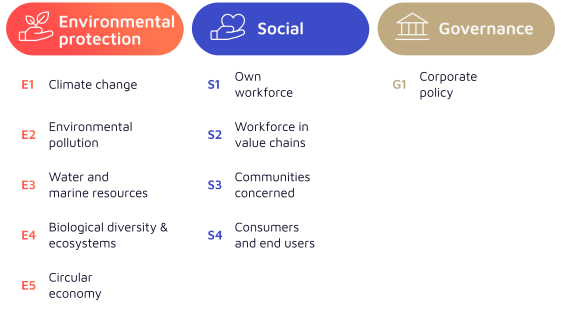
The CSRD represents an extension to the Non-Financial Reporting Directive and also increases the number of companies affected from approx. 11,600 to approx. 50,000.
The new obligations associated with the CSRD are:
Future-oriented action
The objectives and benefits of the CSRD
The CSRD offers a variety of benefits, including the promotion of transparency and comparability of sustainability information, which helps companies to better understand and optimize their performance in this area.
It also facilitates the identification of best practices and benchmarks, which in turn enables companies to learn and develop from the experiences of others.
Furthermore, the guideline helps to simplify investment decisions by providing investors with transparent insights into the sustainability performance of companies and thus promoting the integration of sustainability criteria into decision-making processes.
Last but not least, the CSRD can help position sustainability as a competitive advantage by encouraging companies to improve their sustainability practices and demonstrate their commitment to environmental and social responsibility.

January 1, 2024
Validity for large companies that already have to report in accordance with NFRD
January 1, 2025
Valid for all other large companies
January 1, 2026
Valid for all listed SMEs
January 1, 2028
Applies to all non-EU companies and a subsidiary or branch in the EU if they exceed certain thresholds
5 steps to implementing the CSRD
Requirements
The aim of this step is to identify the key sustainability issues for the company and its stakeholders. By involving both internal and external stakeholders, a comprehensive understanding of the relevant topics is achieved. This systematic identification forms the basis for deriving the disclosure obligations that must be made transparent in the company’s sustainability report.
To-do checklist:
The aim of this step is to identify the discrepancies between the company’s current sustainability reports and the CSRD requirements. A detailed analysis should ensure that all areas in which the company does not yet meet the CSRD requirements are identified. Measures are then defined to close these gaps and achieve compliance with the CSRD reporting obligations.
To-do checklist:
In order to meet all CSRD reporting obligations on time, it is necessary to create a detailed and prioritized implementation plan. This plan not only clearly sets out the responsibilities within the company, but also defines the deadlines for each step to ensure timely and proper reporting.
To-do checklist:
This step focuses on implementing the necessary measures in accordance with the previously defined roadmap. It also includes the comprehensive management of the program to ensure coherent implementation across all departments and areas of the company.
To-do checklist:
This step focuses on implementing the necessary measures in accordance with the previously defined roadmap. It also includes the comprehensive management of the program to ensure coherent implementation across all departments and areas of the company.
To-do checklist:
Legally compliant reporting in accordance with the ESRS standard is the final step in this process. The aim here is to ensure that all of the company’s sustainability information complies with European standards and is communicated in accordance with legal requirements.
To-do checklist:
...and their solutions
Companies face the challenge of adapting their internal processes to enable comprehensive and accurate reporting. The core challenges include integrating sustainability aspects into existing reporting systems, ensuring data quality and availability and developing a coherent communication strategy that meets the requirements of stakeholders.
Consideration of the entire value chain requires close cooperation with partners and suppliers. Against this backdrop, it is crucial to develop strategic approaches that not only aim to fulfill the requirements of the CSRD, but also lay the foundation for continuous improvements in the area of sustainability. The aim is to anchor sustainability as an integral part of the corporate strategy and thus secure long-term competitive advantages.
Low resource availability
Templates for fast implementation
Many local contacts
Enabling the organization in a structured transformation approach
High manual effort
Smart data analytics solutions
Uncertainty: "Where to start CSRD?"
CSRD GAP analysis (readiness check)
Diffuse process governance
Maximum process transparency through automated reporting tool
Complex and heterogeneous reporting
Integrated performance management
In order to efficiently and pragmatically address challenges while making the most of opportunities, we support you end-to-end with customized solutions. We are at your side throughout your entire sustainability journey, from identifying key sustainability issues to creating and implementing thematic sustainability strategies and embedding them in cross-company performance management.
Our specialized consulting services cover the following key areas:
Status quo in sustainability reporting
Comparison of the status quo in sustainability reporting with the requirements of the CSRD and other internal and external sustainability requirements
Roadmap
Design and implementation of the roadmap including detailed planning to close gaps in content (e.g. creation of decarbonization strategy) and processes (e.g. data availability, internal responsibilities)
Performance Management System
Design and implementation of a performance management system for the pragmatic and optimal fulfillment of recurring reporting obligations, including implementation of EU taxonomy requirements as part of CSRD reporting obligations
Sustainability strategies
Creation and support of sustainability strategies for the implementation of key sustainability topics (e.g. decarbonization strategy incl. reduction of Scope 3 emissions)
Circular Economy
Circular economy through the development and implementation of strategies that promote the circular economy and increase resource efficiency and reuse along the value chain
Sustainable supply chains
Sustainable supply chains through analysis, optimization and increased transparency of all supply processes, taking into account social and ecological standards
Data analytics
Data analytics for the systematic collection, processing and analysis of relevant sustainability indicators to enable fact-based decisions and reports
Double materiality analysis
Conducting a double materiality analysis including environment and stakeholder analysis to identify material sustainability issues and derive reporting obligations
Sustainable ecosystems & corporate culture
Sustainable ecosystems & corporate culture by integrating sustainability into structures, processes and values to ensure long-term acceptance and commitment
LCA and Life Cycle Assessment
LCA and life cycle assessment to evaluate environmental impacts along the entire product and company life cycle and derive specific optimization measures
Do you have any questions? Let's get into conversation.

Jan Laakmann
Partner
valantic

Marco Fuhr
Managing Consultant
valantic

Dr. Jens Lehnen
Principal
valantic

Sebastian Badaghlou
Partner & Managing Director
valantic