Highlight

Successful together – our valantic Team.
Meet the people who bring passion and accountability to driving success at valantic.
Get to know usThis website is also available in your language.
About
Highlight
Successful together – our valantic Team.
Meet the people who bring passion and accountability to driving success at valantic.
Get to know usAbout
Highlight
Successful together – our valantic Team.
Meet the people who bring passion and accountability to driving success at valantic.
Get to know usOur mission: Digital excellence for our customers.
With in-depth know-how, clear values, and a vibrant corporate culture, we shape digital transformations that make a real impact.
Careers
Careers
Highlight

Female Digital Impact
Women are increasingly shaping the IT industry – at valantic, we create opportunities together and promote talent so that diversity becomes a strength.
Turn your vision into realityCareers
Highlight
Female Digital Impact
Women are increasingly shaping the IT industry – at valantic, we create opportunities together and promote talent so that diversity becomes a strength.
Turn your vision into realityCareers at valantic – making a difference together.
Are you looking for a professional environment with challenging digital projects for renowned clients? You're in the right place.
Industrialization of procurement
COOP is a leading Swiss retail group. By centralizing procurement and optimizing selected product groups, the company achieved significant savings in the double-digit million range. A central procurement organization was established to ensure long-term efficiency and cost reductions.


The Coop Group, headquartered in Basel, Switzerland, is one of the largest retail and wholesale companies in Switzerland. Founded in 1890, Coop operates around 2,600 sales outlets, including supermarkets, specialty stores and online stores, and offers a wide range of food, non-food products and sustainable private labels such as Coop Naturaplan. With a focus on quality, regionality and sustainability, Coop is committed to fair procurement and environmentally friendly initiatives. The cooperative employs around 95,000 people and is active in Switzerland and internationally through subsidiaries such as Transgourmet.
The challenge
COOP’s procurement was organized decentrally, with autonomous responsibility in the production plants for large procurement volumes. This led to a large number of suppliers and a resulting lack of transparency. The aim was to optimize the procurement processes and bundle the volumes. At the same time, the individual requirements of the production companies were to be preserved in order to enable cost reductions.
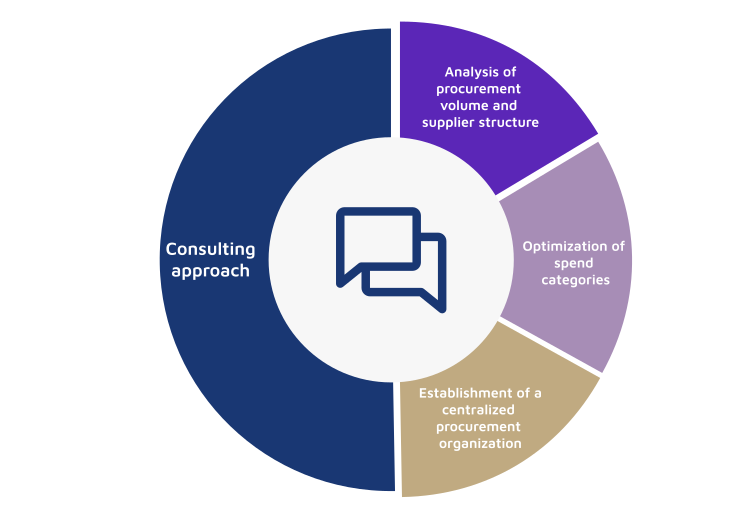
Consulting approach
Solution & results in detail
Pooling the procurement volume and reducing the number of suppliers led to considerable savings in the double-digit million range. High percentage savings potential was realized each year, particularly in packaging products. A central procurement organization secured these effects and created the basis for the continuous further development of employees.
Conclusion
By industrializing procurement, COOP achieved significant financial improvements and established a sustainable procurement strategy. The centralization of procurement and the optimization of product groups led to long-term cost reductions and a more efficient procurement organization.
