Highlight

Successful together – our valantic Team.
Meet the people who bring passion and accountability to driving success at valantic.
Get to know usOptimization of indirect procurement
bofrost* AG, with more than 10,000 employees and revenues exceeding 1.2 billion euros, faced the challenge of optimizing its procurement process. With valantic’s support, a complete P2P process was implemented in the SAP standard, and a new e-catalog solution was introduced to enable around 70% of orders to be processed via the e-catalog.


bofrost* AG, a leading direct distributor of frozen food and ice cream, employs more than 10,000 people and generates a turnover of over 1.2 billion euros. The company was faced with the challenge of optimizing its procurement process and reducing manual effort. The aim was to map a complete P2P process (procure-to-pay) in the SAP standard and to introduce a new e-catalog solution in order to map around 70% of orders using the e-catalog.
The challenge
The existing procurement process was characterized by a high level of manual and operational effort. This prevented strategic processing of issues and efficient use of resources. In addition, the existing catalog system was not being used optimally, which led to inefficiencies and delays. The company therefore needed a solution that would enable the P2P process to be fully integrated into SAP without media disruptions and significantly simplify the ordering process.
Consulting approach
In order to successfully master the challenge, the selection process for the e-catalog system was divided into three clearly structured phases:
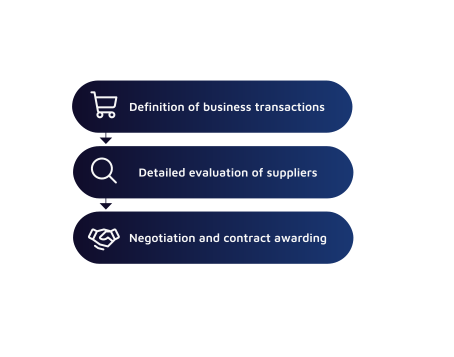
Definition of business transactions
Detailed evaluation of suppliers
Negotiation and contract awarding
Solution and customer benefits
By implementing the e-catalog system, the entire P2P process was mapped in the SAP standard. A key user concept ensures long-term use and maintenance. The standardization of the procurement process reduced manual queries and adjustments and led to a significant increase in efficiency. Operational expenditure in procurement was reduced by a double-digit percentage.
Conclusion
The new e-catalogue system enabled digital mapping of the P2P process, reduced operational expenditure in indirect procurement and increased efficiency by standardizing procurement processes.