Highlight

Successful together – our valantic Team.
Meet the people who bring passion and accountability to driving success at valantic.
Get to know usSolving a complex and costly challenge with data and AI
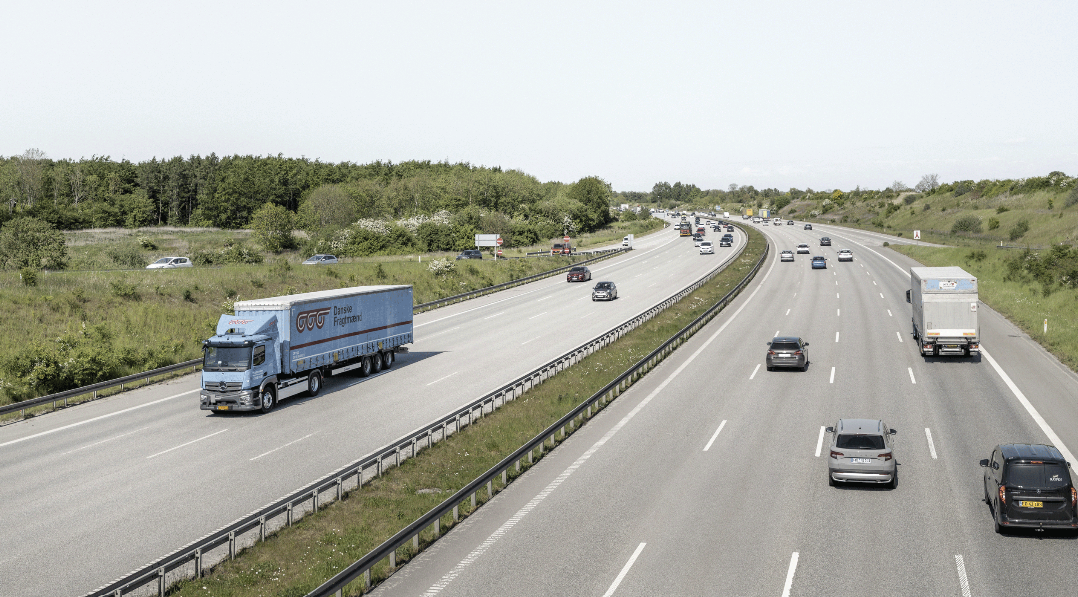
When 1,300 trucks hit the Danish highways every day, it’s not just cargo being moved – it’s vast amounts of data. And for Danske Fragtmænd, data and AI became the key to solving a complex and costly challenge brought on by new Danish road tolls.
At the start of 2025, a new Danish law came into effect: Trucks over 12 tons would now have to pay road tolls on selected roads and in urban zones. From 2028, the toll will apply to all roads.

While the toll itself wouldn’t be a major issue for a traditional transport company, it posed a serious administrative challenge – especially for Danske Fragtmænd, a joint-stock company owned by 40 independent hauliers. They make about 10 million deliveries a year, some under the Danske Fragtmænd brand and others privately.
This made the accounting and toll-processing as messy as a rain-soaked rest area. Because how do you split a monthly Brobizz bill worth millions across many hauliers – when you don’t even know which trips were company-related and which were private?

The company: Danske Fragtmænd
Danske Fragtmænd is one of Denmark’s leading freight and logistics companies, operating a fleet of around 1,300 trucks and handling approximately 10 million deliveries annually. The company is structured as a joint-stock corporation owned by 40 independent hauliers, creating a unique operational model where trips are carried out both under the Danske Fragtmænd name and in private haulage. With 27 freight terminals and extensive warehouse capacity across Denmark, Danske Fragtmænd plays a central role in national logistics.
Challenge
Danske Fragtmænd faced a serious tracking and billing issue. As a company with both internal and independently-run trucks, they lacked insight into who drove what and where. Monthly Brobizz invoices in the millions had to be split correctly – without knowing if the trips were business or private. Manual allocation was impossible at scale, and transparency was essential.
Consulting approach
The final solution automatically allocates toll costs to the correct haulier with 98% accuracy. This drastically reduces manual processing and ensures fair billing, removing friction between the company and the hauliers. Beyond tolls, the system enables precise environmental reporting and workforce forecasting – shifting operations from guesswork to data-driven efficiency.
Customer benefit and solution
valantic’s data scientists partnered closely with Danske Fragtmænd, rapidly developing a Python-based model within just three months. The solution combines GPS data, Brobizz transactions, and toll zone maps processed directly in Snowflake. By running daily retrospective calculations, the model balances accuracy with performance. The agile, co-owned approach ensured on-time delivery under high pressure.
The Challenge in Detail
Together with data scientists from valantic, Danske Fragtmænd developed an advanced model where math – quite literally – took the wheel.
Using a combination of:
The model matches GPS coordinates – pinged every 15 seconds – with specific toll-triggering road segments. It also integrates Brobizz transactions to enable precise and transparent billing.
The model doesn’t run live but retrospectively, calculating every day what happened the day before. This ensures high data quality without sacrificing performance.
Danske Fragtmænd processes the millions of GPS pings per day in their Snowflake data platform. Snowflake’s scalable compute and ability to handle semi-structured data are key advantages – especially when dealing with large, complex datasets.
Solution & Results in Detail
The road toll project was initiated in October 2024 with the goal of being ready by January 2025 – the same date the toll law came into effect.
That created enormous time pressure, requiring fast decisions, technical agility, sharp project management, and consultants ready to take ownership and maintain high momentum.
The result: A solution launched on time – and a collaboration that ran like a well-oiled engine.
Solution and Client Benefits
The toll project is now fully operational. It automatically allocates privately driven toll costs to the individual hauliers, saving both them and Danske Fragtmænd a significant number of hours every month.
The precision? About 98%. In cases of doubt, Danske Fragtmænd pays the cost. But for Rasmus Meulengracht and his team, it’s about more than just money:
“The most important thing wasn’t actually the savings – it was removing the administrative burden from the hauliers. Their job is to transport goods, not to deal with tolls and tedious paperwork.” (Rasmus Meulengracht, Head of BI & ERP, Danske Fragtmænd)
With the project in place, Danske Fragtmænd is now improving environmental reporting – based on actual trips, not just estimated averages. They are also forecasting how many trucks and employees are needed to move and handle freight between their 27 terminals and 200,000 m² of warehouse space.
“We used to plan based on gut feeling and experience. Now we use training data and precision. It makes a difference – for our finances and our staff, so we’re never over- or understaffed.” (Rasmus Meulengracht, Head of BI & ERP, Danske Fragtmænd)
With tools like Snowpark (to run Python models directly in Snowflake), AutoML via Cortex, and future possibilities for containerized services, Danske Fragtmænd has laid a foundation where predictive models and advanced optimization tools can be built – without moving data out of Snowflake.

Anja Overgaard
Commercial Lead Manager, Strategy & Sales
Inspari – a valantic company