Highlight

Successful together – our valantic Team.
Meet the people who bring passion and accountability to driving success at valantic.
Get to know usAugust 1, 2025

In an era of rising data protection requirements and growing demand for data-driven decision-making, precise and efficient tracking solutions have become essential. Traditional client-side tagging, however, faces increasing limitations, ranging from slower page load times to browser restrictions and ad blockers. Yet, the need for accurate and consistent user data remains critical – whether for evaluating marketing performance, optimizing conversions, or enabling reliable attribution.
Server-side tagging presents a viable solution to these challenges, offering a state-of-the-art alternative that provides greater control, security, and performance. But what does server-side tagging entail? What benefits does it offer, and who should consider making the switch? In this article, we delve into how server-side tagging works and how valantic can assist with its implementation – all backed by real-world client success stories.
Tagging involves integrating tracking scripts – or tags – on a website to record user interactions, conversions, and other critical events. These tags transmit data to tracking and analytics services such as Google Analytics, Meta Pixel, or other advertising networks.
In conventional client-side tagging, the entire tracking code runs in the user’s browser. Each tag loads its own scripts, collects data, and sends it directly to the respective services. However, this approach has several drawbacks:
Server-side tagging alters the traditional data flow. Instead of transmitting browser data directly to third-party providers like Google Analytics, Meta, or LinkedIn, it first goes to a dedicated server container. This container processes, filters, and then forwards the data to the desired services.
This is typically executed through a server-side Google Tag Manager (sGTM), operated alongside a first-party tracking subdomain and a hosting solution (such as Stape.io). For conversion APIs like Meta, TikTok, or Pinterest, events can be deduplicated using unique IDs to synchronize parallel client and server data streams. Though this approach isn’t new, its practical implementation holds significant potential.

Heightened restrictions on client-side tracking make it increasingly difficult for companies to collect reliable data:
Server-side tagging tackles these challenges by restoring data collection control to the website operator. It retains the benefits of client-side tracking while eliminating its disadvantages by adding an additional layer: the server.
By deploying a separate tracking subdomain, custom loader, and additional “power-ups” (such as a master cookie), tracking is less frequently blocked. Additionally, the lifespan of analytics and marketing cookies is extended, or they can be restored if deleted.
This results in:
Server-side tagging significantly reduces the number of external scripts loaded in the user’s browser. Instead of pixel-heavy client-side tagging, this approach dramatically lowers the number of required tracking pixels.
The outcome:
With server-side tagging, data is first processed on a dedicated, controlled server.
This allows you to:
In short: You stay in control of what data is shared and with whom. Especially for companies in the EU looking for data protection-compliant solutions, this is a strong argument in favor of server-side tagging.
This approach is particularly suitable for:
Smaller organizations might also benefit if they are willing to invest in some initial technical setup. The long-term advantages often far outweigh the costs.
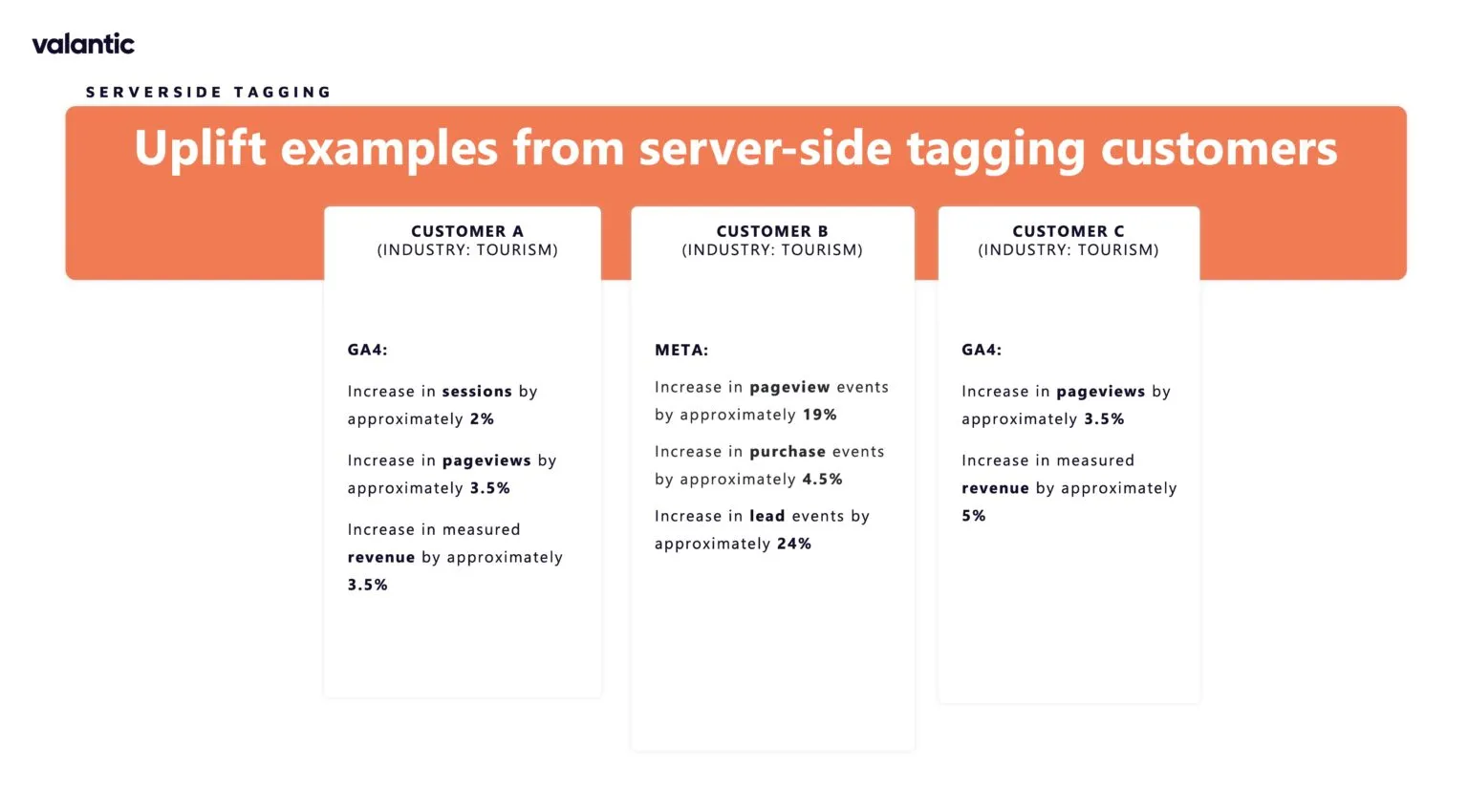
Various real-world examples demonstrate how server-side tagging significantly boosts data accuracy. For instance, three of our tourism clients saw notable improvements post-implementation – among them: a 19 % increase in page view events, a 24 % increase in lead events through Meta tracking, and a 5 % increase in sales seen in Google Analytics 4. Sessions and page views also increased noticeably.
These results show that server-side tagging helps recover lost data, providing a more reliable foundation for performance-related decisions.
Getting started with server-side tagging involves:
Templates, automated setups, and customized interfaces can facilitate this process. Our tracking team is happy to assist with implementation!
Server-side tagging isn’t a cure-all, but it addresses many of the key challenges modern marketing and analytics teams face. If you want to accurately track customer journeys, make the most of your ad spend, and stay legally compliant, server-side tagging offers a future-proof and reliable solution.
We have extensive expertise in the setup and operation of server-side tagging environments. Our services include:
Don't miss a thing.
Subscribe to our latest blog articles.