Highlight

Successful together – our valantic Team.
Meet the people who bring passion and accountability to driving success at valantic.
Get to know usvalantic viewpoint
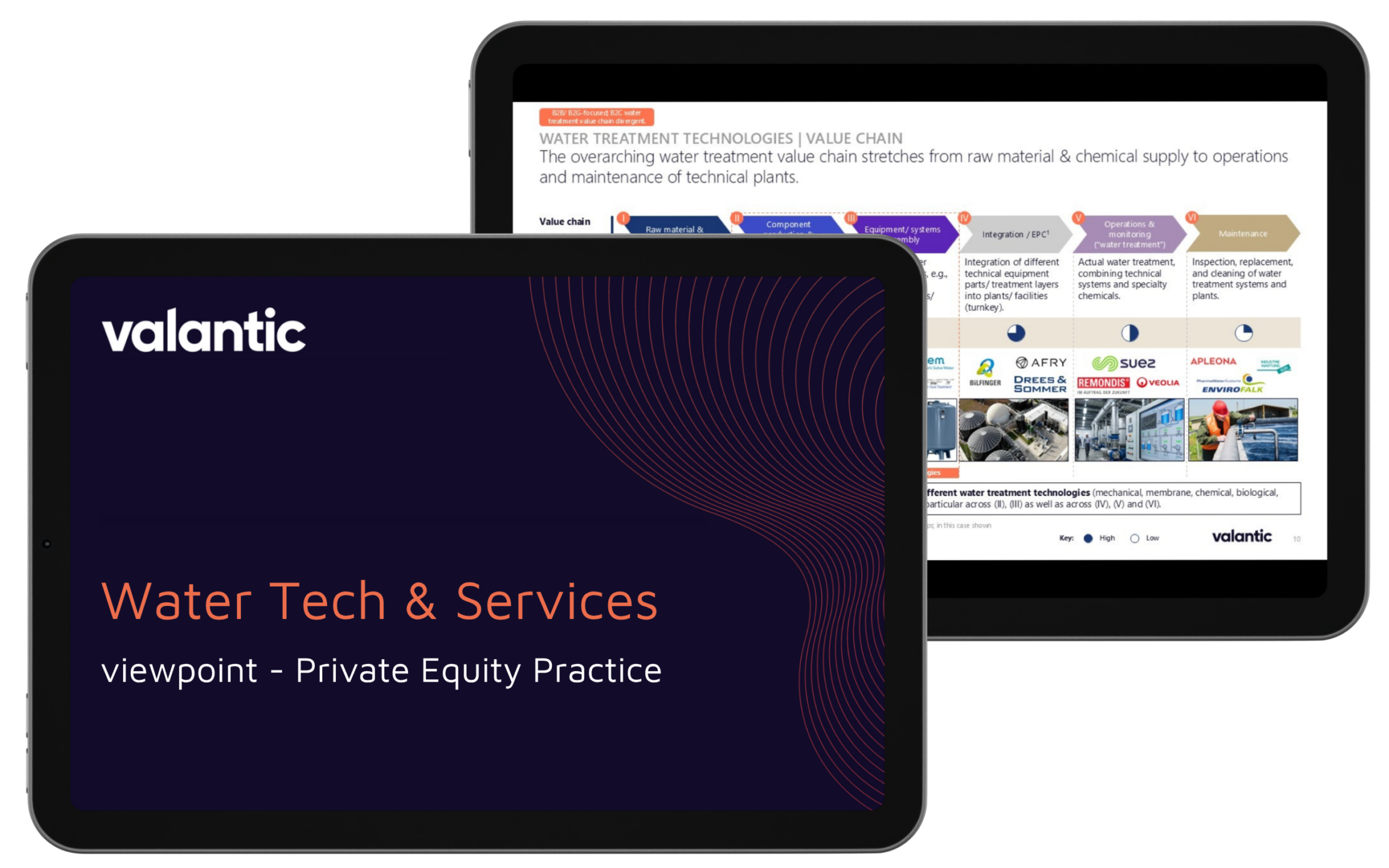
Water Tech & Services is becoming a priority investment field as regulation, aging infrastructure, and digitalization reshape demand.
This is an excerpt of our viewpoint on Water Tech & Services. Get in touch if you would like to learn more about the market dynamics, business model, competitive landscape, and growth drivers in this market.

€215.7 bn backlog
German municipal infrastructure gap
2028 threshold
EU leakage compliance milestone
€23 bn shortfall
annual water investment gap
Executive Summary
Water Tech & Services offers private equity investors a rare combination of non-discretionary demand, regulatory visibility, recurring revenue potential, and fragmented competitive structures. The market spans four core segments, water treatment technologies, water infrastructure, point-of-use water quality, and smart water and digital solutions. Each segment shows distinct value creation paths, from compliance-led treatment demand and municipal framework agreements to cartridge replacement models and software-enabled analytics.
Regulatory pressure around PFAS, wastewater treatment, leakage reduction, and industrial discharge is turning water quality and infrastructure resilience into board-level priorities. At the same time, the market remains operationally complex. Revenue quality must be tested carefully, as project work, hardware bundling, procurement delays, and non-contractual reorder behavior can dilute headline recurrence. For investors, the most attractive platforms combine credible regulatory exposure, demonstrable recurring revenue, strong customer lock-in, and a clear buy-and-build logic.
Regulation is turning Water Tech & Services from optional modernization into compliance-driven spending.
Fragmented provider landscapes create attractive buy-and-build opportunities across all major segments.
Revenue quality requires diligence, as recurring profiles often differ from contractual reality.

Jan Dingerkus
valantic Partner
”The most attractive platforms combine compliance pressure, customer lock-in, and scalable operating models.“
Water Tech & Services is shifting from a technical niche into a strategic investment market. Four segments define the opportunity set, each with different demand drivers, customer types, and diligence questions. Water treatment technologies benefit from regulatory compliance, particularly PFAS limits, while water infrastructure is anchored in replacement cycles and municipal backlogs. Point-of-use water quality is driven by consumer awareness rather than direct regulation, which makes demand less predictable but still attractive where cartridge reorder behavior is proven. Smart water and digital solutions are gaining relevance as utilities address leakage, workforce constraints, and network optimization. The EU drinking water PFAS limit of 0.1 µg/l has been live since January 2026, while Germany’s stricter 0.02 µg/l stage creates additional medium-term pressure. In parallel, smart water adoption is supported by leakage regulation and a broad push toward automation, data visibility, and predictive maintenance.
Key takeaways:

The Water Tech & Services market is supported by several mutually reinforcing growth drivers. Regulatory mandates are the strongest near-term catalyst, particularly in PFAS treatment, wastewater compliance, leakage reduction, and industrial discharge control. Infrastructure aging adds a long-cycle investment case, with Germany alone showing a €215.7bn municipal infrastructure backlog and significant reported deficits in water and wastewater systems. Demand is also shaped by execution bottlenecks, as understaffed planning offices, complex public procurement, and lengthy approvals slow full replacement programs and sustain demand for inspection, maintenance, and targeted rehabilitation. Digital adoption is reinforced by workforce scarcity. The source indicates that 57,000 skilled workers left the water and energy sector between 2019 and 2025, while 85% of utilities rated the shortage as existential. This makes automation, remote monitoring, and AI-assisted network management operational necessities rather than optional upgrades.
Key takeaways:

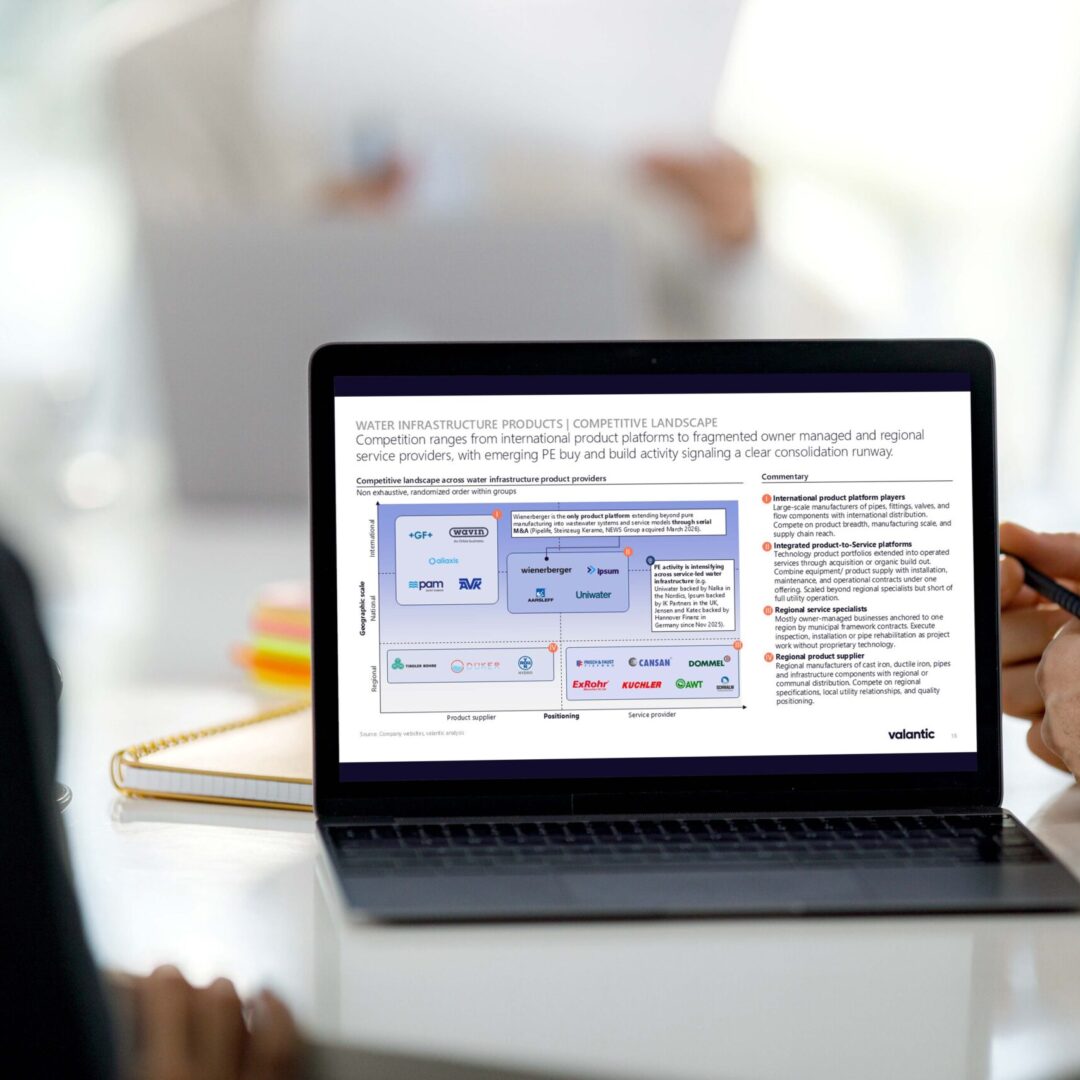
Competition in Water Tech & Services remains fragmented, with different archetypes across the value chain. In water treatment, niche technology specialists, diversified mid-market providers, integrated service platforms, and global operators compete across contaminant removal, plant integration, O&M, and managed treatment models. Representative players include Cornelsen, Nijhuis Saur, Pentair, Xylem, SUEZ, Veolia, Ovivo, and Skion Water, each positioned within broader market roles rather than as single-company cases. In water infrastructure, international product platforms such as Wavin, Aliaxis, Wienerberger, Saint-Gobain PAM, AVK, and Georg Fischer compete alongside regional service providers and emerging integrated platforms. Smart water shows a three-layer stack, connectivity, hardware and sensors, and analytics platforms. Only a small number of leading players span all three layers, leaving room for vertical integration. Across the market, consolidation logic is strongest where fragmented specialists can be combined into scalable platforms with recurring revenue elements.
Key takeaways:
Business models in Water Tech & Services vary materially by segment, making revenue quality a core diligence topic. Water treatment providers often combine equipment sales, project delivery, O&M contracts, plant rental, technology licensing, and Water-as-a-Service models. Infrastructure businesses typically rely on replacement-driven demand, public tenders, and multi-year municipal framework agreements. Point-of-use companies sell devices and rely on cartridge replacement or subscriptions, but reorder behavior must be verified at cohort level. Smart water businesses often combine hardware, sensors, connectivity, analytics, and SaaS-like software layers. The value chain in treatment stretches from raw materials and chemicals to component production, system assembly, EPC integration, operations, monitoring, and maintenance. Five main technology clusters shape the market, mechanical, membrane, chemical, biological, and thermal. Complexity and energy intensity increase along this spectrum, especially when dissolved contaminants or trace pollutants require multi-step treatment trains.
Key takeaways:

The most attractive Water Tech & Services investment cases combine structural demand with platform scalability. In water treatment, growth comes from regulatory compliance, broader contaminant coverage, O&M conversion, and technology-compatible acquisitions. In infrastructure, regional density, framework agreements, and service integration can improve resilience and unlock consolidation benefits. In point-of-use water quality, the critical levers are verified cartridge attach rates, repeat purchases, subscription conversion, channel diversification, and brand portfolio fit. In smart water, growth is driven by software share, SCADA integration, analytics upsell, and leakage reduction mandates. The EU leakage threshold expected by January 2028 and the 2030 remediation planning milestone strengthen visibility for smart water adoption. At market level, the European Investment Bank’s €15bn commitment to water resilience investments for 2025 to 2027 sits alongside a roughly €23bn annual investment shortfall, highlighting the continued need for capital-efficient solutions beyond full pipe replacement.
Key takeaways:


Daniel Meyn
Director
”In Water Tech & Services, regulatory momentum is strong, but diligence must prove revenue quality.“
Want the full breakdown? The full viewpoint on Water Tech & Services is available on request.
The typical scope includes market size, market trends & drivers, competitive landscape, competitor groups, competitor benchmarks, explanation of the business models, value chain and future growth levers.

Jan Dingerkus
Partner & Managing Director
Private Equity Practice

Christoph Nichau
Partner & Managing Director
Private Equity Practice

Khalid Ouaamar
Managing Director
Private Equity Practice