Highlight

Successful together – our valantic Team.
Meet the people who bring passion and accountability to driving success at valantic.
Get to know usPlaybook | valantic × Debt Advisory Partners
A fragmented provider landscape and demographic tailwinds open the opportunity; we distilled the success factors into a blueprint aligning market thesis, operating model, tech backbone, and financing.
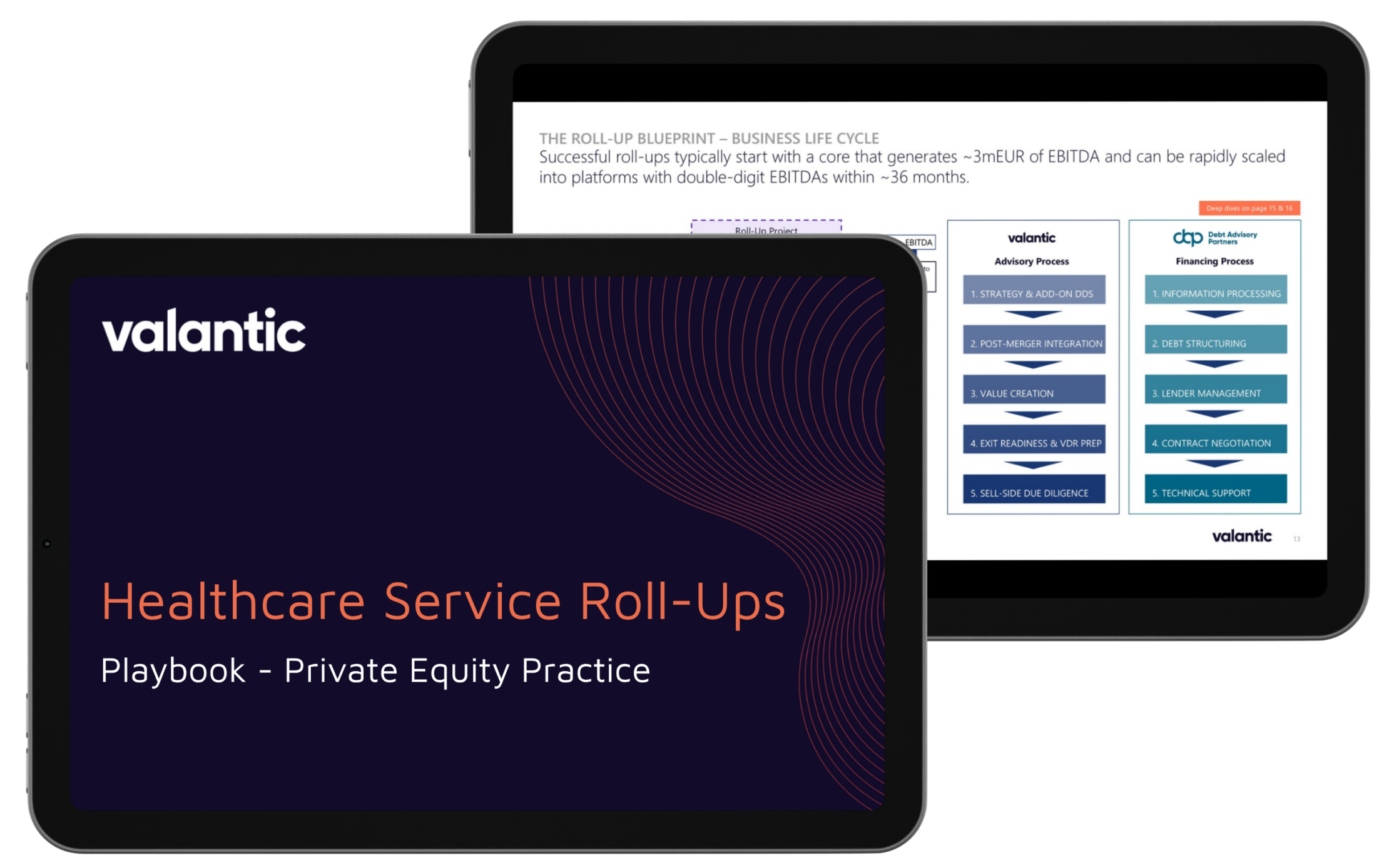
This is an excerpt of our playbook on healthcare service roll-ups. Get in touch if you would like to learn more about the market dynamics, the roll-up blueprint, financing architecture, and growth levers in this market.

~6.6m
people in need of care in germany until 2030
~36 months
typical platform-build from ~€3m to more than €10m EBITDA
5-10
acquired and properly integrated add-ons per year are achievable

Khalid Ouaamar
Managing Director, valantic
About Khalid Ouaamar
Completed 120+ sell- & buy-side due diligence projects for small-to-large cap funds and 40+ strategy projects with a focus on healthcare; Co-founded a digital health RMP start-up for pregnant women with diabetes and hypertension.

Philipp Widmaier
Managing Partner, Debt Advisory Partners
About Philipp Widmaier
Former banker, corporate finance practice leader and founder of DAP. Has been responsible for 100+ financings with his team for small & mid cap funds, large family businesses and rapid growth companies.
Executive Summary
Healthcare services in Germany sit on structural demand tailwinds. An ageing population, rising disease burden, and policy shifts toward outpatient care all push volumes higher, while the provider landscape remains deeply fragmented and under succession pressure. Roll-ups convert that fragmentation into scalable platforms by centralizing management, standardizing care delivery, and pooling workforce capacity.
The success factor is execution: a phased blueprint that links the commercial thesis, the operating model, the tech backbone, and the financing architecture from day one. Sponsors that industrialize their roll-up engine, with disciplined targeting, repeatable due diligence, and lender-ready acquisition facilities, compound EBITDA faster and exit with a defensible equity story. Sponsors that treat phases as parallel workstreams typically stall at one of three predictable choke points.
This playbook sets out the success factors, the investor checklist, and an anonymized case snapshot of a regional care platform built through roughly 25 add-ons over five years.
Healthcare services are attractive for Roll-Ups due to ageing populations, rising care demand, fragmented providers, and scalable margin levers across sites.
Winning Roll-Ups need a structured blueprint linking market thesis, operating model, tech backbone, PMI, KPI transparency, and lender-ready financing.
Main execution risks are pipeline readiness, performance transparency, and PMI value capture; investors need phase-specific checklists to manage growth discipline and exit readiness.

Khalid Ouaamar
Managing Director, valantic
”Succession pressure across owner-operated providers is opening the deepest add-on pipeline German healthcare services have seen in a generation.“
Healthcare services in Germany sit on demand drivers that are structural, not cyclical. Around 6.2 m people are classified as in need of care today, and this base expands through 2030 as the over-65 cohort, already 23 % of the population and up around 2 pp in a decade, ages further. Disease burden compounds the effect: nearly seven in ten older adults are multimorbid, lifting the intensity and duration of professional care. Policy keeps pushing the same direction. The Hybrid-DRG rollout and an expanded outpatient surgery catalog accelerate the shift of care procedures out of inpatient settings, while integrated care reforms encourage providers to coordinate diagnostics, therapy, and follow-up under one roof. The aggregate picture is a fragmented provider market absorbing a rising volume base. For sponsors, that combination of structural demand and unconsolidated supply is rare, and it underwrites multi-year roll-up theses with real visibility on the demand side.
Key Takeaways:

Most German healthcare services operate as small, owner-led practices, and succession pressure makes that base structurally up for grabs. Roll-ups turn this fragmentation into a system. They expand clinical capability and service breadth across sites because investments no longer depend on a single location’s cash flow. They standardize processes and billing so patient volumes scale without proportional admin growth. They industrialize workforce planning, building employer attractiveness through training paths and central recruiting that single sites cannot match. They install a central backbone for finance, compliance, HR, and IT, freeing site managers to focus on care delivery rather than overhead. The cumulative effect is the rare combination that PE sponsors prize: better patient outcomes and higher, more resilient margins from the same care segment. This is why roll-up platforms in fragmented provider markets command sustained multiple uplift versus single-site benchmarks, and why the add-on pipeline keeps refilling as more local operators run into succession or capital constraints.
Key Takeaways:

Successful roll-ups follow a phased blueprint rather than a single sprint, and the phases are best run as an integrated sequence. Phase 1 lays the foundations: a focused thesis on where to play and what to buy, a target operating model that defines what is run centrally versus locally, a tech and data backbone that scales reporting across sites, and a financing architecture sized for the add-on pipeline. Phase 2 industrializes execution. A standardized due diligence playbook, a 100-day integration cadence, an explicit synergy tracker, and acquisition facilities sized with covenant headroom keep deal pace and risk under control. Phase 3 validates and monetizes. The equity story is sharpened with growth initiatives and remaining roll-up runway, platform maturity is documented through reliable KPI evidence, and financing is optimized through refinancing, staple finance, or dividend recap routes. Sponsors that respect the sequence typically move a core asset from around 3 m to over 10 m EBITDA inside roughly 36 months.
Key Takeaways:

Financing is where many roll-up theses quietly stall. A regional platform built through a series of bilateral bank loans inherits a fragmented capital structure that does not scale with the add-on pace, and founders often carry personal guarantees that constrain bankability. The solution is to design the financing alongside the commercial blueprint, not after it. Committed acquisition facilities pre-size debt headroom for the next wave of add-ons, removing the lender approval bottleneck that typically slows deal pace. Covenant packages are calibrated with enough headroom for integration costs and timing slippage. Single Point of Enforcement structures simplify lender risk and improve pricing because the security perimeter is unified across the platform. The end-to-end financing process averages roughly five months from preparation to closing when run with the right lender pack and a defensible business plan. Done well, the financing architecture creates multiple value-realization paths at exit: a competitive refinancing, a staple-finance package for the sale process, or a dividend recap that crystallizes value while keeping strategic flexibility.
Key Takeaways:


Philipp Widmaier
Managing Partner, Debt Advisory Partners
”The roll-ups that compound are the ones where financing architecture was designed alongside the commercial thesis, not bolted on after.“
Underperforming roll-ups rarely fail on thesis. They fail on execution, and the failure modes are predictable. The first is deal pipeline readiness. Sourcing dependent on personal networks and ad-hoc outreach produces inconsistent prioritization, optimistic budgets, and pricing drift that erodes returns. The second is performance transparency. Heterogeneous unit economics across sites mask the true cash generators, KPI definitions vary by location, and site-level visibility is too weak to support disciplined steering. The third is PMI value capture. Without a clear target operating model and standardized processes, overhead grows faster than synergies in early integration, and IT harmonization stalls under day-to-day pressure. A phase-specific investor checklist neutralizes all three. In Phase 1, lock target profile, value levers, financing strategy, and the central management backbone. In Phase 2, run a deal funnel with stage gates, apply a standard 100-day integration plan, and monitor pro-forma leverage. In Phase 3, prove site economics, evidence the equity story with KPI discipline, and validate the deleveraging path.
Key Takeaways:

An anonymized example brings the blueprint to life. A regional care platform in Southern and Western Germany has built a multi-site network over five years through roughly 25 add-on acquisitions, growing from a single site into more than 30 care centers across outpatient care, day care, and assisted living. Patient volume has expanded approximately four-fold over the same period. The original financing structure, assembled deal-by-deal as bilateral bank loans, eventually became the binding constraint: limited headroom for new acquisitions, founder personal exposure, and no dedicated M&A or integration capacity. A redesigned growth-debt package removes those bottlenecks, consolidating the lender base, freeing liquidity, and pre-sizing acquisition headroom so the next wave of add-ons runs without renegotiating debt at every step. The targeted outcome over the next growth cycle is roughly a doubling of platform enterprise value through EBITDA compounding, synergy capture, and continued organic growth. The full case study, with the detailed EBITDA trajectory, refinancing economics, and integration playbook, forms part of the complete playbook and is available on request.
Key Takeaways:

Want the full breakdown? The full playbook on healthcare service roll-ups is available on request. The typical scope includes market size and demand dynamics, the roll-up investment logic, the phased blueprint, financing architecture, the investor checklist, and the detailed regional care case study.

Christoph Nichau
Partner & Managing Director
Private Equity Practice

Khalid Ouaamar
Managing Director
Private Equity Practice
Philipp Widmaier
Managing Partner
Debt Advisory