Highlight

Successful together – our valantic Team.
Meet the people who bring passion and accountability to driving success at valantic.
Get to know usAugust 22, 2022

In the field of marketing technologies (MarTech), we like to speak metaphorically of a jungle, because the subject proves to be a multifaceted landscape with different terrains and disciplines. Due to the sheer mass, one easily runs the risk of losing the overview.
In the context of this metaphor, Customer Experience Platforms (CXPs) can be described as green clearings from which the majority of these terrains can be accessed. One of these clearings may be Emarsys.
To give a better perspective on the topic and the tool, we asked our colleague and MarTech Consultant David five questions about Emarsys. David has been working for many years not only in the MarTech environment, but also with Emarsys as a tool and is therefore an absolute expert in the field. He knows the features inside out and knows exactly what marketing automation and data-driven marketing is all about.
First of all, let’s clarify some MarTech terminology: In the Marketing Automation context, we work with two basic systems: CDP and CXP. The Customer Data Platform (also called CDP) focuses as a tool on the preparation, transformation and aggregation of customer data. A Customer Experience Platform (CXP for short) focuses its attention on the omnichannel customer experience. It enables omnichannel delivery of relevant marketing messages to the target audience. Emarsys, as part of SAP, has undergone a strong evolution in recent years. Many still know Emarsys exclusively as an email marketing tool, but that is far from all! The tool has now evolved into an omnichannel engagement platform, fulfilling all the requirements for a successful CXP.
After all, personalizing the customer experience has long since ceased to be a purely email-based affair and now spans a multitude of channels. Emarsys therefore offers online marketing, lead management and campaign management in addition to features such as reporting and analytics. This enables the creation of personalized, data-driven campaigns.
Emarsys can be used to solve all the well-known problems of online marketing in e-commerce. One of them is inconsistent customer targeting. Customers are contacted by the company through different communication channels, but the overall experience (the customer experience) is still not thought holistically. Emarsys addresses this problem and ensures a consistent omnichannel customer approach through its different templates and functions. This ensures a holistic customer experience across all company channels.
Predefined use case templates and workflows for personalized addressing of customers are another specialty of Emarsys. Especially in the classic B2C environment, this enables a greater competitive advantage in retail or e-commerce. For example, increases in the average shopping cart value or the conversion rate can be achieved quite efficiently.
A highlight of Emarsys is the aforementioned selection of diverse use case templates that find an answer to a wide variety of e-commerce problems. Companies can increase their brand awareness faster through the predefined strategies and measure and monitor their activities in a more targeted way.
Emarsys also has a very good and intuitive template builder. Since the tool has historically grown up in email marketing, the builder is particularly strong in this area.
And Emarsys has also found its place in the SAP family. The tool is integrating better and better with the existing SAP Flagships, enabling increasingly seamless collaboration between different tools.
When working with segmentations, unfortunately not all data points and data sources can be used at the same time yet. Therefore, a separate segmentation builder is always needed per data source, which could sometimes prove impractical in application.
Emarsys has some limitations in web tracking. A problem for which SAP, on the other hand, has already found a suitable solution with its CDP.
Before implementing Emarsys and importing data into the tool, you should first think in detail about your own data strategy. This means that the first thing to do is to build an architecture and identify source systems from which the marketing use cases can sustainably benefit.
It also makes sense to take a look at the SAP CDP, which can be connected before Emarsys. This namely offers some additional possibilities for data transformation as well as aggregation.


Customer Experience October 8, 2026
Interview: From PIM to Data Spine – How companies prepare their data for AI
AI is changing the requirements for data, governance, and processes. Where should companies start, and what skills do they need? In this interview, Dietmar Rietsch, CEO of Pimcore, and Timo Huguet of valantic discuss the importance of clean data, the concept of the “Data Spine,” and the changing role of humans in the age of agentic AI.
Interview: From PIM to Data Spine – How companies prepare their data for AI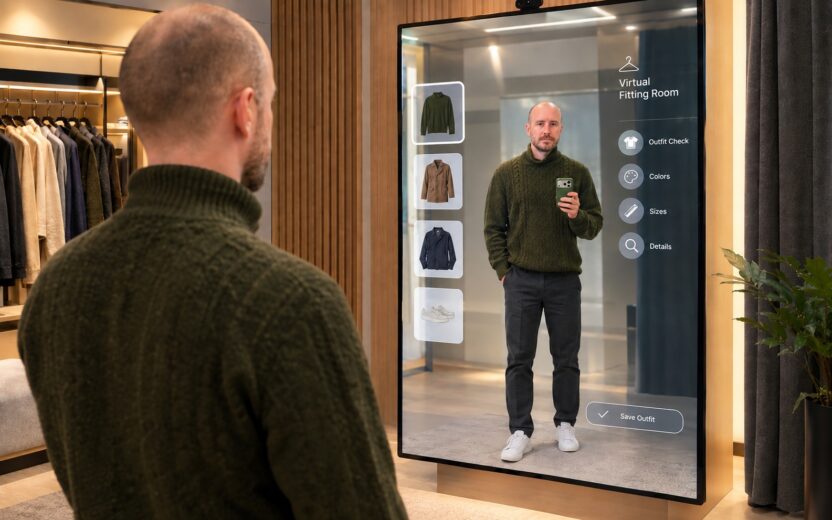

Customer Experience September 18, 2026
From webshop to virtual try-on: how AI is making its way into retail stores
Digital interfaces such as smart mirrors turn AI in the store into a tangible business case. What potential does this hold for the customer experience and in-store personalization? Matthias Vollmer explains how the retail industry can combine the best of both worlds and turn physical touchpoints into an intelligent part of the omnichannel journey.
From webshop to virtual try-on: how AI is making its way into retail stores
Digital Marketing September 3, 2026
ChatGPT Ads: a new touchpoint in the customer journey
ChatGPT Ads bring advertising to a new stage of the customer journey. We explain how the new ad format works, where its strengths lie, and what role it could play alongside Google Ads, paid social, and organic AI visibility.
ChatGPT Ads: a new touchpoint in the customer journeyDon't miss a thing.
Subscribe to our latest blog articles.