Highlight

Successful together – our valantic Team.
Meet the people who bring passion and accountability to driving success at valantic.
Get to know usMay 29, 2023

IT system architecture is taking on the leading role: it should create transparency and synergies in the consideration of product and customer life cycles in order to establish a forward-looking Industry & Manufacturing Experience as a real value driver. How this can be achieved with product usage data and why CRM is the discipline of the hour.
The era of the fourth industrial revolution belongs to value creation networks in which the focus is shifting more than ever to direct relationships – especially with customers, but also with suppliers and partners. This also makes customer relationship management (CRM) more important again. However, the digitized customer relationship is changing part of the premise. New interaction possibilities are dynamizing the time horizons in which individual business units are challenged. Push becomes “pull” and a generic sales and service strategy becomes a personalized customer journey. Automation is successful when these mechanics are optimized and personalized. Especially in economically uncertain times, this is far more than “good service”, but a supporting pillar of customer loyalty.
The customer journey is the supporting concept in the analogous view to the product life cycle. A consistently maintained knowledge database in CRM recognizes dynamics at an early stage. This can include the dynamic design of touchpoints, such as the website with reference to a digital inquiry portal with lead-gen functions, or the continuous training of the sales organization on specific trends and developments. The top priority: from the very first moment of the customer relationship, develop a holistic customer picture that takes into account marketing activation and initial sales contact as well as specialist consulting, service management, or corporate communications. Transparency across the customer relationship, in conjunction with product usage data, secures the basis for data-driven business models.
From the moment a project becomes concrete, the digital customer file is supplemented by a further chapter: the digital image of the end product in the form of the digital twin, on which customer engagement in the use phase of a product is based.
Specific customer data and its connection to existing data sets are highly relevant. Maintained account structures in an Ultimate Parent Account prove their efficiency when calculating prices or creating offers. Categorized customer use cases in CRM can also help to increase process competence in assignment to designs and blueprints in PLM. Starting with production and project cost calculations in ERP and the first technical blueprints results in a consistent database.
This interaction results in a wide range of use cases across the entire customer journey: Maintenance, for example, which is controlled proactively and via a field service CRM connected to the system landscape, is considerably more efficient thanks to automated order creation, dynamic checklists, or proactive spare parts inventory checks/re-orders. Minimized risks due to avoided downtimes save time and thus money in the industrial context – which, in addition to the product quality promise, favors long-term customer loyalty.
A data-driven service operating model also offers potential for (old) existing machines in customer operations, since the various realities of the historically grown files can be recorded in the CRM system. However, it is not intended to become a second PLM system; rather, it supports the structured capture of unstructured information. The resulting up-sell and x-sell potentials become part of the transparent database in the sales and service CRM. Digital and automated interactions across the customer journey can be ideally optimized using product usage data from networked machines and systems.
The current situation surrounding rising energy costs alone provides examples of use cases that can be played out dynamically and in a personalized manner. If changes in the use of machines are detected that indicate increased energy efficiency, e-mail marketing can be used to offer either advice or other services such as module retrofits. In addition, data on the energy intensity of production processes can also be used for sustainability efforts or ESG compliance policies.
The transformation of the entire infrastructure in terms of customer experience technology, cloud tech, IoT and PLM relies on transparency: the core task is to make the customer lifecycle with the product lifecycle accessible to all essential corporate functions as a shared database and to anchor the systematic exploitation of potentials in the organization. Implicit mechanisms of action must become explicit: between machine use and new machine needs, between customer use cases, the properties of products and the capabilities but also the efforts of the organization, or knowledge about existing customers and hypotheses about new customers. Understanding these explicit interdependencies and integrating them both technologically and organizationally is the value lever of digital business models with a multiplier effect.


Customer Experience October 8, 2026
Interview: From PIM to Data Spine – How companies prepare their data for AI
AI is changing the requirements for data, governance, and processes. Where should companies start, and what skills do they need? In this interview, Dietmar Rietsch, CEO of Pimcore, and Timo Huguet of valantic discuss the importance of clean data, the concept of the “Data Spine,” and the changing role of humans in the age of agentic AI.
Interview: From PIM to Data Spine – How companies prepare their data for AI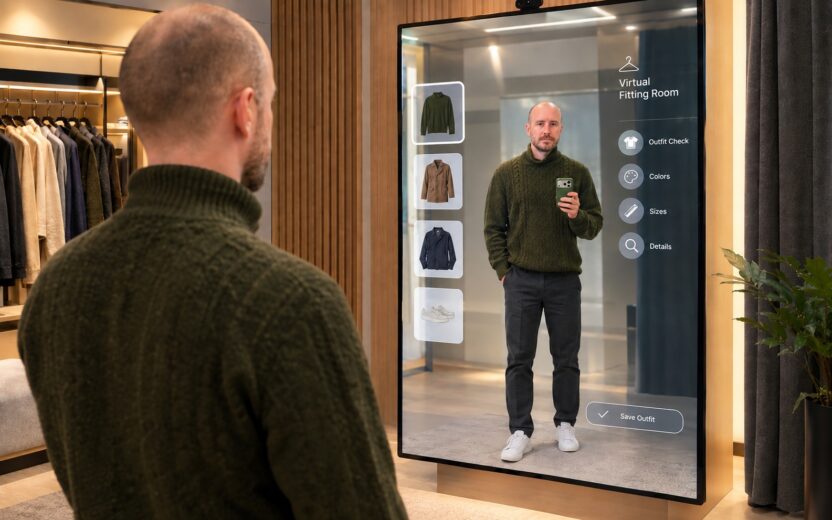

Customer Experience September 18, 2026
From webshop to virtual try-on: how AI is making its way into retail stores
Digital interfaces such as smart mirrors turn AI in the store into a tangible business case. What potential does this hold for the customer experience and in-store personalization? Matthias Vollmer explains how the retail industry can combine the best of both worlds and turn physical touchpoints into an intelligent part of the omnichannel journey.
From webshop to virtual try-on: how AI is making its way into retail stores
Digital Marketing September 3, 2026
ChatGPT Ads: a new touchpoint in the customer journey
ChatGPT Ads bring advertising to a new stage of the customer journey. We explain how the new ad format works, where its strengths lie, and what role it could play alongside Google Ads, paid social, and organic AI visibility.
ChatGPT Ads: a new touchpoint in the customer journeyDon't miss a thing.
Subscribe to our latest blog articles.