Highlight

Successful together – our valantic Team.
Meet the people who bring passion and accountability to driving success at valantic.
Get to know usNovember 17, 2023

⏰ Estimated reading time: 4 minutes
The internet is a borderless marketplace that anyone should be able to enter. But unfortunately, for millions of Europeans, online shopping is not as obvious as it seems. Think of people with visual or hearing impairments, or those who have difficulty reading or navigating with a mouse. This creates a crucial opportunity for you as an e-commerce manager of a large webshop: making your online platform accessible.
To make online products and services accessible to all Europeans, the European Accessibility Act (EAA) was drafted. This European Accessibility Act concerns European regulations in the field of digital accessibility. And even though it may seem dull and a ‘must’: it can also be an excellent opportunity for your company to generate more turnover!
The idea behind the EAA is to ensure that everyone, regardless of their situation, can easily use digital products such as websites and apps. Everyone in the European Union should have access to digital products and services in the same way. Research shows that not all webshops comply with this. That’s why many e-commerce managers will have to work on this in the coming year.
Your company must therefore ensure that you comply with this EEA soon (no later than 28 June 2025). But apart from this legal obligation, you also have the intrinsic motivation to be accessible to everyone, including those with disabilities. And don’t just think about people with poor vision or hearing problems. This includes people with ADHD, a temporary disability (arm in plaster) or people with low literacy levels. And it delivers: Your potential customer base will increase enormously if you start complying with these EEA rules. Here are some numbers: the Netherlands has 4 million people with a disability, for Europe this number is 135 million. And this number will only increase. Consider, for example, the ageing population. So the sooner you get involved, the better it is for your turnover. In addition, it has been proven that people with disabilities are generally very loyal customers. A positive experience on an easily accessible website makes the ease and confidence to return and buy again a lot greater. An accessible website can therefore lead to more site visits and therefore more sales.
An important factor in Google’s algorithm is the user experience. Google is happy with accessible websites. The better Google understands what information is on your website, and what is important, the more user-friendly your website will be. It is precisely because of this that your website will appear higher in the search results.
In concrete terms, this means that your company must ensure that everyone can order and use your products and services, regardless of their situation or their (physical) limitations. We are going to help you with that.
All rules about accessibility are included in the WCAG, the Web Content Accessibility Guidelines. These guidelines are designed to make websites and digital content more accessible to people with different types of disabilities. They provide requirements (and recommendations) for creating web content that is understandable and usable by everyone.
For example, the WCAG sets all kinds of (technical) requirements. Think of the contrast on your website, clear alternative texts for images and videos on your website. Other examples include:
The aim is to provide an inclusive online environment so that all people can fully participate in digital life regardless of visual, auditory, motor or cognitive impairments.
In addition, we recommend that you regularly have your website tested for accessibility by experts (people from various target groups). This helps to improve the user experience of your website for everyone. And, last but not least, make sure you have internal awareness: Train your employees in digital accessibility and how to apply the rules of the EAA.
We therefore recommend that you start making your website accessible now. Why wait when you can win more loyal and satisfied customers now? Do you want to know how you can make your website more accessible? Please contact us. And keep an eye on our website. We will discuss a number of other issues later on.
Together, we will ensure that your company is accessible to everyone.

Embracing Digital Accessibility as an Opportunity
valantic’s mission is not to warn clients about the European Accessibility Act (EAA) but to develop the full potential of an inclusive customer experience…


Artificial Intelligence October 16, 2026
Autonomous Enterprise Journey: How AI value engineering creates measurable business value
How can the ROI of AI initiatives be reliably assessed and measured? How can companies identify the biggest levers and key processes for AI? Katrin Luft, Senior Expert at valantic and co-developer of the “Autonomous Enterprise Journey,” provides answers and recommendations in a conversation with Darya Basarhina, Vice President of Sales & Marketing and Manufacturing Practice Lead at valantic.
Autonomous Enterprise Journey: How AI value engineering creates measurable business value
Customer Experience October 8, 2026
Interview: From PIM to Data Spine – How companies prepare their data for AI
AI is changing the requirements for data, governance, and processes. Where should companies start, and what skills do they need? In this interview, Dietmar Rietsch, CEO of Pimcore, and Timo Huguet of valantic discuss the importance of clean data, the concept of the “Data Spine,” and the changing role of humans in the age of agentic AI.
Interview: From PIM to Data Spine – How companies prepare their data for AI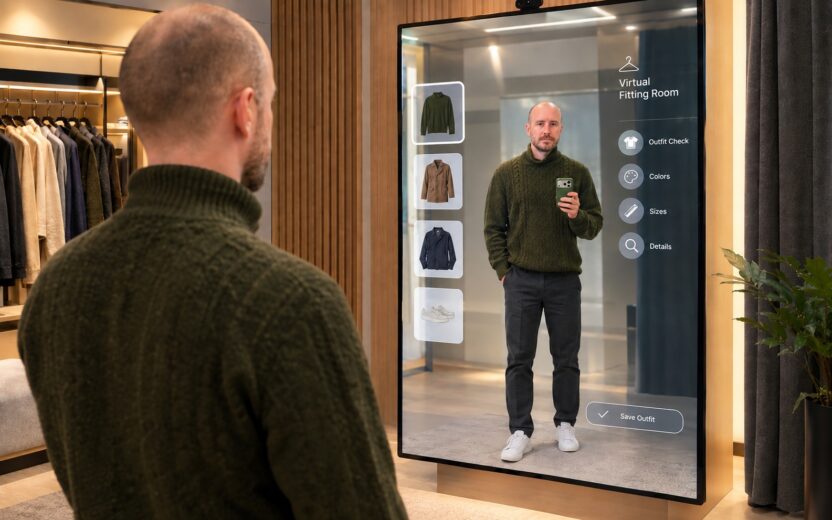
Customer Experience September 18, 2026
From webshop to virtual try-on: how AI is making its way into retail stores
Digital interfaces such as smart mirrors turn AI in the store into a tangible business case. What potential does this hold for the customer experience and in-store personalization? Matthias Vollmer explains how the retail industry can combine the best of both worlds and turn physical touchpoints into an intelligent part of the omnichannel journey.
From webshop to virtual try-on: how AI is making its way into retail storesDon't miss a thing.
Subscribe to our latest blog articles.