Highlight

Successful together – our valantic Team.
Meet the people who bring passion and accountability to driving success at valantic.
Get to know usMay 24, 2024

Detailed and accurate product data is crucial for success in present-day eCommerce. It not only has an impact on search and category list views but is also vital for the entire purchasing process. Product comparisons based on poorly maintained data generally have little meaning, and effective search engine marketing becomes almost impossible. The potential for future innovations is also significantly hindered.
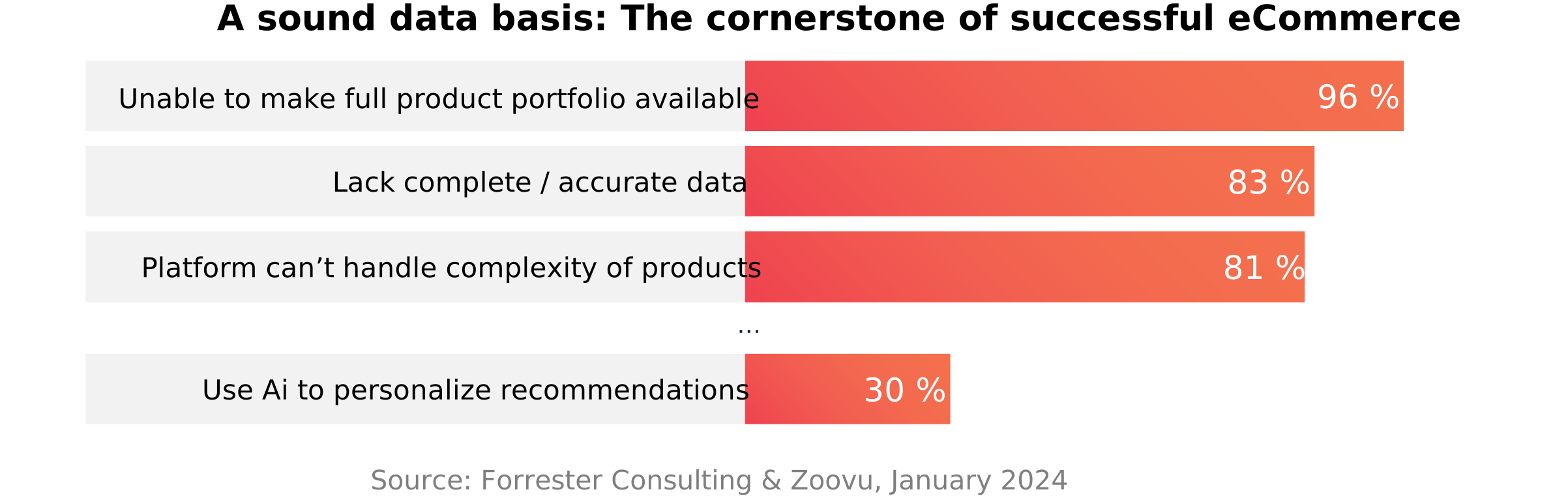
As online commerce continues to gain traction in the B2B sector, many companies struggle with effective implementation. A recent Forrester Consulting study from January 2024 reveals that only a few B2B companies can place a full product catalog online. The main challenge lies in inadequate product data which is often incomplete or inaccurate. Over the past few months, valantic’s experts have been responding to this, developing several solutions to address the problem of deficient product data. The resulting ecosystem combines innovative AI technology with conventional methodologies such as OCR-based text recognition. This robust data framework offers flexibility to handle numerous complex situations, ensuring the accuracy and completeness essential for successful e-commerce.
valantic’s solution focuses on the integration of a wide range of data sources, including product images, PDF files (such as data sheets and manuals), and technical drawings in various formats. Our intelligent system processes this content efficiently, extracting relevant information such as text content from images using Optical Character Recognition (OCR).
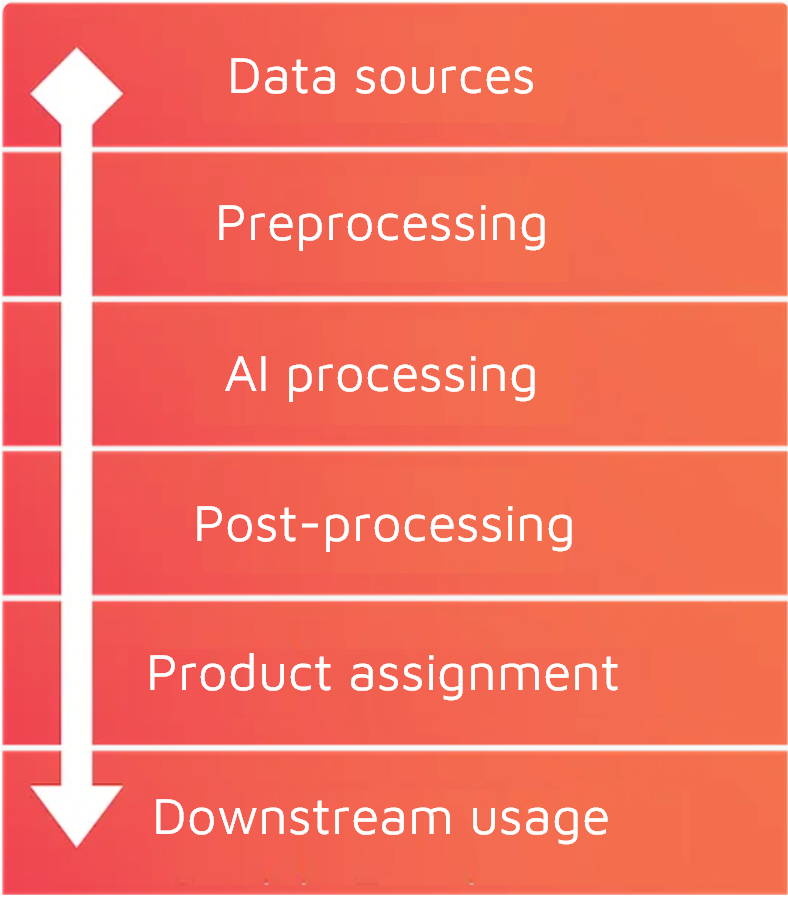
Central to the downstream processing pipeline is the custom adaptation of powerful AI models to the prevailing data and requirements. This involves various techniques such as data-driven systems for extracting key technical information, large language models (LLMs) for generating high-quality texts, and multilingual models for creating accurate translations.
After the underlying data has been generated using AI, it is post-processed to filter out irrelevant information and remove unnecessary formatting. This results in high-quality datasets which can be seamlessly integrated into existing store systems where they can be meaningfully filtered, searched, and displayed.
Our processing pipeline stands out for its scalability and flexibility, allowing it to be customized to the specific needs of different industries and use cases. As a result, we consistently achieve optimal results for each unique project.
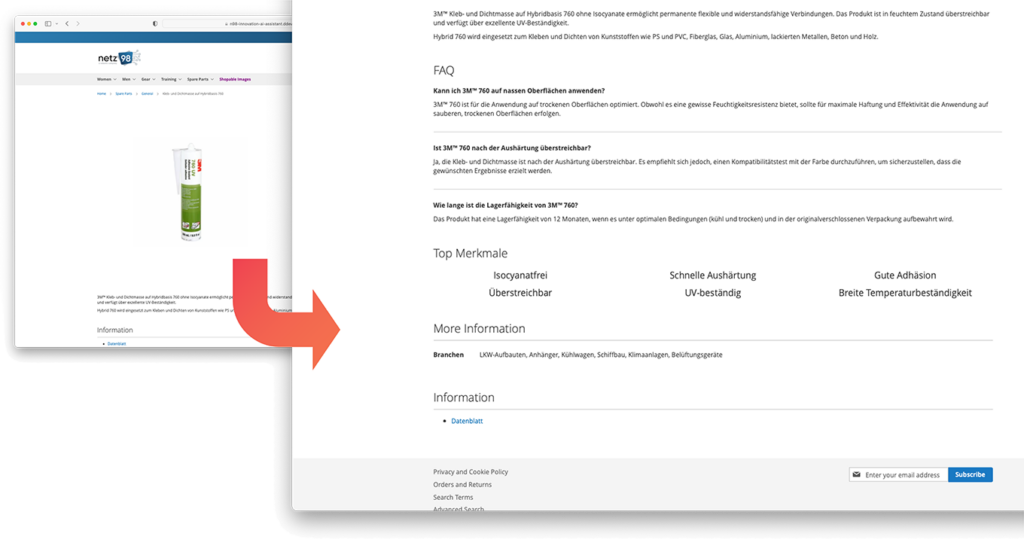
Customers visiting the web store of an adhesives and sealants retailer faced a significant challenge in searching for the right product. The available information – product name, description, and image – was insufficient to decide on the product to purchase. Potential customers thus needed to consult PDF data sheets before they could make an informed choice. This laborious process was frustrating for customers and led to high bounce rates.
To resolve this problem, the store operator automatically analyzed the data sheets and integrated the extracted information into its store. A custom pipeline was developed to extract key product attributes, including:
The automated processing of data sheets using valantic’s data framework allowed the store owner to greatly enhance the customer journey through:
An average of one to two minutes is needed to enrich the data for each product. This time is not negligible for large product ranges, but it is significantly faster and more cost-effective than the manual techniques used in the past. Automatic processing thus quickly proved to be a worthwhile investment, enhancing the customer journey, increasing conversion rates, and significantly reducing data maintenance costs.
Once the AI pipeline has been set up and fine-tuned for the first time, the data processing proceeds fully automatically. Manual intervention is unnecessary, though casual monitoring is recommended to allow any required corrections to be made quickly. Typically, the pipeline runs overnight to avoid impacting performance or store functionality.
For very large volumes of data, AI processing can run on an external system and the final content be imported en bloc. This approach avoids any disruptions to the web store’s operations.
Various methods are used to address data protection and intellectual property (IP) concerns, including the use of local models which execute the AI pipeline in a closed environment under our control. This ensures that no data leaks can occur and stops proprietary data from being used externally, such as for training new AI systems. valantic individually evaluates the necessary infrastructure at the start of each project to ensure all requirements and guidelines are met.
Flexible solution for (almost all) eCommerce data challenges
Incomplete, incorrect, and inconsistent product data is widespread across all industries, impacting many platforms. Nevertheless, comprehensive, high-quality product data is essential for all aspects of online retail and directly impacts a company’s competitive edge.
The maintenance of product data used to be a labor-intensive and manual task at most companies. However, valantic’s AI-driven solutions essentially automate this process now, delivering significant time, cost, and efficiency benefits.
Our proprietary framework forms a sound basis for enriching product data, but it can also be used to process any other desired data entities, such as customer data, categories, and custom data models within a platform.
To summarize, our system provides a flexible and scalable solution for optimizing product data and other eCommerce data entities. It enables companies to manage their data efficiently, improve its quality, and enhance their competitive advantage.


Artificial Intelligence October 16, 2026
Autonomous Enterprise Journey: How AI value engineering creates measurable business value
How can the ROI of AI initiatives be reliably assessed and measured? How can companies identify the biggest levers and key processes for AI? Katrin Luft, Senior Expert at valantic and co-developer of the “Autonomous Enterprise Journey,” provides answers and recommendations in a conversation with Darya Basarhina, Vice President of Sales & Marketing and Manufacturing Practice Lead at valantic.
Autonomous Enterprise Journey: How AI value engineering creates measurable business value
Customer Experience October 8, 2026
Interview: From PIM to Data Spine – How companies prepare their data for AI
AI is changing the requirements for data, governance, and processes. Where should companies start, and what skills do they need? In this interview, Dietmar Rietsch, CEO of Pimcore, and Timo Huguet of valantic discuss the importance of clean data, the concept of the “Data Spine,” and the changing role of humans in the age of agentic AI.
Interview: From PIM to Data Spine – How companies prepare their data for AI
Customer Experience September 18, 2026
From webshop to virtual try-on: how AI is making its way into retail stores
Digital interfaces such as smart mirrors turn AI in the store into a tangible business case. What potential does this hold for the customer experience and in-store personalization? Matthias Vollmer explains how the retail industry can combine the best of both worlds and turn physical touchpoints into an intelligent part of the omnichannel journey.
From webshop to virtual try-on: how AI is making its way into retail storesDon't miss a thing.
Subscribe to our latest blog articles.